


In May, PlanetRomeo, an online community and gay dating service for men, released its Gay Happiness Index (GHI) for gay men. Iceland topped the index with a score of 79 out of 100, while other Nordic countries Norway (77) and Denmark (76) took the second and third spot.
The index ranks countries on three criteria: public opinion, public behavior and life satisfaction. Uganda (20) at 127 was the unhappiest country for gay men. Taiwan (54) was listed 34 on the index, but there is still room for improvement.
Among Asian nations, the top three were Israel (71) at seven, Thailand (67) at 16 and then Taiwan. China (41) placed 63 on the index, which was slightly lower than South Korea (43) at 57 and one spot higher than Singapore (41) at 64.

Photo: Su Meng-chuan, Taipei Times
THREE ‘HAPPY’ CRITERIA
Of the index’s three criteria, “public opinion” measures how gay men feel about society’s view on homosexuality, such as whether their country’s laws are positive (or negative) and whether they would kiss or hold hands with another man in public. Taiwan scored 45 points out of 100.
The “public behavior” category measures how gay men experience the way they are treated — family and workplace discrimination, for example, or verbal or physical abuse. Taiwan scored 63 points in this category.
How satisfied gay men are with their lives and whether they accept themselves, including whether they have or intend to move or change jobs on account of their sexual orientation, is measured by “life satisfaction.” Taiwan scored 55 points in this category.
These results show that there is room for improvement before lesbian, gay, bisexual and transgender (LGBT) people obtain a high degree of life satisfaction.
“The GHI ranking correlates with the scale of democratic societies and freedom to autocratic countries and human rights violations,” the company says. “The GHI is not only about the happiness of gay men, it can also be seen as a powerful indicator for the general development of freedom, justice and security in a country.”
The company adds that low-ranking countries “are known for having a negative view towards basic human freedoms in society.”
NO MORE DELAYS
The situation facing LGBT people in Taiwan has gradually improved. Ever since Kaohsiung launched its “sunshine registration” (陽光註記) policy to allow semi-official registration of same-sex couples at its household registration offices in May last year, many of the nation’s cities and counties have followed suit.
Over the past year, all six municipalities — Taipei, New Taipei City, Taoyuan, Taichung, Tainan and Kaohsiung — as well as Chiayi City, Changhua County, Hsinchu County and Yilan County have adopted the registration policy, which accounts for 79.8 percent of the nation’s total population. This actually gives registered gay couples some of the rights enjoyed by married heterosexual couples, including being allowed to make certain medical decisions and sign formal documents for their partners.
President Tsai Ing-wen (蔡英文) promised to protect LGBT people’s equal rights in the lead up to the elections in January. Unfortunately, Tsai changed her position three months after being elected, stating that the legalization of same-sex marriage has to be based on “the blessing of the whole society” (整體社會的祝福).
Although the local governments have moved in a progressive direction, the central government has failed to put the LGBT issue on its legislative priority list, borrowing the previous government’s talking point that society has to reach a “consensus” on the issue before amending the law. What “consensus” does her administration need before taking action, and how many more years will the delay continue? Its determination to protect LGBT people’s human rights seems questionable.

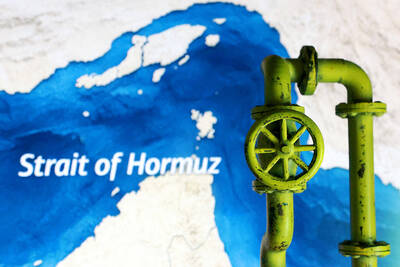
The US war on Iran has illuminated the deep interdependence of Asia on flows of oil and related items as raw materials that become the basis of modern human civilization. Australians and New Zealanders had a wake up call. The crisis also emphasizes how the Philippines is a swatch of islands linked by jet fuel. These revelations have deep implications for an invasion of Taiwan. Much of the commentary on the Taiwan scenario has looked at the disruptions to world trade, which will be in the trillions. However, the Iran war offers additional specific lessons for a Taiwan scenario. An insightful
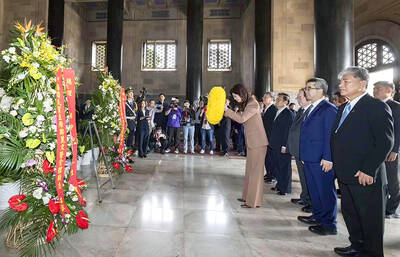
The problem with Marx’s famous remark that history repeats itself, first as tragedy, the second time as farce, is that the first time is usually farce as well. This week Chinese Nationalist Party (KMT) Chair Cheng Li-wun (鄭麗文) made a pilgrimage to the People’s Republic of China (PRC) “to confer, converse and otherwise hob-nob” with Chinese Communist Party (CCP) officials. The visit was an instant international media hit, with major media reporting almost entirely shorn of context. “Taiwan’s main opposition leader landed in China Tuesday for a rare visit aimed at cross-strait ‘peace’”, crowed Agence-France Presse (AFP) from Shanghai. Rare!

April 6 to April 13 Few expected a Japanese manga adaptation featuring four tall, long-haired heartthrobs and a plucky heroine to transform Taiwan’s television industry. But Meteor Garden (流星花園) took the nation by storm after premiering on April 12, 2001, single-handedly creating the “idol drama” (偶像劇) craze that captivated young viewers across Asia. The show was so successful that Japan produced its own remake in 2005, followed by South Korea, China and Thailand. Other channels quickly followed suit, with more than 50 such shows appearing over the following two years. Departing from the melodramatic

Sunflower movement superstar Lin Fei-fan (林飛帆) once quipped that the Democratic Progressive Party (DPP) could nominate a watermelon to run for Tainan mayor and win. Conversely, the DPP could run a living saint for mayor in Taipei and still lose. In 2022, the DPP ran with the closest thing to a living saint they could find: former Minister of Health and Welfare Chen Shih-chung (陳時中). During the pandemic, his polling was astronomically high, with the approval of his performance reaching as high as 91 percent in one TVBS poll. He was such a phenomenon that people printed out pop-up cartoon


 RSS
RSS