


Every morning just down the road from Shoufeng (壽豐) Train Station, for what passes as the center of town in this rural part of Hualien, a ramshackle market sets itself up around 8am. It is based around a largish grocer’s stall which has a good range of vegetables. The real action, however, takes place around a number of smaller stands where Amis women settle down in front of their day’s harvest of a smattering of this and that, as they enjoy a cigarette and a chat. Even after a couple of years in Hualien, there are plenty of surprises to be found here, most particularly in the spring, when a plethora of foraged vegetables become available.
Thanks to these women and their daily harvests of fresh veg, I have become a devotee of sweet potato leaves, bird’s nest fern and kohlrabi, vegetables that I only had passing acquaintance with after more than a decade in Taipei. I have gradually developed the courage to tackle more exotic items such as fiddle head fern (soon to be featured in this column), and various other leaves that I have as yet failed to discover viable English names for.
I am constantly amazed by the wild vegetables eaten in Hualien; and equally amazed, after less than successful attempts to cook some of them, that they are eaten at all. Many are bitter, while others seem rather flavorless. But they shouldn’t be dismissed out of hand.
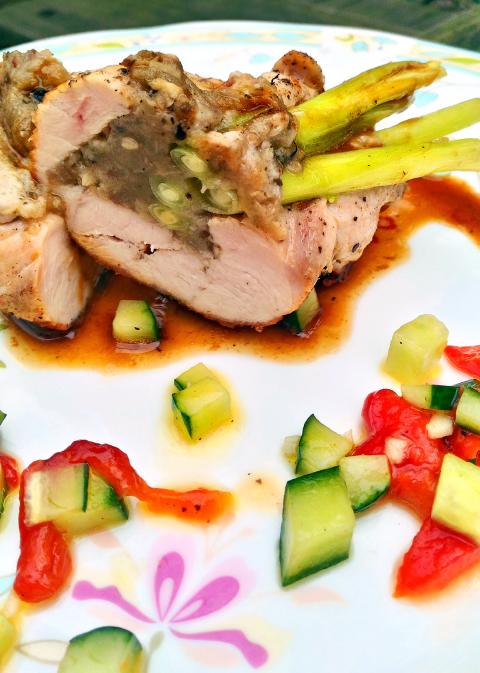
Photo: Ian Bartholomew
The local Amis produce a soup of foraged vegetables that can be remarkably sophisticated in its mixture of flavors, though it has tasted quite different on each occasion I have tried it. What is remarkable is that many of the leaves that go into this soup don’t have a very notable, or even pleasant, taste when eaten on their own.
Talking to the women at the market, instructions for cooking these vegetables seem inevitably too simple. “Just toss them in boiling water” or “a little oil and garlic and fry them” are clearly viable, but not terribly exciting, and there seems almost an implicit challenge to do something more with this wealth of produce.
Which brings me to the subject of grass hearts (牧草心). I had tasted this vegetable on a couple of occasions, both at restaurants specializing in wild foods, meats such a muntjac and boar, usually accompanied by a variety of foraged vegetables. These latter were often indifferently cooked, never straying far from generic stir-fry, a process that often seems to make every vegetable taste very much the same.
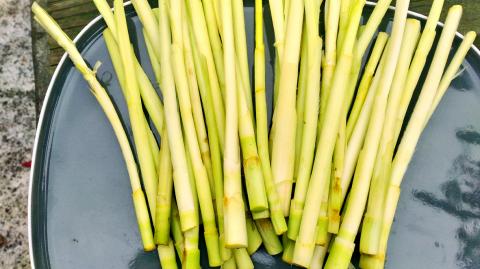
Photo: Ian Bartholomew
As far as I have been able to gather, grass hearts are the inside of the thick stem of the wild grass Pennisetum, which is used as forage for grazing animals and also grows wild extensively all over Taiwan. Its flavor is extremely subtle and it requires rather elaborate preparation in the removal of the fibrous husk that cloaks the tender heart.
Among the Amis, grass hearts are regarded as a delicacy. Some compare them to asparagus, and with their fibrous husks that need to be painstakingly removed and their elusive flavor that grows on you rather than being immediately evident, there are definitely similarities. It also requires careful cooking, as the delicate taste is easily overwhelmed by other flavors.
As a grass, grass hearts are an excellent source of dietary fiber, and Chinese medical lore suggests that eating grass hearts is good for stimulating the digestive system and is able to assist in weight loss. As the core of a robust grass, they are also rich in nutrients, vitamins and minerals, and given their virile growth in the wild, even farmed varieties of grass hearts are generally free of pesticide residue and other banes of modern agriculture.
Chicken breast, aubergine and grass heart roll
Recipe
(serves 4)
This recipe comes out of a desire to find a gentler way of cooking the grass hearts that would allow their flavor to shine, and the mix of frying and roasting seems to bring out an almost hay-like flavor that is a particularly delightful accompaniment to the chicken breasts. This recipe uses an aubergine puree (for recipe see the Taipei Times on Dec. 6, 2014, page 12) that began as a side dish but has become a staple to my larder, perfect for enhancing to all kinds of meat dishes. Timing is essential to this dish, making sure that the chicken is just barely cooked before serving to ensure tenderness.
Ingredients
2 chicken breasts, skin removed
2 tbsp lemon juice
2 tbsp olive oil
Salt and pepper
1/4 cup chunky aubergine puree (see above)
10-15 stems of grass hearts
1/2 cup white wine
1 stem fresh thyme
1 clove garlic
Directions
1. Marinate the chicken breasts in a mixture of salt, pepper, lemon juice and olive oil for about 20 minutes.
2. Clean the grass hearts from the outside layer that may have been missed by the vendor.
3. Preheat oven to 160c.
4. Spread a thin layer of aubergine puree over the inside of the chicken breast. Place the grass hearts inside. Bind with cooking twine into a roll. It doesn’t matter too much if the grass hearts are exposed, but avoid leakage of the puree.
5. Heat a skillet (with metal handle, as this will have to go into the oven) with olive oil and fry the rolls over medium heat, allowing the meat to get a nice golden brown color, about 4 minutes.
6. Place in the oven to finish for about 10 minutes.
7. Remove the chicken rolls and put the skillet back on the hob. (Make sure you wear oven gloves!) Deglaze with white wine and add garlic and thyme, cooking down over low heat until the sauce becomes thick.
8. Remove garlic and thyme from the sauce. Pour the sauce over the chicken roll. Serve with a salad or lightly pickled vegetables.
Ian Bartholomew runs Ian’s Table, a small guesthouse in Hualien. He has lived in Taiwan for many years writing about the food scene and has decided that until you look at farming, you know nothing about the food you eat. He can be contacted at Hualien202@gmail.com.


The US war on Iran has illuminated the deep interdependence of Asia on flows of oil and related items as raw materials that become the basis of modern human civilization. Australians and New Zealanders had a wake up call. The crisis also emphasizes how the Philippines is a swatch of islands linked by jet fuel. These revelations have deep implications for an invasion of Taiwan. Much of the commentary on the Taiwan scenario has looked at the disruptions to world trade, which will be in the trillions. However, the Iran war offers additional specific lessons for a Taiwan scenario. An insightful

The problem with Marx’s famous remark that history repeats itself, first as tragedy, the second time as farce, is that the first time is usually farce as well. This week Chinese Nationalist Party (KMT) Chair Cheng Li-wun (鄭麗文) made a pilgrimage to the People’s Republic of China (PRC) “to confer, converse and otherwise hob-nob” with Chinese Communist Party (CCP) officials. The visit was an instant international media hit, with major media reporting almost entirely shorn of context. “Taiwan’s main opposition leader landed in China Tuesday for a rare visit aimed at cross-strait ‘peace’”, crowed Agence-France Presse (AFP) from Shanghai. Rare!

April 6 to April 13 Few expected a Japanese manga adaptation featuring four tall, long-haired heartthrobs and a plucky heroine to transform Taiwan’s television industry. But Meteor Garden (流星花園) took the nation by storm after premiering on April 12, 2001, single-handedly creating the “idol drama” (偶像劇) craze that captivated young viewers across Asia. The show was so successful that Japan produced its own remake in 2005, followed by South Korea, China and Thailand. Other channels quickly followed suit, with more than 50 such shows appearing over the following two years. Departing from the melodramatic

Sunflower movement superstar Lin Fei-fan (林飛帆) once quipped that the Democratic Progressive Party (DPP) could nominate a watermelon to run for Tainan mayor and win. Conversely, the DPP could run a living saint for mayor in Taipei and still lose. In 2022, the DPP ran with the closest thing to a living saint they could find: former Minister of Health and Welfare Chen Shih-chung (陳時中). During the pandemic, his polling was astronomically high, with the approval of his performance reaching as high as 91 percent in one TVBS poll. He was such a phenomenon that people printed out pop-up cartoon


 RSS
RSS