


The status of Taiwan has been one of contention since the end of World War II. Though Japan surrendered sovereignty over Taiwan in the San Francisco Peace Treaty (1952), it never specified to whom Taiwan should then belong. This opened the door for numerous claims and opinions, and yet ironically, in the resultant hubbub of those conflicting claims, no one has ever asked the Taiwanese for their thoughts or opinions. This book, Taiwan’s Struggle, Voices of the Taiwanese, aims to rectify that.
The 23 writers who contribute are all Taiwanese and do not hold back in their opinions. As politicians, academics and professionals, most live in Taiwan, but some remain “diaspora,” having been forced abroad during the harshness of Taiwan’s White Terror era. However, wherever they are, in writing about the topics of Taiwan’s identity, international status, international relations and economic issues, they leave no doubt that they consider Taiwan their motherland.
PROMINENT THINKERS
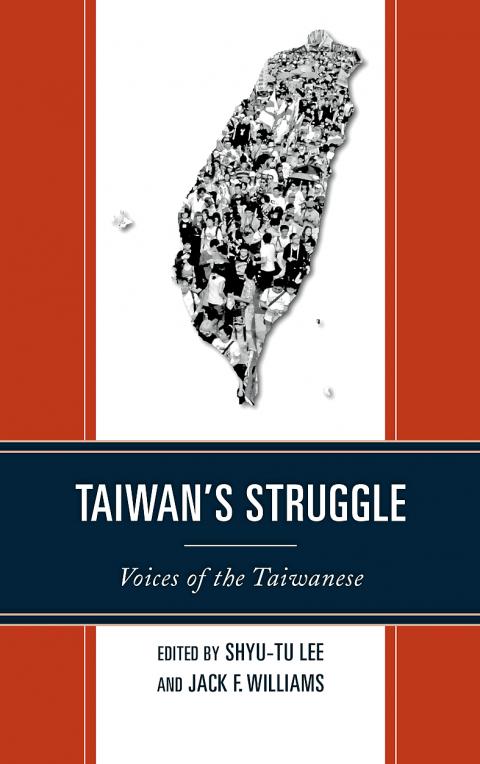
On the political side, readers will recognize several prominent contributors. Lee Teng-hui (李登輝), president of Taiwan from 1988 to 2000, starts things off. In “Establishing a Taiwan-Centered Identity,” he traces both his own journey of freedom from the myth of “Asian values,” and how he guided Taiwan into its present state of democracy.
Peng Ming-min (彭明敏), Lee’s opponent in Taiwan’s first direct presidential election, argues in “The International Status of the Taiwanese People” that Taiwanese remain locked in “political-legal limbo” despite the nation’s de facto independence. China’s irredentist claims to Taiwan are the main culprit.
Annette Lu (呂秀蓮), vice president from 2000 to 2008 and Wong Ming-shien (翁明賢), a senior advisor to the National Security Council, (2006 to 2008) go into greater detail about China’s many-pronged strategy to silently annex Taiwan in successive periods and under various Chinese leaders. Throughout this process, Taiwan has faced challenges in the military, cultural, political, economic and social arenas.
A different perspective is brought out in Joseph Kuo’s (郭正昭), “The ‘Black Hole’ and the ‘Mystery Force.’” The metaphoric black hole reference to China is obvious as it seeks to suck in Taiwanese businesses and absorb Taiwan. However, the “mystery force” of the US may surprise some; here Kuo presents situations where the US selectively interferes with Taiwan’s democracy if it jeopardizes the US’ pursuit of economic gain from China.
Interspersed in this work are essays on the development of Taiwan’s democracy such as George Sung’s (宋朝昇) “Democratization in Taiwan: Lifting the Blacklist,” and Strong Chuang’s (莊秋雄) touching “Memoir” on how he found courage from others to risk defying that blacklist. The blacklist of “undesirable Taiwanese who support democracy and self-rule” was finally removed in 1992.
Also present are testimonies such as Aquia Tsay’s (蔡丁貴) account of his personal epiphany when he, like many others, overcame the “brainwashing” of the Chinese Nationalist Party (KMT) government while working on his doctorate in the US. Aquia can often be found in the front lines of protest including that of assisting the Sunflower movement’s takeover of the legislature by distracting the police.
The book is a treasure trove of diverse topics. The rise of nationalism is traced as well as the shaping of culture by history; then there is the matter of the diversity of Taiwan’s DNA, the development of human rights; it all ends in how Taiwan’s history is clearly separate from that of China.
Detailed examinations of relations between Taiwan and China include China’s meddling even in the assassination attempt on Chen Shui-bian (陳水扁), how the Cold War made Taiwan a “pariah and pawn” and how a democratic Taiwan would have been good for all Asia as a counter to China’s developing hegemony in the South China Sea. Little is left untouched.
TIME CAPSULE EFFECT
A final feature of this book is its time capsule effect. As the book was in the process of publication, three important happenings were developing in Taiwan. They came almost as if in response to the warnings and suggestions given in the essays.
First, the Sunflower movement in March 2014 stopped the nation’s blind headlong plunge into an unpopular trade deal and called for an item-by-item examination by the legislature. Chen Po-chih (陳博志) warns of these dangers in “ECFA and China’s Strategy to the World” as do other essays on Taiwan’s economy and China’s dangerous threat to its high-tech industries.
Further, the results of Taiwan’s November 2014 nine-in-one elections where the KMT lost the majority of major cities, and the elections in January this year, when the Democratic Progressive Party (DPP) took the presidency and a majority in the legislature, reflects the books emphasis on a developing Taiwanese identity.
The idea that Taiwan is different from China, that it is capable of being a responsible member of the international community and that the Taiwanese should have hope for the future pervade the book in mixed voices that are sad, angry and hopeful. With a DPP president and the party in control of the legislature, what will the next 4 years be like? That remains to be seen, but if the voices heard in this book are any indication, the Taiwanese are quite aware of their situation and what needs to be done.

The US war on Iran has illuminated the deep interdependence of Asia on flows of oil and related items as raw materials that become the basis of modern human civilization. Australians and New Zealanders had a wake up call. The crisis also emphasizes how the Philippines is a swatch of islands linked by jet fuel. These revelations have deep implications for an invasion of Taiwan. Much of the commentary on the Taiwan scenario has looked at the disruptions to world trade, which will be in the trillions. However, the Iran war offers additional specific lessons for a Taiwan scenario. An insightful
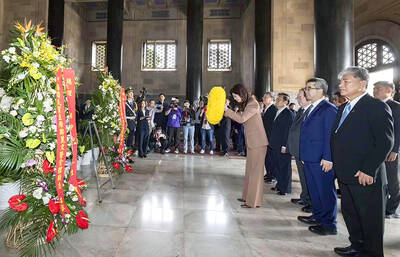
The problem with Marx’s famous remark that history repeats itself, first as tragedy, the second time as farce, is that the first time is usually farce as well. This week Chinese Nationalist Party (KMT) Chair Cheng Li-wun (鄭麗文) made a pilgrimage to the People’s Republic of China (PRC) “to confer, converse and otherwise hob-nob” with Chinese Communist Party (CCP) officials. The visit was an instant international media hit, with major media reporting almost entirely shorn of context. “Taiwan’s main opposition leader landed in China Tuesday for a rare visit aimed at cross-strait ‘peace’”, crowed Agence-France Presse (AFP) from Shanghai. Rare!
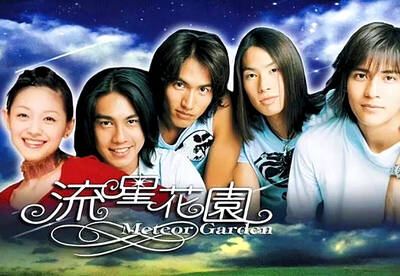
April 6 to April 13 Few expected a Japanese manga adaptation featuring four tall, long-haired heartthrobs and a plucky heroine to transform Taiwan’s television industry. But Meteor Garden (流星花園) took the nation by storm after premiering on April 12, 2001, single-handedly creating the “idol drama” (偶像劇) craze that captivated young viewers across Asia. The show was so successful that Japan produced its own remake in 2005, followed by South Korea, China and Thailand. Other channels quickly followed suit, with more than 50 such shows appearing over the following two years. Departing from the melodramatic

Sunflower movement superstar Lin Fei-fan (林飛帆) once quipped that the Democratic Progressive Party (DPP) could nominate a watermelon to run for Tainan mayor and win. Conversely, the DPP could run a living saint for mayor in Taipei and still lose. In 2022, the DPP ran with the closest thing to a living saint they could find: former Minister of Health and Welfare Chen Shih-chung (陳時中). During the pandemic, his polling was astronomically high, with the approval of his performance reaching as high as 91 percent in one TVBS poll. He was such a phenomenon that people printed out pop-up cartoon


 RSS
RSS