


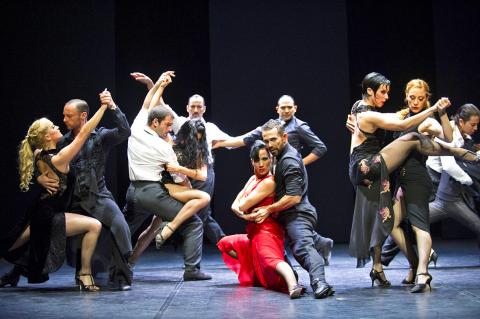
Belgian choreographer Sidi Larbi Cherkaoui returns to Taipei with his highly praised exploration of the world of tango, Milonga (米隆加), which opens at the National Theater for a three-show run tomorrow night.
Taipei audiences caught their first glimpse of Cherkaoui in September 2007, when he and British choreographer Akram Kham performed their stunning Zero Degrees as part of the Novel Hall Dance series. Since then a lot has happened for the now 40-year-old Cherkaoui.
In 2008, he followed Khan in being named an associate artist of Sadler’s Wells, the London theater that is a leading proponent and promoter of contemporary dance. In 2010, he established his own company, Eastman, in his hometown of Antwerp, and became the artistic director of the Festival Equilibrio in Rome. In September last year, he became artistic director of the Royal Ballet Flanders.
Credit: Courtesy of Sadler’s Wells
MULTI-TALENTED
It has been an interesting journey for a man who only took up dancing at age 15, inspired by the music videos he saw on television. He threw himself into learning a wide variety of genres — ballet, hip-hop, tap, jazz, flamenco — as well as acrobatics, and within a few years, he was dancing on TV himself.
Cherkaoui enrolled at Anne Teresa de Keersmaeker’s contemporary dance school, PARTS (Performing Arts Research and Training Studios) in Brussels while continuing to perform with both a hip-hop and a jazz dance company. He joined the dance collective Les Ballets C de la B in 1997 and two years later choreographed an award-winning musical.
However, his choreographic career really took off with Rien de Rien in 2000, his first full-length work, and he has never looked back. He continued to choreograph for Les Ballets C de la B for six more years before leaving to join the Toneelhuis theater in his hometown.
Two of most consistent elements of Cherkaoui’s works are that their themes and styles vary widely, as do the artists he collaborates with. In addition to Khan, he has worked with fellow Belgian Wim Vandekeybus, Theater Stap’s mentally disabled actors, Shaolin Temple monks — for Sutra, which he brought to Kaohsiung in March last year — and flamenco dancer Maria Pages, to name a few.
Cherkaoui has said that his works are about relationships and how people handle each other.
Milonga, created for Sadler’s Wells, premiered in 2013 and was the first large-scale tango production to be directed by a non-Argentine artist, although the Argentine tango dancers and musicians involved in the project are credited as co-creators, such as tango superstar Nelida Rodriguez, who served as consultant and rehearsal director.
PASSION FOR TANGO
Cherkaoui has said that he had long been moved by tango.
“In tango I saw some sort of magic happening, some sort of communication going on that was completely without any sign of even almost visual contact or words, and somehow through touch they could tell each other a lot of things and we could follow that conversation from outside,” he said in a Sadler’s Wells video about the show.
For his cast, he chose 10 tango dancers from Buenos Aires who had been working with each other for a long time, including German Cornejo and Gisela Galeassi, and then added two contemporary dancers, Jason Kittelberger and Jennifer White.
In Cherkaoui’s highly charged production, the dancers’ feet and legs move with razor-like precision, pelvises swivel and eyes smolder; even on video the electricity is palpable. Yet the show is more than just an homage to tango’s traditions, for the choreographer’s love of mixing things up provides some alternative realities for 21st century tango enthusiasts.
Eugenio Szwarcer designed the set and video projections, which aim to convey the atmosphere of both Buenos Aires and the late-night tango parties for which the show is named, while the score features new music from Argentinean composer Fernando Marzan and frequent Cherkaoui collaborator Szymon Brzoska with tango classics, performed live by five musicians.
The show should prove as popular with local audiences as it has with those in Europe and the US since tango has a fast-growing fan base in Taiwan, which boasts a handful of tango orchestras and several regular “milongas” in Taipei and Tainan, while the annual Taipei Tango Festival marked its 13th anniversary last year.
Cherkaoui’s Milongo runs 85 minutes, without intermission. There is a pre-show talk in the theater lobby starting a half-hour before each show and a post-show talk after Sunday’s matinee.


The US war on Iran has illuminated the deep interdependence of Asia on flows of oil and related items as raw materials that become the basis of modern human civilization. Australians and New Zealanders had a wake up call. The crisis also emphasizes how the Philippines is a swatch of islands linked by jet fuel. These revelations have deep implications for an invasion of Taiwan. Much of the commentary on the Taiwan scenario has looked at the disruptions to world trade, which will be in the trillions. However, the Iran war offers additional specific lessons for a Taiwan scenario. An insightful
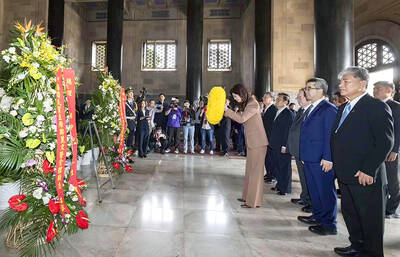
The problem with Marx’s famous remark that history repeats itself, first as tragedy, the second time as farce, is that the first time is usually farce as well. This week Chinese Nationalist Party (KMT) Chair Cheng Li-wun (鄭麗文) made a pilgrimage to the People’s Republic of China (PRC) “to confer, converse and otherwise hob-nob” with Chinese Communist Party (CCP) officials. The visit was an instant international media hit, with major media reporting almost entirely shorn of context. “Taiwan’s main opposition leader landed in China Tuesday for a rare visit aimed at cross-strait ‘peace’”, crowed Agence-France Presse (AFP) from Shanghai. Rare!
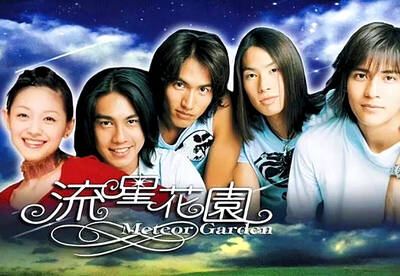
April 6 to April 13 Few expected a Japanese manga adaptation featuring four tall, long-haired heartthrobs and a plucky heroine to transform Taiwan’s television industry. But Meteor Garden (流星花園) took the nation by storm after premiering on April 12, 2001, single-handedly creating the “idol drama” (偶像劇) craze that captivated young viewers across Asia. The show was so successful that Japan produced its own remake in 2005, followed by South Korea, China and Thailand. Other channels quickly followed suit, with more than 50 such shows appearing over the following two years. Departing from the melodramatic

Sunflower movement superstar Lin Fei-fan (林飛帆) once quipped that the Democratic Progressive Party (DPP) could nominate a watermelon to run for Tainan mayor and win. Conversely, the DPP could run a living saint for mayor in Taipei and still lose. In 2022, the DPP ran with the closest thing to a living saint they could find: former Minister of Health and Welfare Chen Shih-chung (陳時中). During the pandemic, his polling was astronomically high, with the approval of his performance reaching as high as 91 percent in one TVBS poll. He was such a phenomenon that people printed out pop-up cartoon


 RSS
RSS