


At last, the periodic table looks tidy. To nobody’s surprise, the discoveries — and indeed creation — of elements number 113, 115, 117 and 118 were verified on Dec. 30 by the US-based International Union of Pure and Applied Chemistry (IUPAC), and the seventh period is now complete, giving the main table a nice, smooth bottom row.
The elements, discovered by scientists in Japan, Russia and America, are the first to be added to the table since 2011, when elements 114 and 116 were added.
IUPAC announced that a Russian-American team of scientists at the Joint Institute for Nuclear Research in Dubna and Lawrence Livermore National Laboratory in California had produced sufficient evidence to claim the discovery of elements 115, 117 and 118.
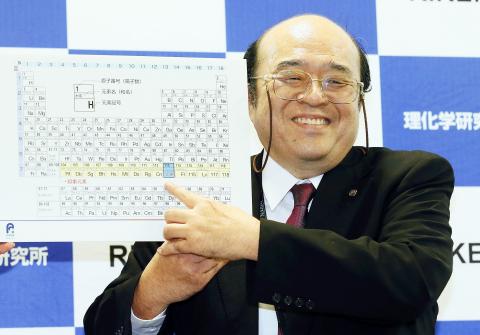
Photo: Kyodo News via AP
The body awarded credit for the discovery of element 113, which had also been claimed by the Russians and Americans, to a team of scientists from the Riken institute in Japan.
Kosuke Morita, who was leading the research at Riken, said his team now plans to “look to the unchartered territory of element 119 and beyond.”
Ryoji Noyori, former Riken president and Nobel laureate in chemistry said, “To scientists, this is of greater value than an Olympic gold medal.”
The elements, which currently bear placeholder names, will be officially named by the teams that discovered them in the coming months. Element 113 will be the first element to be named in Asia.
New elements can be named after a mythological concept, a mineral, a place or country, a property or a scientist. Once the names are settled upon, the world’s chemistry textbooks can be reprinted.
ELEMENTS OF INTRIGUE
Since we first began to understand that each element consists of a specific number of protons surrounded by the same number of electrons (and flavored with various numbers of neutrons), it has been easy to speculate about finding more. The Russian chemist Dmitri Mendeleev first arranged them in the now familiar way in 1869, having seen the table in a dream. Henceforth, if anyone asks you what the universe is, you can give (as a short answer): “This.” So here are some of the most intriguing elements on the all-singing, all-dancing new periodic table.
3. Lithium
Very weird stuff, lithium. At room temperature, it’s a solid metal that floats on water. If people with bipolar mood disorder swallow lithium compounds, it seems to smooth out their highs and lows. It is also responsible for the smartphone revolution (and perhaps an electric car one to follow), by making it possible to build light, powerful batteries. Much of the world’s available lithium is found in Bolivia and Peru, so it may yet turn the Andes into the new Middle East.
5. Boron
If you want to feel sorry for an element, go for boron. Numbers one and two (hydrogen and helium) make up stars. Three and four treat mental illness (lithium) and build rockets (beryllium). Six, seven and eight (carbon, nitrogen, oxygen) are the basic constituents of life. And there in the middle, at number five, sits boron, the stuff that makes silly putty soft yet bouncy.
54. Xenon
A fairly cool element, it must be said. It certainly has the coolest name, and like the other noble gases, helium, neon, argon, krypton (nothing to do with Superman) and radon, it just floats around not doing much. Under extreme pressure, however, xenon can be forced to make ultra-bright lights for massive cinemas.
83. Bismuth
The hipster element. No one’s heard of bismuth. Those who have, though, think it’s the last stable element before everything becomes radioactive (spontaneously breaks itself), but in fact it is just very, very, very, very un-radioactive. Generally, elements should behave a bit like the others around them, but bismuth doesn’t at all. Lead is poisonous, polonium is what killed Alexander Litvinenko and bismuth is the main ingredient in the stomach-settler Pepto-Bismol.
115. Ununpentium
Element number 115 will only be called ununpentium until its Russian discoverers come up with a better name. However, it has already been credited with some extremely far-fetched properties. According to Bob Lazar, a man who claimed to have worked on analyzing alien technology in Area 51, ununpentium is the fuel used in alien spacecraft. It isn’t.
76. Osmium
When children ask you, “What’s the heaviest naturally occurring element?”, after explaining that they mean “most dense”, give them the answer: “Osmium.” At this point, many smart-aleck children will say, “Don’t you mean iridium?” “No,” you can then say patiently. “That’s a common misconception based on mistaken measurement in the past.” Then buy them Theodore Gray’s superb The Elements app for their next birthday.
106, 105. Seaborgium, dubnium
Cold-war squabbling will be frozen into the periodic table for ever thanks to the rivalry between researchers in the University of California, Berkeley, led by Glenn Seaborg, and those at the Joint Institute for Nuclear Research in Dubna, Russia. The two teams discovered many radioactive heavy elements at similar times, and in secret, making it difficult to say who got there first. In 1997, the IUPAC finally decided to give dubnium to one side and seaborgium to the other — the only element ever named after a living person.
60. Neodymium
Makes really, really strong little magnets like the ones children play with and must never, ever swallow. While we’re down here, why are these two rows of elements — the lanthanides and actinides — set apart from all the others? Chemists have a secret answer to that: they actually belong in periods six and seven, but if you put them there the table would be too wide to print comfortably. Proof that nothing is ever really tidy.
47. Silver
Not cool for the reasons you think, but very cool for other ones. Solid silver is a strange thing to cherish in the form of coins or jewelry because it reacts with oxygen in the air and goes dark. When clean, however, it is the very shiniest element of all. It also conducts electricity better than any other element. When clean.
55. Caesium
The main thing everyone knows about the metal caesium is that it is so reactive that it will explode if you drop it in a bowl of water. Should you have any lying around, you could also watch it melt on a warm day as the temperature passes 28C. When not performing party tricks, caesium regulates the measurement of time for the human race by having a hyperfine atomic structure that is useful in atomic clocks.
Additional reporting by Guardian staff

The US war on Iran has illuminated the deep interdependence of Asia on flows of oil and related items as raw materials that become the basis of modern human civilization. Australians and New Zealanders had a wake up call. The crisis also emphasizes how the Philippines is a swatch of islands linked by jet fuel. These revelations have deep implications for an invasion of Taiwan. Much of the commentary on the Taiwan scenario has looked at the disruptions to world trade, which will be in the trillions. However, the Iran war offers additional specific lessons for a Taiwan scenario. An insightful
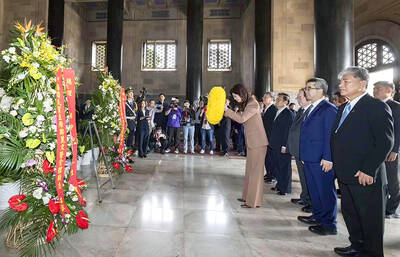
The problem with Marx’s famous remark that history repeats itself, first as tragedy, the second time as farce, is that the first time is usually farce as well. This week Chinese Nationalist Party (KMT) Chair Cheng Li-wun (鄭麗文) made a pilgrimage to the People’s Republic of China (PRC) “to confer, converse and otherwise hob-nob” with Chinese Communist Party (CCP) officials. The visit was an instant international media hit, with major media reporting almost entirely shorn of context. “Taiwan’s main opposition leader landed in China Tuesday for a rare visit aimed at cross-strait ‘peace’”, crowed Agence-France Presse (AFP) from Shanghai. Rare!

April 6 to April 13 Few expected a Japanese manga adaptation featuring four tall, long-haired heartthrobs and a plucky heroine to transform Taiwan’s television industry. But Meteor Garden (流星花園) took the nation by storm after premiering on April 12, 2001, single-handedly creating the “idol drama” (偶像劇) craze that captivated young viewers across Asia. The show was so successful that Japan produced its own remake in 2005, followed by South Korea, China and Thailand. Other channels quickly followed suit, with more than 50 such shows appearing over the following two years. Departing from the melodramatic

Sunflower movement superstar Lin Fei-fan (林飛帆) once quipped that the Democratic Progressive Party (DPP) could nominate a watermelon to run for Tainan mayor and win. Conversely, the DPP could run a living saint for mayor in Taipei and still lose. In 2022, the DPP ran with the closest thing to a living saint they could find: former Minister of Health and Welfare Chen Shih-chung (陳時中). During the pandemic, his polling was astronomically high, with the approval of his performance reaching as high as 91 percent in one TVBS poll. He was such a phenomenon that people printed out pop-up cartoon


 RSS
RSS