


Art Taipei, Taiwan’s most important marketplace for art, did not release sales figures for the first time in recent memory following the fair’s close on Monday, signaling that the local art business could be down.
The booths were less daring, the tone was more Taiwan-focused and conservative, and with less money in the air, the “zing factor” was palpably lacking. Though Art Taipei remains an important regional fair, one can sense that it is losing ground to bigger, more international fairs in Singapore, Hong Kong and China.
Overseas galleries barely outnumbered Taiwanese galleries, stalling the fair’s recent trend towards internationalization.
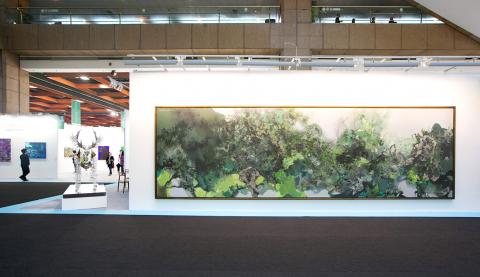
Photo courtesy of Art Taipei
Then there were the little things. The VIP party was on the wrong night, but with nobody important flying into Taipei, it probably didn’t matter anyway. The panel discussions were a complete afterthought, the exhibition space map was printed in minuscule 5-point type and the only section for experimental “tech art” looked to be an advertisement for Jaguar. Some gallerists moaned that fair invitations were withheld from Chinese galleries and given to Taiwanese galleries instead because it’s an election year.
HIGH-END ART SALES FALL
According to Art Taipei’s final press release, only a few works sold for more than US$100,000, and those were by blue-chip Chinese modernists like Zao Wou-ki’s (趙無極) 30-7-64 (no sales total announced) and Yeh Tzu-chi’s (葉子奇) Mist Mountain — Hualien (NT$14 million), whose collector base is limited to Taiwan, Hong Kong, China and Chinese in Southeast Asia.
This basically means that only rich, conservative local collectors were buying, and they were buying the things they usually buy.
Western galleries seemed to have abandoned the fair. Despite a gorgeous showcase booth by Swiss gallerist Urs Miele, who showed a very funky optical wallpaper installation by German artist Tobias Rehberger, the galleries from New York or Berlin or London from recent editions were no longer to be seen, having tested the waters and moved on. And Urs Miele was in fact exhibiting through his Beijing branch.
There is still a very strong regional presence by galleries from Japan, South Korea, Singapore and others, who do good business in Taipei.
Works by Japanese artist Yayoi Kusama, the aging queen of polka dots, were prominent in many booths. Tainan’s Der-Horng Gallery made a prominent display of Yoshitomo Nara’s Fucking No. 1, a naive, comic-style painting of a blank-faced little girl standing on a scale that displays her as being slightly overweight.
Tokyo’s Gallerie Nichido, which showed a mix of Japanese and Western artists and sold at least one C-print by Brazilian artist Vik Muniz, Woman Ironing, after Degas (2015), said it had cultivated a collector base over several years participation in Art Taipei and felt good about the fair. On this basis it recently opened a permanent Taipei branch on Dunhua South Road (敦化南路). Tokyo’s Whitestone Gallery, exhibiting at Art Taipei for the first time, displayed paintings by the wild 1960s performance artists of Japan’s Gutai group.
TAIWANESE GALLERIES
Taiwanese galleries had mixed reports, though most said sales were tolerable. One notable absence was Chi-Wen Gallery, which shows conceptual “biennial ready” works. Gallerist Joanne Huang (黃其玟) will exhibit at large international fairs including Frieze New York, Art Basel Hong Kong and Art Stage Singapore, but “didn’t have time for Taipei this year,” she said.
An art fair’s decision not release sales totals is often based on its reluctance to pop the bubble of euphoria that fuels most art purchases, but could include other factors.
In each of the previous three years, Art Taipei has amassed around NT$1 billion in sales of artworks over a four or five day stretch. This year the fair made only an early announcement of sales, declaring NT$300 million in sales on the first two days — a period when important collectors get first access to works and sales tend to be brisk — however no mention of a final total was announced after the event’s close on Monday evening.
“The number is too difficult to calculate, and even if we announce it, it may not be accurate,” says Teng Yu-ching (鄧聿檠), Art Taipei’s PR supervisor.
Sales totals at art fairs are based on questionnaires distributed to participating galleries, but not all galleries are willing to divulge sales information. It is also nearly impossible to estimate sales based on negotiations that begin during an art fair, but conclude once the fair is over. When art fairs declare a “final number,” it’s always an estimate, though the practice is common, including Art Taipei up until this year.
Other regional art fairs, including two of Asia’s most prominent fairs — Art Basel Hong Kong and Art Stage Singapore — have refrained from releasing sales totals in recent years. Basically, they schluff off the sales total as if it were a competition on penis size rather than an economic indicator.
In all, 168 galleries participated in the fair, including 80 galleries from Taiwan. Total attendance was 47,000.
Update: In our Nov. 4 edition, we reported incorrectly that there were 85 Taiwanese galleries at Art Taipei this year (“Art Taipei loses its mojo,” page 12). The number was in fact 80 Taiwanese galleries. The Taipei Times regrets the error.

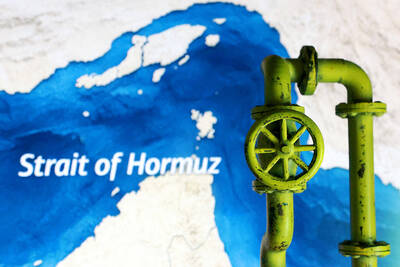
The US war on Iran has illuminated the deep interdependence of Asia on flows of oil and related items as raw materials that become the basis of modern human civilization. Australians and New Zealanders had a wake up call. The crisis also emphasizes how the Philippines is a swatch of islands linked by jet fuel. These revelations have deep implications for an invasion of Taiwan. Much of the commentary on the Taiwan scenario has looked at the disruptions to world trade, which will be in the trillions. However, the Iran war offers additional specific lessons for a Taiwan scenario. An insightful
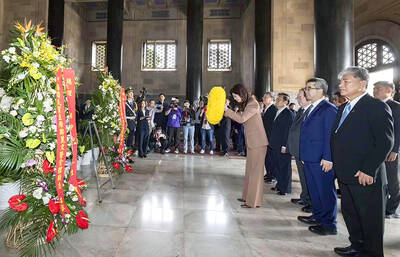
The problem with Marx’s famous remark that history repeats itself, first as tragedy, the second time as farce, is that the first time is usually farce as well. This week Chinese Nationalist Party (KMT) Chair Cheng Li-wun (鄭麗文) made a pilgrimage to the People’s Republic of China (PRC) “to confer, converse and otherwise hob-nob” with Chinese Communist Party (CCP) officials. The visit was an instant international media hit, with major media reporting almost entirely shorn of context. “Taiwan’s main opposition leader landed in China Tuesday for a rare visit aimed at cross-strait ‘peace’”, crowed Agence-France Presse (AFP) from Shanghai. Rare!
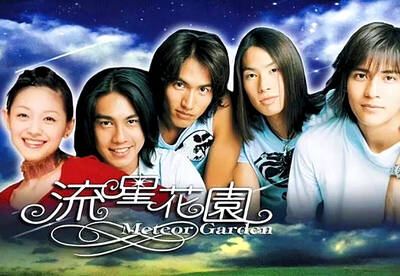
April 6 to April 13 Few expected a Japanese manga adaptation featuring four tall, long-haired heartthrobs and a plucky heroine to transform Taiwan’s television industry. But Meteor Garden (流星花園) took the nation by storm after premiering on April 12, 2001, single-handedly creating the “idol drama” (偶像劇) craze that captivated young viewers across Asia. The show was so successful that Japan produced its own remake in 2005, followed by South Korea, China and Thailand. Other channels quickly followed suit, with more than 50 such shows appearing over the following two years. Departing from the melodramatic
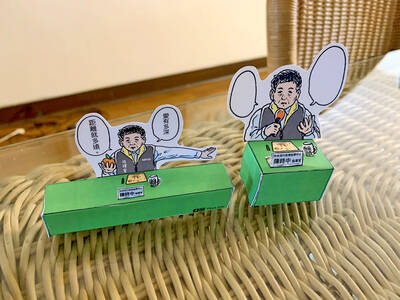
Sunflower movement superstar Lin Fei-fan (林飛帆) once quipped that the Democratic Progressive Party (DPP) could nominate a watermelon to run for Tainan mayor and win. Conversely, the DPP could run a living saint for mayor in Taipei and still lose. In 2022, the DPP ran with the closest thing to a living saint they could find: former Minister of Health and Welfare Chen Shih-chung (陳時中). During the pandemic, his polling was astronomically high, with the approval of his performance reaching as high as 91 percent in one TVBS poll. He was such a phenomenon that people printed out pop-up cartoon


 RSS
RSS