


When New York Times climate blogger Andrew C. Revkin was invited by a local foundation to give a lecture about the ongoing destruction of the Amazon rain forest, he didn’t know that Sting would be giving a concert at the Taipei Arena later the same day. But when a local reporter told him about the Sting show, Revkin said that if his schedule permits, he will try to make it and perhaps try to say hello to Sting backstage later.
Revkin will give a lecture, The Invisible Ax: Global Corporations Slaughter the Amazon, tomorrow as part of the Lung Yingtai Cultural Foundation’s (龍應台文化基金會) MediaTek Taipei Salon (台北沙龍) series. Kurtis Pei (裴家騏), a professor at the Institute of Wildlife Conservation, National Pingtung University of Science and Technology, will moderate the lecture. Revkin, who has written extensively on sustainability issues and climate change, will discuss the global impact of rainforest destruction.
It turns out that Revkin was once on the board of Rainforest Foundation which Sting helped create in the late 1980s, and the two men know each other.
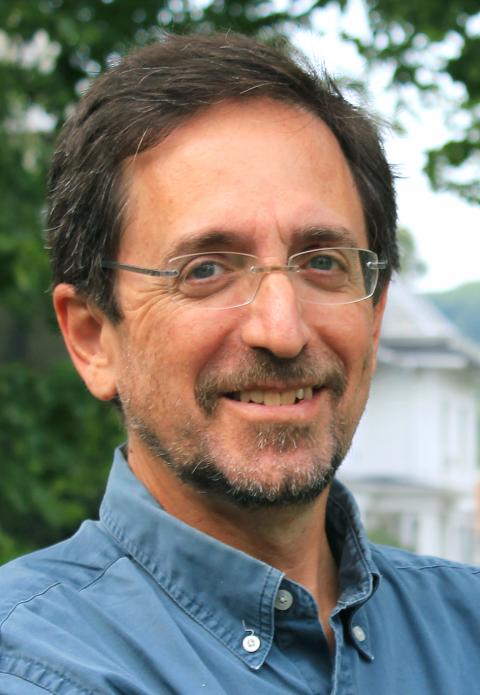
Photo courtesy of the Lung Yingtai Cultural Foundation
The Rainforest Foundation was founded in 1989 by Sting and his wife Trudie Styler after they saw first-hand the destruction of the Amazon rainforest, and the devastating impact it had on the lives of the indigenous peoples who lived there. It now operates in more than 20 countries.
While Revkin carved out a career as a globe-trotting science reporter for Discover magazine and the New York Times, he is also an amateur musician and songwriter. He plays a mean folk guitar and has been known to back up folksinger Pete Seeger at shows in the New York area. In addition, he is a member of Uncle Wade, a blues-roots band.
Revkin has written movingly about the destruction of the Amazon rain forest, as well as the 2004 Asian tsunami that hit Thailand and Indonesia. He has also visited Greenland to see first-hand the melting glaciers there.
As a singer/songwriter himself, Revkin admires Sting and would love to take in his Taipei show if time allows, he said in an e-mail from New York before flying to Taiwan.
Two films have been based on Revkin’s work, with one about the Amazon rain forest and other about a rock tribute band.
The Burning Season was an HBO film based on a biography of Chico Mendes, the iconic, slain defender of the Amazon rain forest. The second movie, Rock Star, was based on a 1997 newspaper article titled “A Metal-Head Becomes a Metal-God. Heavy,” in which Revkin described how a singer in a Judas Priest tribute band rose to replace his idol in the real band.
Taipei Salon (台北沙龍), The Invisible Ax: Global Corporations Slaughter the Amazon, tomorrow from 2pm to 4pm. The lecture takes place at Yue-han Hall (月涵堂), 110 Jinhua St, Taipei City (台北市金華街110號) and will be conducted in English with simultaneous interpretation in Mandarin. Admission is free, but those attending must register online at www.civictaipei.org or by calling (02) 3322-4907.
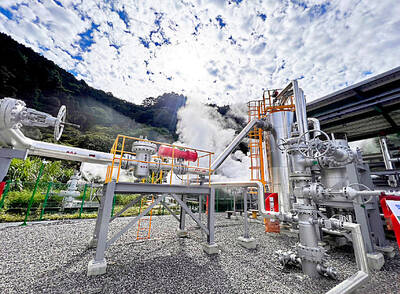
Taiwan’s semiconductor industry consumes electricity at rates that would strain most national grids. Taiwan Semiconductor Manufacturing Co (TSMC) alone accounted for more than 9 percent, or 2,590 megawatts (MW), of the nation’s power demand last year. The factories that produce chips for the world’s phones and servers run around the clock. They cannot tolerate blackouts. Yet Taiwan imports 97 percent of its energy, with liquefied natural gas reserves measured in days. Underground, Taiwan has options. Studies from National Taiwan University estimate recoverable geothermal resources at more than 33,000 MW. Current installed capacity stands below 10 MW. OBSTACLES Despite Taiwan’s significant geothermal potential, the

In our discussions of tourism in Taiwan we often criticize the government’s addiction to promoting food and shopping, while ignoring Taiwan’s underdeveloped trekking and adventure travel opportunities. This discussion, however, is decidedly land-focused. When was the last time a port entered into it? Last week I encountered journalist and travel writer Cameron Dueck, who had sailed to Taiwan in 2023-24, and was full of tales. Like everyone who visits, he and his partner Fiona Ching loved our island nation and had nothing but wonderful experiences on land. But he had little positive to say about the way Taiwan has organized its

The entire Li Zhenxiu (李貞秀) saga has been an ugly, complicated mess. Born in China’s Hunan Province, she moved to work in Shenzhen, where she met her future Taiwanese husband. Most accounts have her arriving in Taiwan and marrying somewhere between 1993 and 1999. She built a successful career in Taiwan in the tech industry before founding her own company. She also served in high-ranking positions on various environmentally-focused tech associations. She says she was inspired by the founding of the Taiwan People’s Party (TPP) in 2019 by Ko Wen-je (柯文哲), and began volunteering for the party soon after. Ko

Chinese Nationalist Party (KMT) Chair Cheng Li-wun (鄭麗文) returned from her trip to meet People’s Republic of China (PRC) dictator Xi Jinping (習近平) bearing “a gift” for the people of Taiwan: 10 measures the PRC proposed to “facilitate the peaceful development of cross-strait relations.” “China on Sunday unveiled 10 new incentive measures for Taiwan,” wrote Reuters, wrongly. The PRC’s longstanding habit with Taiwan relations is to repackage already extant or once-existing policies and declare that they are “new.” The list forwarded by Cheng reflects that practice. NEW MEASURES? Note the first item: establishing regular communication mechanisms between the Chinese Communist Party


 RSS
RSS