


Originally formulated by scientist Edward O. Wilson, the biophilia hypothesis suggests that human beings have an innate affinity with the natural world — plants, animals or even the weather. Yet it’s not biophilia but good old-fashioned fandom that has drawn a small band of Bjork obsessives to queue outside Manchester’s Campfield Market Hall since 10am. Not that there’s anything old-fashioned about the woman they are here to see. Biophilia is the Icelandic singer’s new project — the word means “love of living things” — and promises to push the envelope so far you’ll need the Hubble telescope to see it.
A collection of journalists has already had a preview at a press conference in the Museum of Science and Industry over the road. Bjork is absent, preparing for the live show, her first in the UK for over three years, which will open the Manchester international festival. Instead, artist and app developer Scott Snibbe, musicologist Nikki Dibben and project coordinator James Merry talk through Biophilia’s many layers. There will be an album in September, with an app to go with each of the 10 songs. There will be an education project, designed to teach children about nature, music and technology — some local kids will embark on it next week. There will be a documentary. And then there was a show scheduled for last night that was to be performed in the round to a 2,000-strong crowd including journalists representing publications from New Scientist to the New York Times, as well as the diehard fans waiting outside. One, 20-year-old Nick from London, is a classical violinist who has loved Bjork since the age of 14. “I wasn’t really into pop at all until I heard Medulla,” he says, citing her most challenging album. “It was like a gateway drug from me liking difficult 20th-century Western art music to liking pop.”
It’s a journey in the opposite direction from the one most music fans make, and one that speaks volumes about the complexity of Bjork’s work. “More classical musicians respect Bjork than any other pop star,” he adds.

Photo: Bloomberg
At the museum, Snibbe is demonstrating the apps. The app that goes with the first single, Crystalline, includes a game in which you collect crystals in a tunnel, through which process you alter and customize the music. The app also includes an abstract version of the musical score; and an essay by Dibben that explains, in this case, how the structures of crystals relate to the musical structure of the song. The app for another song, Cosmogony, presents a 3D cosmos you can navigate. Each app has been created by a different — often rival — developer. “To me, it feels like the birth of opera or the birth of cinema,” Snibbe says.
Yet Bjork didn’t have such lofty aspirations in creating the project. “My main aim is to not get too bored myself,” she says, via e-mail (she rests her voice between shows). “I feel that if I’m curious and excited there is a bigger chance the listener might be. At the end of the day, it’s more about the feeling of an adventure rather than the details of the adventure itself. So in short: whatever turns you on.”
That said, the change from a passive to an active listening experience is a radical one.
“The apps are mostly made for headphones and a private experience,” Bjork says. “What you see live is only us playing our version. You can play a totally different version at home.” If you’ve no desire to do that, Biophilia will still exist as a CD or download.
At the show venue, the journalists are being given a tour of the new instruments that have been specially built for the project. One contraption looks like a giant silver mangle decorated with two massive ear trumpets, but is called a sharpsichord. There are two giant pendulums that have strings plucked by a plectrum as they swing past. There’s a Tesla coil that descends in a cage from the ceiling; two prongs that emit purple flashes of lightning — and, with it, sound. There’s also a celeste that has been gutted and fitted with the pipes of a gamelan. These fantastical devices are controlled by an iPad. Above the performance space is a circle of screens that show the apps for each new song; moving tectonic plates for Mutual Core; invading pink cells for Virus (“Like a virus needs a body, as soft tissue feeds on blood, I will find you, the urge is here,” go the lyrics).
It must be one of the most complex pop shows ever, and according to Bjork, it could have been more elaborate still. “Manchester is the prototype,” she says. “We had to leave many things out because of budget and time and stuff.” As it is, the whole project has taken three years and cost so much money she told Rolling Stone that “we’ll be lucky if we earn zero.”
Yet, on purely artistic grounds, it’s hard to regard Biophilia as anything other than a success. As the lights go down, Bjork’s childhood hero David Attenborough’s unmistakable voice, recorded just that day, fills the room to explain the songs. The show includes Bjork’s favorite footage from BBC nature documentaries playing when she performs older songs. Hidden Place is illustrated by a beautiful but disturbing clip from Attenborough’s Life — of a seal’s corpse being devoured by psychedelically colored worms and starfish. All 10 tracks from the new album are played. Such an onslaught of new material would try the patience of most audiences, but this one is rapt — no one even goes to the bar.
Much of this is due to the sensory bombardment of music, images and costumes — not least Bjork’s bright orange wig, which a comment on the Guardian’s review says makes her resemble a tamarin monkey. Her decision to ban cameras from the venue has also played its part. “I feel since everyone has made such an effort to be there all together at the same place and time, we might as well go for it,” she says. “It can be hard to play music for people who are filming you for Twitter or whatever. It’s like going to a restaurant with someone who keeps texting their friends while you are speaking to them — hard to concentrate.”
Then there’s Bjork’s extraordinary voice, once compared by Bono to an icepick, and still imperishable at 45. “My voice has changed,” she says. “I thought it had gone a little deeper. On my last tour I got nodules [on the vocal cords] but managed to stretch it out with three years of vocal work, so I’m back to my old range now.” Bjork “adores” a whole range of singers: “Chaka Khan, Beyonce, Antony” — the latter being Antony Hegarty, a former collaborator who is here in the audience — though her “favorite singer alive today” is Azerbaijani devotional singer Alim Qasimov. She is accompanied by a 24-piece Icelandic choir she discovered on YouTube.
After spending so long meticulously making Biophilia, performance feels liberating. Live shows and making an album are, says Bjork, “extreme opposites. After noodling for ever on an album, gathering together the best moments, it’s refreshing and healthy to have to do it all in one whack. Then you sort of have to take real life into it and accept that you only have whatever you have that day — and that is enough.”
Right now Bjork is at the intersection of music, nature and technology, exploring how the three together might help build a more sustainable future. But is it still pop? “Yes, absolutely!” Bjork claims. “Or perhaps I would rather call it folk music — folk music of our time. I was never too much into Warhol and the whole pop thing — it felt a bit superficial. I prefer folk. People. Humans.”

Ajay Verma, a consultant gastroenterologist at Kettering general hospital in Northamptonshire, says our gut is a “complex machine.” “It is constantly providing us with the nutrition we need, initially to grow and develop, and then for us to survive, thrive and repair from injury and illness.” How can we keep it functioning well? Put simply: “Make sure what you put into it is balanced, and that you clear out its waste products adequately,” Verma says. “In a general gastroenterology clinic, the most common conditions we see are irritable bowel syndrome (IBS), gastroesophageal reflux disease, inflammatory bowel disease and constipation,” says Nisha

And so, in the wake of US President Donald Trump’s trip to the People’s Republic of China (PRC), all the experts on the Strait of Hormuz suddenly became experts on US-China-Taiwan relations. The Internet has certainly expanded human knowledge. Lots of these sudden experts made noise this week about Trump’s words after the meeting with PRC dictator Xi Jin-ping (習近平). Trump is going to sell out Taiwan! Longtime Taiwan commentator J. Michael Cole summed the situation up neatly in the Guardian: “We need to keep in mind that he has a tendency to say many things — sometimes contradicting himself within

Last week US President Donald Trump was asked by a reporter whether he would speak on the phone to the President of Taiwan. “l’ll speak to him. I speak to everybody. We have that situation very well in hand,” Trump said. This marked the second time in a couple of weeks he had said he would talk to the President of Taiwan. In 2016 he famously took a call from then-president Tsai Ing-wen (蔡英文), when he was president-elect. Despite warnings that the apocalypse was nigh because of a phone call, the world quickly forgot about the conversation between two democratically-elected presidents.
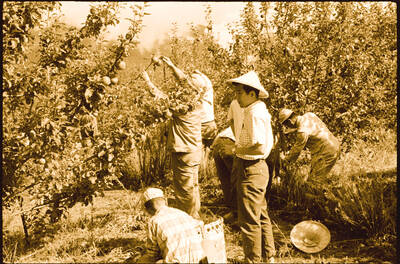
May 25 to May 31 Few believed that apples could be cultivated on a commercial scale in Taiwan’s high mountains. When horticulturalist Cheng Chao-hsiung (程兆熊) first proposed the idea in 1955, both American and Taiwanese colleagues dismissed it as implausible, arguing that temperate fruit could not be reliably grown on a subtropical island, especially on rugged terrain. However, it was this terrain in the Central Mountain Range where many Chinese Civil War veterans were resettled in the late 1950s. With limited job prospects and no family in Taiwan, they were placed on cooperative farms aimed toward self-sufficiency. Some say the conditions


 RSS
RSS