


This week’s tabloids were dominated by rumors of romantic reunions and new affaires d’amour. On home turf, Jay Chou (周杰倫) and Jolin Tsai (蔡依林) continue to make headlines after their sultry duet at the end of the Mando-pop king’s Taipei concert on June 13. Local tabloids have since generated plenty of titillating content for gossip hounds to chew on. One story that seems to have gained the most traction involves a diamond ring from a well-known luxury brand and an alleged marital proposal from Chou to Tsai after the concert.
Fans have greeted the Double-Js’ (雙-J) rumored reunion with great enthusiasm. A composite photo showing the pair cuddling together circulated on the Internet and was quickly picked up by the Liberty Times (the Taipei Times’ sister newspaper) and the Apple Daily.
Both Tsai and Chou say the reports are rubbish. According to the Liberty Times, Chou responded to the question of why he chose to perform with Tsai by saying, “I just wanted to freak everyone out.” Meanwhile, Tsai was quoted as saying: “Getting back together? Thanks, but I’m not crazy.”
One man who is surely freaked out by the possibility of the two getting back together is Tsai’s agent Chen Tse-shan (陳澤杉). The Warner Music (華納音樂) impresario has not been on good terms with the Chairman after the two bickered over a chart-rigging controversy last year. Chen risks losing his cash cow to Chou’s record company, JVR Music (杰威爾音樂), if the Double-Js get really friendly with each other.
Having recovered from two year’s of depression and found Jesus, erstwhile Hong Kong pop diva Sammi Cheng (鄭秀文) is making a comeback with a Mandarin-language gospel album, Faith (信). Chinese-language media outlets also report that Cheng’s old flame Andy Hui (許志安) is back in the 38-year-old star’s life.
A series of snapshots and a chart published by the Liberty Times last Friday detailed Hui and Cheng’s itineraries in Taipei last week, which involved them staying at the same hotel, shooting music videos at the same studio and flying back to Hong Kong on the same plane. But according to their agents, the two are just good friends.
In other celebrity romance news, Chinese heartthrob Huang Xiaoming (黃曉明) and 21-year-old model Angelababy have become the hottest new item on the tabloids’ front pages after Huang publicly acknowledged their relationship in front of the media in Shanghai last week.
Hailed as Hong Kong’s new “sex goddess” (性感女神), Angelababy, whose real name is Yang Ying (楊穎), has quickly risen to stardom in the last couple of years based on nothing more than her looks.
A widely circulated batch of photos seems to indicate that Yang Ying had to go through plenty of revamping before she became the Angelababy we know now. But this has done nothing to dim Huang’s ardor. His public confession of love included an admission that he pampers his woman “as if she were a princess.” China’s most bankable actor is also reported to have introduced his sweetheart to Hong Kong entertainment mogul Peter Lam (林建岳), who, according to rumors, is planning to make Angelababy the next Cecilia Cheung (張柏芝).
After being arrested on drug-related charges for the third time, Taiwanese entertainer Da Bing (大炳), real name Yu Bing-hsian
(余炳賢), was baptized at the Home of Christ church in Taipei last Saturday. The disgraced entertainer said he wants to find inner strength through God’s love.
But will his sexual orientation get between him and God? Da Bing was quoted by the Apple Daily as saying, “That’s between God and me.”
In Pop Stop’s opinion, the quickest way for Da Bing to resolve this issue is to join the Tong-Kwang Light House Presbyterian Church (同光同志長老教會), Taiwan’s first church for gays and lesbians.


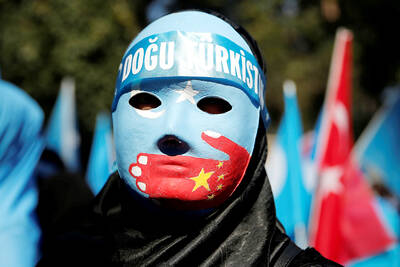
It seems every few days one bumps into one of those “real man” comments in which Taiwan is urged to “face reality” or similar, and “make a deal,” with the speaker implying that soon it will be too late. “Deal” advocates always present themselves as having a superior grip on reality, and the manly ability to make the “hard choice.” Their testosterone-laden language often echoes that of Taiwan sellout advocates. Note that such commentary always specifies a process (“make a deal, work with, make progress”), never the end state of what occupation by a violent authoritarian colonialist state will entail. In

There are shadowy cabals plotting to sell out Taiwan to be annexed by China, by invasion if necessary. Fortunately, they are buffoons. In 2019, former Bamboo Union gangster and founder of the China Unification Promotion Party (CUPP), Chang An-le (張安樂, colorfully known as “White Wolf”), led a protest at the Legislative Yuan against comments made by then-premier Su Tseng-chang (蘇貞昌) that in the event of an attack by China, he would never surrender, but would protect the nation by fighting to the end, even if he only had a broom. Chang had party members bring a wooden casket that they
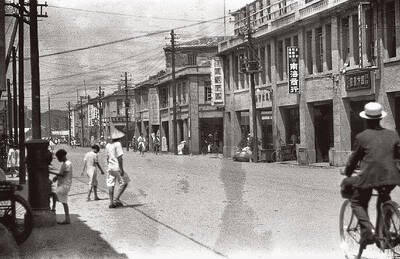
June 1 to June 7 "If all Taiwanese were as afraid of dying as you, then what would happen?” Physician Shih Chiang-nan (施江南) reportedly said this to his wife Chen Chiao-tung (陳焦桐) after she urged him to stop intervening on behalf of Taiwanese soldiers stranded overseas after serving in the Japanese Army during World War II. Shih had clashed with high-ranking officials over the issue, engaged in several heated arguments with Taiwan governor-general Chen Yi (陳儀) and allegedly shouted at general Ko Yuan-fen (柯遠芬), chief of staff of the Taiwan Garrison Command, over

Food prices have often played a major role in Taiwan’s history. The first major wave of migration from China occurred in 1628. A moderate drought, the Ming Dynasty maritime ban that prohibited fishing and trading (intended to reduce piracy) and a temporary tax, conspired to exhaust local resources, leading to famine in Fujian Province. The famed pirate and trader Zheng Zhilong (鄭芝龍), scooped up starving people from Fujian and transported them across the Taiwan Strait, where they settled under the Dutch. Two factors enabled Zheng. First, by 1624 he had settlements around today’s Beigang (北港) in Yunlin County with a small


 RSS
RSS