


European carmakers are looking into ways to scratch components made with parts from China, spooked by deepening geopolitical spats playing out through chipmaker Nexperia BV and Beijing’s export controls on rare earths.
To protect operations from trade ructions, several automakers are pushing major suppliers to find permanent alternatives to Chinese semiconductors, people familiar with the matter said.
The industry is considering broader changes to its supply chain to adapt to shifting geopolitics, Europe’s main suppliers lobby CLEPA head Matthias Zink said.
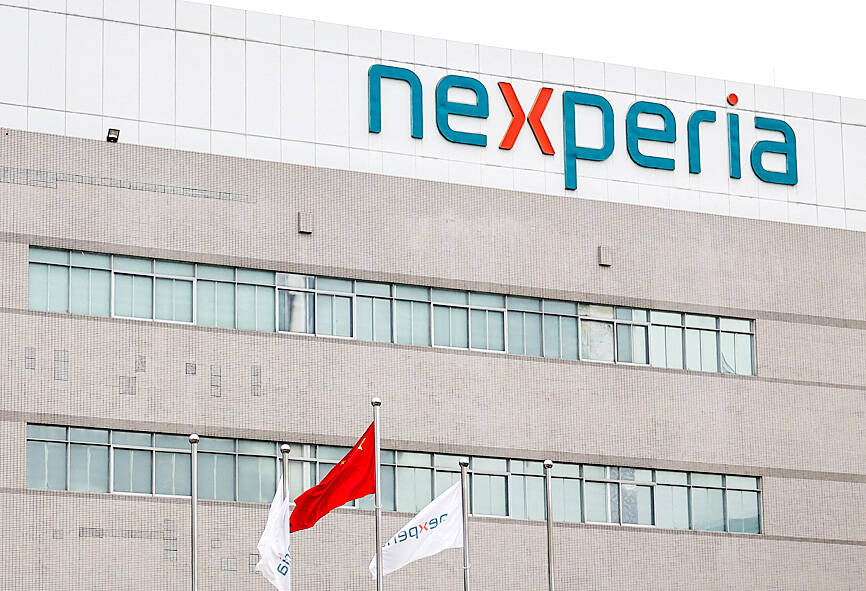
Photo: REUTERS
“We had some indications already — questions like: ‘How can you supply me without this dependency on China?’” Zink, who also heads Schaeffler AG’s powertrain & chassis division, said in an interview.
The moves follow last month’s sudden supply disruption at Chinese-owned Nexperia. The conflict escalated when Beijing blocked exports of key components from Nexperia’s Chinese factories, in response to the Netherlands seizing control of the company’s Dutch operations.
The fallout quickly spread to manufacturers relying on the low-tech but vital chips. Honda Motor Co cut its annual profit guidance after halting production at some plants, while ZF Friedrichshafen AG and Robert Bosch GmbH, the world’s biggest car-parts maker, slowed output. Volkswagen AG and BMW AG set up task forces to source semiconductors, and prices for the components spiked.
“For procurement leaders, this is more than a temporary disruption,” said Sapna Amlani, who oversees Moody’s global supply chain practice. “It signals a structural risk: geopolitical decisions can instantly reshape sourcing economics.”
While governments have made some progress toward a resolution and deliveries are said to have restarted, the feud at Nexperia continues, keeping supply concerns front of mind.
Rolling back established supply lines is costly and complex, with the push for changes revealing deep discomfort among manufacturers as former trade partners turn foes. The chip supply chain, which relies on cross-regional flows, has been exposed as one of the weakest links in the China-US tug of war that is sidelining Europe.
“What we are feeling is that in the geopolitical arena, the American and the Chinese value chains are slowly separating from each other,” German chipmaker Infineon Technologies AG chief executive officer Jochen Hanebeck said.
Nexperia, whose chips power simpler features like window controls and steering systems, currently holds a market share of more than 20 percent in the segment, according to research firm Omdia.
Competitors that could replace its products include US firms On Semiconductor Corp, Vishay General Semiconductor LLC and Diodes Inc, as well as Japanese manufacturer Rohm Co, according to Omdia data.
A spokeswoman for OnSemi said that it is in discussions with existing and new customers “to be able to best support them over the long term.”
During task-force meetings convened to tackle the Nexperia shortage, Zink said carmakers frequently asked: “What are we going to do thereafter?”
The clash over chips adds to persistent concerns about the supply of rare earths, important for magnets that help operate batteries and electric vehicle (EV) motors. China retains a near monopoly on processing the materials and has frequently throttled supply for leverage.
Any meaningful recalibration of sourcing components outside China — be it batteries, chips or rare earths — would take time, Zink said, estimating a time frame of three to seven years depending on the component.
The string of issues has highlighted the risk of going EV-only in Europe, he added, with China supplying the vast majority of the region’s batteries — a dependency he expects to hold for years to come.
That is adding urgency to calls to walk back the EU’s 2035 phase-out of new combustion-engine cars.
The bloc should rethink that plan and keep allowing the sale of new hybrid models and range-extender EVs to reduce that exposure and save jobs, Zink said.
“We should have no illusions on this,” he said, adding that replacing Chinese battery cells and refineries is “going to be difficult for decades.”
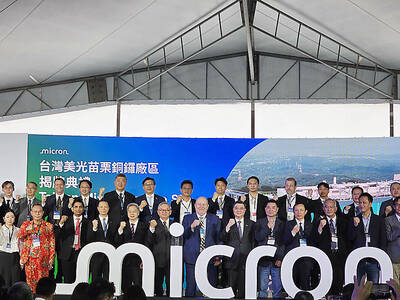
UNPRECEDENTED PACE: Micron Technology has announced plans to expand manufacturing capabilities with the acquisition of a new chip plant in Miaoli Micron Technology Inc unveiled a newly acquired chip plant in Miaoli County yesterday, as the company expands capacity to meet growing demand for advanced DRAM chips, including high-bandwidth memory chips amid the artificial intelligence boom. The plant in Miaoli County’s Tongluo Township (銅鑼), which Micron acquired from Powerchip Semiconductor Manufacturing Corp (力積電) for US$1.8 billion, is expected to make a sizeable capacity contribution to the company from fiscal 2028, the company said in a statement. It would be an extended production site of Micron’s large-scale manufacturing hub in Taichung, the company said. As the global semiconductor industry is racing to reach US$1 trillion

A man walks past real-estate advertisements outside a house in Taipei yesterday. The central bank yesterday said it plans to establish an “Inflation-at-Risk” gauge as a supplementary tool for observing inflation, as policymakers express wish to communicate more effectively with the public when making inflation forecasts.
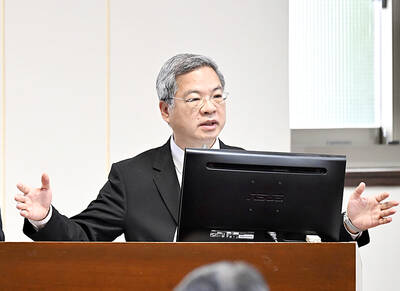
ABOVE LEGAL REQUIREMENT: The Ministry of Economic Affairs is prepared if LNG supply is disrupted, with more than the legal requirement of 11 days of inventory Taiwan has largely secured liquefied natural gas (LNG) supplies through May and arranged about half of June’s supply, Minister of Economic Affairs Kung Ming-hsin (龔明鑫) said yesterday. Since the Middle East conflict began on Feb. 28, Taiwan’s LNG inventories have remained more than 12 days, exceeding the legal requirement of 11 days, indicating no major supply concerns for domestic gas and electricity, Kung said at a meeting of the legislature’s Economics Committee in Taipei. The ministry aims to increase the figure to 14 days by the end of next year, he said. While one or two LNG or crude oil shipments for May

Memory chip stocks extended their losses yesterday after Alphabet Inc’s Google publicized research that could allow more efficient use of the storage needed for artificial intelligence (AI) development. SK Hynix Inc and Samsung Electronics Co, South Korean leaders in the market, fell more than 6 percent and about 5 percent respectively in Seoul. In the US, Micron Technology Inc, Western Digital Corp and Sandisk Corp slid more than 2 percent in pre-market trading, after they all closed lower on Wednesday. Memory companies have been on a tear in recent months as the rapid development of AI infrastructure triggered a spike in chip


 RSS
RSS