


MediaTek Inc (聯發科), the world’s largest mobile phone chip designer, yesterday said it is working closely with Japan’s Denso Corp to build a custom automotive system-on-chip (SoC) solution tailored for advanced driver-assistance systems and cockpit systems, adding another customer to its new application-specific IC (ASIC) business.
This effort merges Denso’s automotive-grade safety expertise and deep vehicle integration with MediaTek’s technologies cultivated through the development of Media-
Tek’s Dimensity AX, leveraging efficient, high-performance SoCs and artificial intelligence (AI) capabilities to offer a scalable, production-ready platform for next-generation driver assistance, the company said in a statement yesterday.
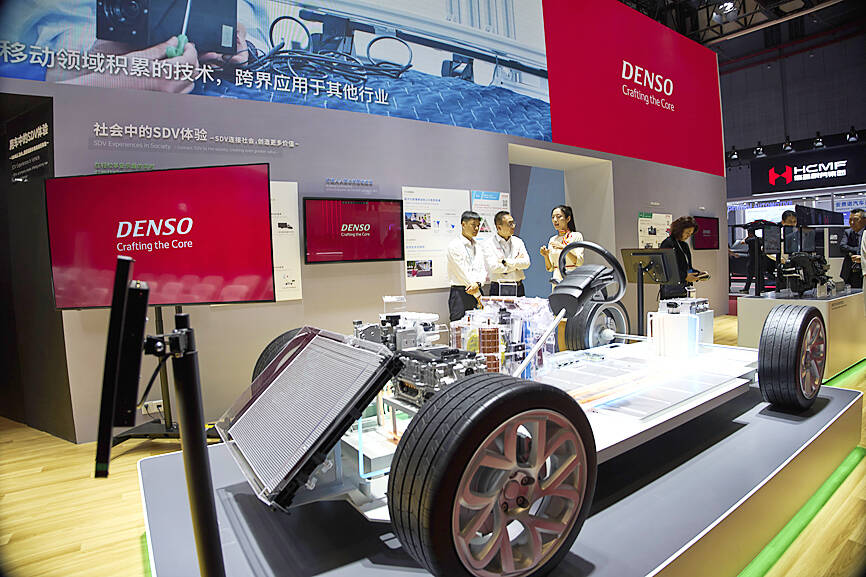
Photo: AP
“Through this collaboration, we are bringing two industry leaders together to support the most demanding requirements of global automotive manufacturers and system integrators, exceeding benchmarks in safety, power efficiency, and AI-enabled perception to advance the future of assisted driving,” said Mike Chang (張豫臺), a corporate vice president and general manager of automotive business at MediaTek.
MediaTek aims to shape the future of intelligent mobility and enable rapid deployment of advanced driver-assistance systems across global markets through its partnership with Denso, the company said.
The partnership with Denso is the first ASIC project from an auto client, based on the announcements made by MediaTek so far. MediaTek has said it is developing a chip for a cloud service provider (CSP), the first ASIC project secured by the company.
Some analysts consider the expanding ASIC market to be a new growth driver for MediaTek, which is expected to grow 113 percent annually next year, outpacing the 66 percent growth estimated for graphic processing units (GPU), according to an International Data Corp (IDC) forecast.
IDC attributed the strong growth to major cloud service providers’ ambition to invest in building their own AI server accelerators for data centers to improve the total cost of ownership by reducing the use of expensive GPUs.
MediaTek expected the company’s first ASIC project to generate US$1 billion in revenue next year and to contribute billions of US dollars in 2027, making the data center ASICs one of the company’s incremental revenue contributors.
Other ASIC projects should contribute revenue from 2028 and beyond, MediaTek told investors.
Within two years, the company aims to gain a 10 to 15 percent share of the world’s cloud ASIC market, valued at US$50 billion, it said.
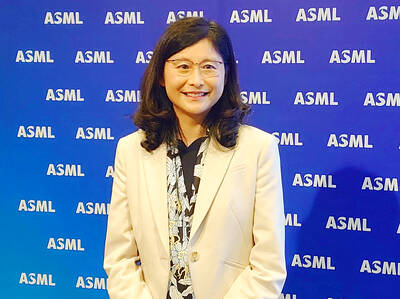
Netherlands-based semiconductor equipment supplier ASML Holding NV yesterday said that it is planning to hire an additional 1,000 people in Taiwan this year in response to growing demand from clients. ASML had previously planned to recruit 600 people this year, but that the plan has been adjusted upward, ASML vice president and ASML Taiwan general manager Grace Wang (汪佳慧) told reporters. ASML has a workforce of more than 4,500 in Taiwan, accounting for about 10 percent of its global total, Wang said. This year’s recruitment campaign would focus on adding people in the customer support, manufacturing and supply chain domains to assist ASML
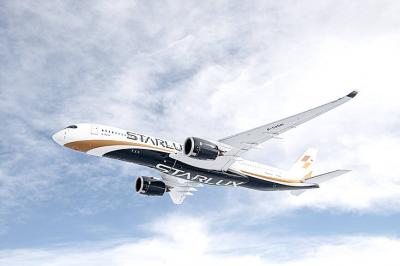
Starlux Airlines Co (星宇航空) today unveiled a long-haul network expansion plan at a shareholders’ meeting in Taipei, including direct flights to Barcelona, Spain, and Zurich, Switzerland, as well as a service connecting Taipei, Sydney and New Zealand. Starlux is to become the first Taiwanese carrier to offer non-stop services to the two European cities, while the inaugural oceanic route is expected to expand transit opportunities within the Australia-New Zealand market, Starlux said. Flight services to Chicago, Dallas, Washington and New York are under evaluation, the airline added. Prior to the shareholders’ meeting, the airline earlier this year announced that it would be
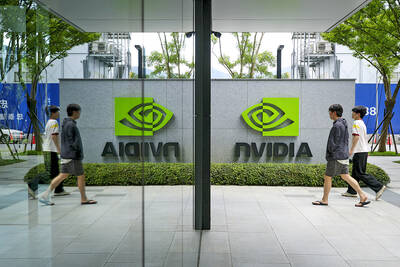
UNDER MICROSCOPE: Taiwan detained three people who allegedly conspired to buy servers in Taiwan and export them using fraudulent documentation, prosecutors said Nvidia Corp chief executive officer Jensen Huang (黃仁勳) on Saturday urged Super Micro Computer Inc to tighten up on compliance after Taiwan detained three people this week for allegedly making fraudulent declarations about artificial intelligence (AI) servers made by its US partner. The development marked the nation’s first crackdown on semiconductor smuggling, which grew after the US slapped restrictions on exports of high-end chips such as Nvidia AI accelerators to China. Nvidia is “rigorous” in explaining regulations to all of its partners, Huang told reporters after arriving in Taipei. “Ultimately Super Micro has to run their own company,” he said in response to

Nvidia Corp yesterday announced that CEO Jensen Huang (黃仁勳) would attend an employee meeting in Taipei tomorrow to celebrate the launch of the company’s Taiwan headquarters project. Huang would attend a gathering at the site of Nvidia’s planned headquarters in Beitou Shilin Technology Park (北投士林科技園區), the company said in a statement. After arriving in Taiwan on Saturday last week, Huang told reporters that he plans to meet with Quanta Computer Inc (廣達) chairman Barry Lam (林百里) and Taiwan Semiconductor Manufacturing Co (TSMC, 台積電) chairman C.C. Wei (魏哲家), and would attend the groundbreaking ceremony for Nvidia’s Taiwan headquarters tomorrow. Nvidia has not yet applied


 RSS
RSS