


Even as the US is embarked on a bitter rivalry with China over the deployment of artificial intelligence (AI), Chinese technology is quietly making inroads into the US market.
Despite considerable geopolitical tensions, Chinese open-source AI models are winning over a growing number of programmers and companies in the US.
These are different from the closed generative AI models that have become household names — ChatGPT-maker OpenAI or Google’s Gemini — whose inner workings are fiercely protected.
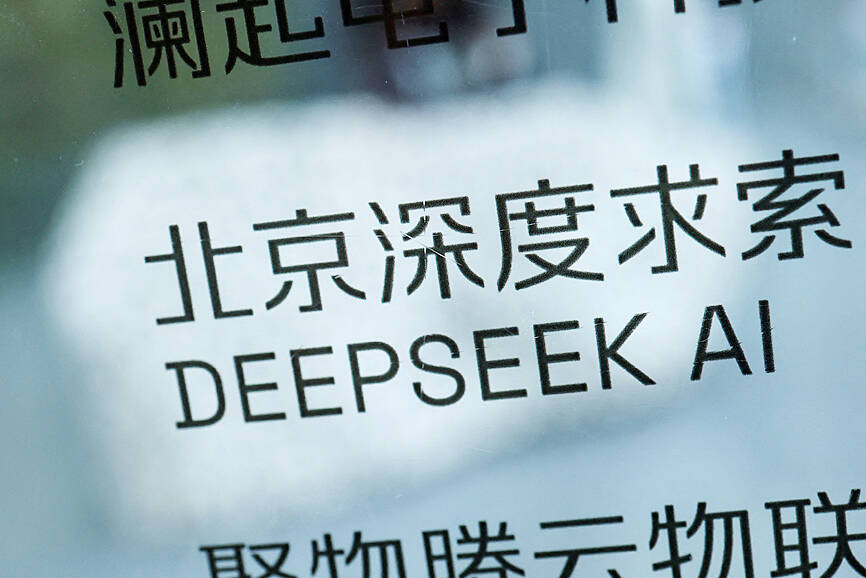
Photo: Reuters
In contrast, “open” models offered by many Chinese rivals, from Alibaba (阿里巴巴) to DeepSeek (深度求索), allow programmers to customize parts of the software to suit their needs.
Globally, use of Chinese-developed open models has surged from just 1.2 percent late last year to nearly 30 percent in August, according to a report published this month by the developers’ platform OpenRouter and US venture capital firm Andreessen Horowitz.
China’s open-source models “are cheap — in some cases free — and they work well,” said Wang Wen (王文), dean of the Chongyang Institute for Financial Studies at Renmin University of China in Beijing.
One American entrepreneur, speaking on condition of anonymity, said that their business saves US$400,000 annually by using Alibaba’s Qwen AI models instead of the proprietary models.
“If you need cutting-edge capabilities, you go back to OpenAI, Anthropic or Google, but most applications don’t need that,” the entrepreneur said.
US chip titan Nvidia, AI firm Perplexity and California’s Stanford University are also using Qwen models in some of their work.
The January launch of DeepSeek’s high-performance, low-cost and open source R1 large language model defied the perception that the best AI tech had to be from US juggernauts such as OpenAI, Anthropic or Google.
It was also a reckoning for the US — locked in a battle for dominance in AI tech with China — on how far its rival had come.
AI models from Shanghai-based MiniMax (上海稀宇科技) and Beijing-based Z.ai (北京智譜華章科技) are also popular overseas, and the country has entered the race to build AI agents — programs that use chatbots to complete online tasks like buying tickets or adding events to a calendar.
Agent friendly — and open-source — models, like the latest version of the Kimi K2 model from Beijing-based start-up Moonshot AI (北京月之暗面科技), released last month, are widely considered the next frontier in the generative AI revolution.
The US government is aware of open-source’s potential.
In July, the administration of US President Donald Trump released an AI Action Plan that said the US needed “leading open models founded on American values.”
They could become global standards, it said.
However, some US companies are taking the opposite track.
Meta, which had led the country’s open-source efforts with its Llama models, is now concentrating on closed-source AI instead.
However, this summer, OpenAI — under pressure to revive the spirit of its origin as a nonprofit — released two “open-weight” models (slightly less malleable than “open-source”).
Among major Western companies, only France’s Mistral is sticking with open-source, but it ranks far behind DeepSeek and Qwen in usage rankings.
Western open-source offerings are “just not as interesting,” said the US entrepreneur who uses Alibaba’s Qwen.
The Chinese government has encouraged open-source AI technology, despite questions over its profitability.
Mark Barton, chief technology officer at OMNIUX, said that he was considering using Qwen, but some of his clients could be uncomfortable with the idea of interacting with Chinese-made AI, even for specific tasks.
Given the US administration’s stance on Chinese tech companies, risks remain, Barton said.
“We wouldn’t want to go all-in with one specific model provider, especially one that’s maybe not aligned with Western ideas,” he said. “If Alibaba were to get sanctioned or usage was effectively blacklisted, we don’t want to get caught in that trap.”
Paul Triolo, a partner at DGA-Albright Stonebridge Group, said there were no “salient issues” surrounding data security.
“Companies can choose to use the models and build on them ... without any connection to China,” Triolo said.
A recent Stanford study published posited that “the very nature of open-model releases enables better scrutiny” of the tech.
Gao Fei, chief technology officer at Chinese AI wellness platform BOK Health, agreed.
“The transparency and sharing nature of open source are themselves the best ways to build trust,” he said.

Cairo’s new monorail slices across the city skyline, running above the familiar chaos of blaring horns and aging buses’ exhaust fumes that mark rush hour below. The US$4.5 billion monorail, opened this month, is among Egypt’s most prominent new transport projects, part of a debt-funded infrastructure drive criticized for sapping state finances while bringing limited benefits to most of the country’s 109 million people. “It feels like you’re in a different country,” said Ramy Sayed, a restaurant manager, aboard a driverless Innovia 300 train. “No noise, no traffic, we’re not used to this.” The eastern line runs 56km from the bustling middle-class
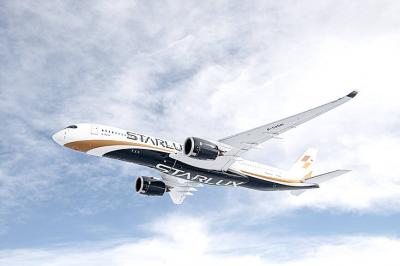
Starlux Airlines Co (星宇航空) today unveiled a long-haul network expansion plan at a shareholders’ meeting in Taipei, including direct flights to Barcelona, Spain, and Zurich, Switzerland, as well as a service connecting Taipei, Sydney and New Zealand. Starlux is to become the first Taiwanese carrier to offer non-stop services to the two European cities, while the inaugural oceanic route is expected to expand transit opportunities within the Australia-New Zealand market, Starlux said. Flight services to Chicago, Dallas, Washington and New York are under evaluation, the airline added. Prior to the shareholders’ meeting, the airline earlier this year announced that it would be

Taiwanese firms have increased investment in the Philippines in recent years as Manila’s ties with Washington deepen and global supply chains continue to shift away from China, an expert at the Chung-Hua Institution for Economic Research (CIER, 中華經濟研究院) said yesterday. The Philippines had not been among Taiwanese investors’ top choices in Southeast Asia, CIER Taiwan ASEAN Studies Center director Kristy Hsu (徐遵慈) said at a seminar in Taipei. However, Taiwan’s investment in the country has grown significantly since the COVID-19 pandemic, reaching US $257 million last year, a high in recent years, she said. Although Taiwan’s total investment in the Philippines still lags

Intel Corp regards Taiwan Semiconductor Manufacturing Co (TSMC, 台積電) as a longstanding partner, as the US chipmaker would continue outsourcing production of advanced chips to TSMC, Intel chief executive officer Lip-Bu Tan (陳立武) said yesterday. “I don’t look at people as competitors. I look at the collaboration... Nvidia is also, you know, a good friend,” Tan told a news conference following his keynote speech at the Computex trade show in Taipei. “It’s a very trusted partnership for us... We are a big, top customer for them, and we’re going to continue doing that,” he said, referring to TSMC, the world’s largest foundry


 RSS
RSS