


A proposed billionaires’ tax in California has ignited a political uproar in Silicon Valley, with tech titans threatening to leave the state while California Governor Gavin Newsom of the Democratic Party maneuvers to defeat a levy that he fears would lead to an exodus of wealth.
A technology mecca, California has more billionaires than any other US state — a few hundred, by some estimates. About half its personal income tax revenue, a financial backbone in the nearly US$350 billion budget, comes from the top 1 percent of earners.
A large healthcare union is attempting to place a proposal before voters in November that would impose a one-time 5 percent tax on the assets of billionaires — including stocks, art, businesses, collectibles and intellectual property — to backfill federal funding cuts to health services for lower-income people that were signed by US President Donald Trump last year.
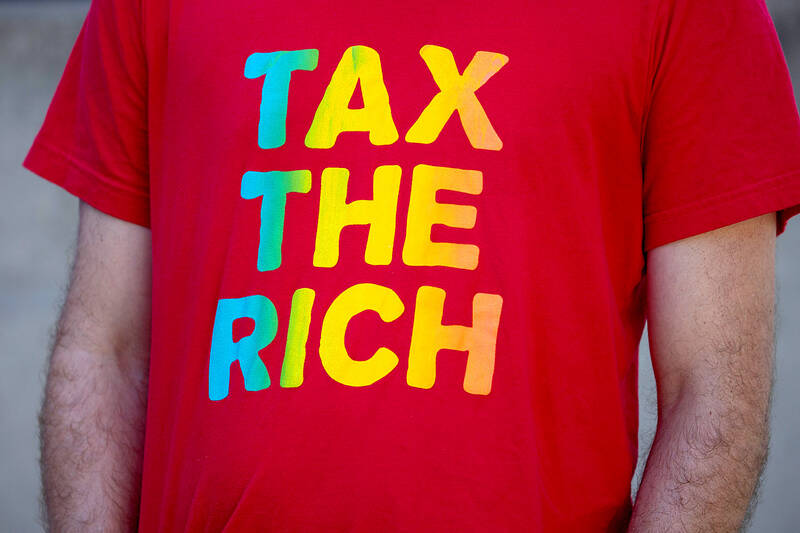
Photo: Reuters
In a state with a vast gap between rich and poor, the plan has resulted in a tangle of competing interests at a time when Democrats and Republicans are struggling to respond to economic anxiety driven by rising costs ahead of this year’s midterm elections.
An online war of words has tech leaders pondering a hollowing out of Silicon Valley, and millions of dollars are flowing to political committees engaged in the fight. That includes US$3 million from billionaire Peter Thiel, a founder of PayPal and a Trump acolyte, to a committee tied to a business group opposing the tax.
However, it is not clear if the proposal would make the ballot, with more than 870,000 petition signatures required for it to qualify.
Although the tax would affect only a minuscule slice of California’s about 39 million residents, it would siphon money from an immense pool of wealth. It would apply retroactively to billionaires living in the state as of Jan. 1.
At least 25 billionaires listed among Forbes magazine’s last year’s rankings of the world’s 500 wealthiest people either lived in California or had some significant ties to the state, based on a review by The Associated Press.
However, determining whether they were full-time residents or just frequent visitors could turn into a matter of dispute, since many of them own property elsewhere.
“You are really playing with fire with this one,” said Aaron Levie, chief executive officer of the publicly traded Silicon Valley company Box.
Levie said he fears that the proposed tax would drive entrepreneurs to look elsewhere to run their companies and launch start-ups.
Even liberal-leaning tech pioneers would “find it absurd just on pure economic and structural grounds, even if they might agree that the cause itself is very worthy,” said Levie, who is not a billionaire.
Newsom has long opposed state-level wealth taxes, believing such levies would be disadvantageous for the world’s fourth-largest economy. At a time when California is strapped for cash and he is considering a 2028 US presidential run, he is trying to block the proposal before it reaches the ballot.
Analysts say an exodus of billionaires could mean a loss of hundreds of millions of tax dollars.
“It’s one of the reasons why Newsom’s path to the Democratic nomination is not going to be an easy one,” Claremont McKenna College political scientist Jack Pitney said. “He’s already facing a [budget] deficit the size of which is uncertain ... and in the years to come, a billionaires tax that could backfire badly.”
The proposal has created a deep rift between Newsom and prominent members of his party’s progressive wing, including Vermont Senator Bernie Sanders, who endorsed it and said it should be a template for other states.
“Our nation will not thrive when so few have so much while so many have so little,” Sanders said on social media.
Another supporter, and a potential 2028 Newsom rival, is Democratic US Representative Ro Khanna, who mocked billionaires for threatening to flee over a tax intended to provide healthcare for lower-income people.
The measure’s lead proponent, the Service Employees International Union (SEIU), said it saw the threat of an exodus as exaggerated.
The tax is a “workable response to a crisis created by [US] Congress,” SEIU-United Healthcare Workers West chief of staff Suzanne Jimenez said in a statement.
Jimenez added that it would “keep emergency rooms open, hospitals staffed and healthcare systems functioning.”
Meanwhile, the California Business Roundtable is leading an effort to defeat the measure, saying it would “undermine our economy, decimate the state budget, drive investment out of the state, and ultimately make everyday life more expensive for working families.”
Fleeing California because of its high cost of living and reputation for stringent regulations started to gather momentum well before the proposed wealth tax began circulating last year.
Elon Musk, the world’s wealthiest man with a US$724 billion fortune, bought a home in Texas and moved his electric automaker Tesla Inc to Austin several years ago.
The financial threat posed by the proposed tax apparently is pushing even more of Silicon Valley’s renowned pioneers to curtail their exposure to California and its liberal policies, including Google cofounders Larry Page and Sergey Brin, who moved to the state during the mid-1990s for graduate study at Stanford University.
Page and Brin stepped away from their executive roles years ago, but remain the largest shareholders in Google parent company Alphabet Inc, with stakes that account for most of their combined fortunes of US$530 billion, according to Forbes.
However, both men have begun moving more of their assets to Florida, multiple reports said.
Google, which has been based in Mountain View, California, for the past quarter century, did not respond to an Associated Press inquiry about their recent moves.
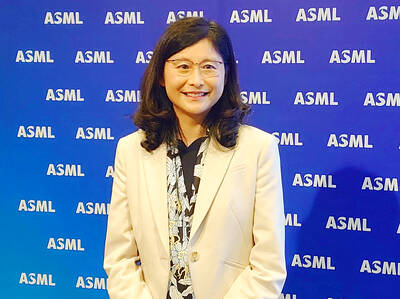
Netherlands-based semiconductor equipment supplier ASML Holding NV yesterday said that it is planning to hire an additional 1,000 people in Taiwan this year in response to growing demand from clients. ASML had previously planned to recruit 600 people this year, but that the plan has been adjusted upward, ASML vice president and ASML Taiwan general manager Grace Wang (汪佳慧) told reporters. ASML has a workforce of more than 4,500 in Taiwan, accounting for about 10 percent of its global total, Wang said. This year’s recruitment campaign would focus on adding people in the customer support, manufacturing and supply chain domains to assist ASML
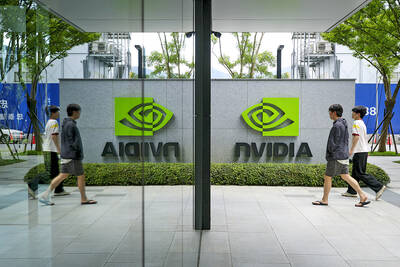
UNDER MICROSCOPE: Taiwan detained three people who allegedly conspired to buy servers in Taiwan and export them using fraudulent documentation, prosecutors said Nvidia Corp chief executive officer Jensen Huang (黃仁勳) on Saturday urged Super Micro Computer Inc to tighten up on compliance after Taiwan detained three people this week for allegedly making fraudulent declarations about artificial intelligence (AI) servers made by its US partner. The development marked the nation’s first crackdown on semiconductor smuggling, which grew after the US slapped restrictions on exports of high-end chips such as Nvidia AI accelerators to China. Nvidia is “rigorous” in explaining regulations to all of its partners, Huang told reporters after arriving in Taipei. “Ultimately Super Micro has to run their own company,” he said in response to

Nvidia Corp yesterday announced that CEO Jensen Huang (黃仁勳) would attend an employee meeting in Taipei tomorrow to celebrate the launch of the company’s Taiwan headquarters project. Huang would attend a gathering at the site of Nvidia’s planned headquarters in Beitou Shilin Technology Park (北投士林科技園區), the company said in a statement. After arriving in Taiwan on Saturday last week, Huang told reporters that he plans to meet with Quanta Computer Inc (廣達) chairman Barry Lam (林百里) and Taiwan Semiconductor Manufacturing Co (TSMC, 台積電) chairman C.C. Wei (魏哲家), and would attend the groundbreaking ceremony for Nvidia’s Taiwan headquarters tomorrow. Nvidia has not yet applied
Huawei Technologies Co (華為) said it has come up with a new pathway to shorten its gap with industry leader Taiwan Semiconductor Manufacturing Co (TSMC, 台積電), potentially achieving a breakthrough in making advanced semiconductors without cutting-edge equipment. Right now there is about a five-year gap between what TSMC is capable of and what Huawei, together with its manufacturing partner Semiconductor Manufacturing International Corp (中芯), can produce. Huawei is to start making 1.4-nanometer chips by 2031 with its own “LogicFolding” technology, Huawei semiconductor chief He Tingbo (何庭波) said in a rare public appearance during a chip conference yesterday, while TSMC has


 RSS
RSS