


The United Arab Emirates (UAE) and Kuwait started reducing oil production, as the near-closure of the crucial Strait of Hormuz ripples through energy markets and affects global supply.
Abu Dhabi National Oil Co (ADNOC) is “managing offshore production levels to address storage requirements,” the company said in a statement, without giving details.
Kuwait Petroleum Corp said it was lowering production at its oil fields and refineries after “Iranian threats against safe passage of ships through the Strait of Hormuz.”
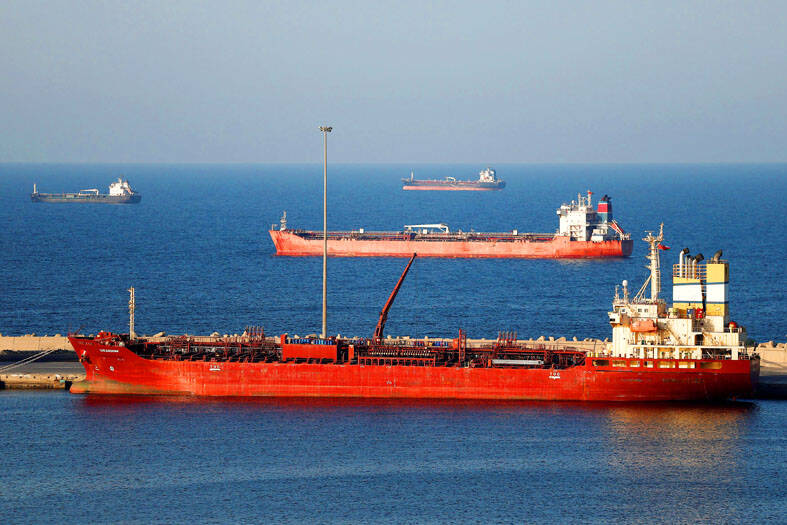
Photo: Reuters
The war in the Middle East has all but closed Hormuz, the narrow waterway linking the Persian Gulf to the open seas, to maritime traffic following Iranian threats to shipping. That has clogged up exports from the world’s top oil-producing region and helped drive prices in London to the highest close in more than two years at almost US$93 a barrel, sending consumers searching for alternatives and threatening to push global inflation higher.
Kuwait’s oil cutback started with about 100,000 barrels a day as of early Saturday and was expected to almost triple yesterday, with further gradual reductions depending on storage levels and the status of Hormuz, a person with direct knowledge of the plan said, asking not to be named, because the details are private.
The UAE, which pumped more than 3.5 million barrels a day as OPEC’s third-biggest producer in January, is using export capacity that bypasses the Strait of Hormuz and its international storage facilities to ensure supply to global markets.
ADNOC operates a 1.5 million barrel-a-day pipeline to Fujairah on the UAE’s western coast to avoid the Hormuz Strait.
The company said its onshore operations are continuing normally.
Cutbacks by the two OPEC members follow a swathe of others in the region. Iraq started holding back production earlier last week as storage tanks started filling up, while Saudi Arabia shut its biggest refinery, and Qatar closed the world’s largest liquefied natural gas export plant after drone attacks.
Kuwait Petroleum declared force majeure — a legal clause allowing a company not to fulfill contractual obligations because of circumstances outside its control — on sales of oil and refinery products, according to a notice seen by Bloomberg.
The country produced about 2.57 million barrels a day of oil in January, data compiled by Bloomberg showed.
The only route out for the supply is through the Strait of Hormuz. Saudi Arabia, the biggest producer in the region, has diverted some of its crude away from this route toward Yanbu in the Red Sea.
Kuwait had earlier begun lowering processing rates at its refineries because of the fuller tanks. The nation’s plants — Al-Zour, Mina al-Ahmadi and Mina Abdullah — have a combined capacity of about 1.4 million barrels a day. Al-Zour is one of the biggest oil-processing facilities in the Middle East.
US President Donald Trump said he expected crude prices to drop at the end of the war, which he called a “minor excursion” that was likely to continue “for a little while.”
“We figured oil prices would go up, which they will,” Trump told reporters aboard Air Force One on Saturday. “They’ll also come down. They’ll come down very fast, and we will have gotten rid of a major, major cancer on the face of the Earth.”
On Friday, US gasoline prices rose to the highest since September 2024. US crude futures ended the week above US$90 a barrel — more than US$20 higher than the previous week — and notched the biggest weekly percentage gain on record in data going back to the 1980s.

Nanya Technology Corp (南亞科技) yesterday said the DRAM supply crunch could extend through 2028, as the artificial intelligence (AI) boom has led the world’s major memory makers to dramatically reduce production of standard DRAM and allocate a significant portion of their capacity for high-bandwidth memory (HBM) chips. The most severe supply constraints would stretch to the first half of next year due to “very limited” increases in new DRAM capacity worldwide, Nanya Technology president Lee Pei-ing (李培瑛) told a news briefing. The company plans to increase monthly 12-inch wafer capacity to 20,000 in the first half of 2028 after a

Property transactions in the nation’s six special municipalities plunged last month, as a lengthy Lunar New Year holiday combined with ongoing credit tightening dampened housing market activity, data compiled by local land administration offices released on Monday showed. The six cities recorded a total of 10,480 property transfers last month, down 42.5 percent from January and marking the second-lowest monthly level on record, the data showed. “The sharp drop largely reflected seasonal factors and tighter credit conditions,” Evertrust Rehouse Co (永慶房屋) deputy research manager Chen Chin-ping (陳金萍) said. The nine-day Lunar New Year holiday fell in February this year, reducing
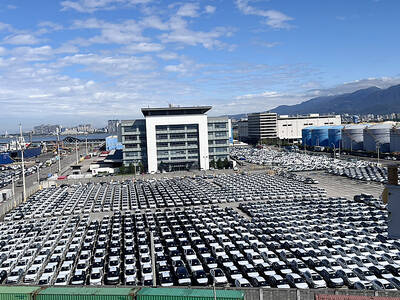
New vehicle sales in Taiwan plunged about 37 percent sequentially last month as the long Lunar New Year holiday and 228 Peace Memorial Day holiday cut short the number of working days, along with the lingering uncertainty over import tax cuts on US vehicles, market researcher U-Car said in a report yesterday. New car sales last month totaled 22,043, slumping from 35,073 units in January and down 19.89 percent from 37,515 in February last year, U-Car data showed. Sales of imported luxury cars, led by Mercedes-Benz, plummeted about 45 percent to 3,109 units last month from 5,663 units in the previous month,

RATIONING: The proposal would give the Trump administration ample leverage to negotiate investments in the US as it decides how many chips to give each country US officials are debating a new regulatory framework for exporting artificial intelligence (AI) chips and are considering requiring foreign nations to invest in US AI data centers or security guarantees as a condition for granting exports of 200,000 chips or more, according to a document seen by Reuters. The rules are not yet final and could change. They would be the first attempt to regulate the flow of AI chips to US allies and partners since US President Donald Trump’s administration said it rescinded its predecessor’s so-called AI diffusion rules. Those rules sought to keep a significant amount of AI


 RSS
RSS