


US officials are debating a new regulatory framework for exporting artificial intelligence (AI) chips and are considering requiring foreign nations to invest in US AI data centers or security guarantees as a condition for granting exports of 200,000 chips or more, according to a document seen by Reuters.
The rules are not yet final and could change. They would be the first attempt to regulate the flow of AI chips to US allies and partners since US President Donald Trump’s administration said it rescinded its predecessor’s so-called AI diffusion rules. Those rules sought to keep a significant amount of AI infrastructure buildout in the US and route most purchases through a handful of US cloud computing companies.
If adopted, the proposal would give the Trump administration ample leverage to negotiate investments in the US, one of Trump’s top priorities, as it decides how many AI chips to give to each country.
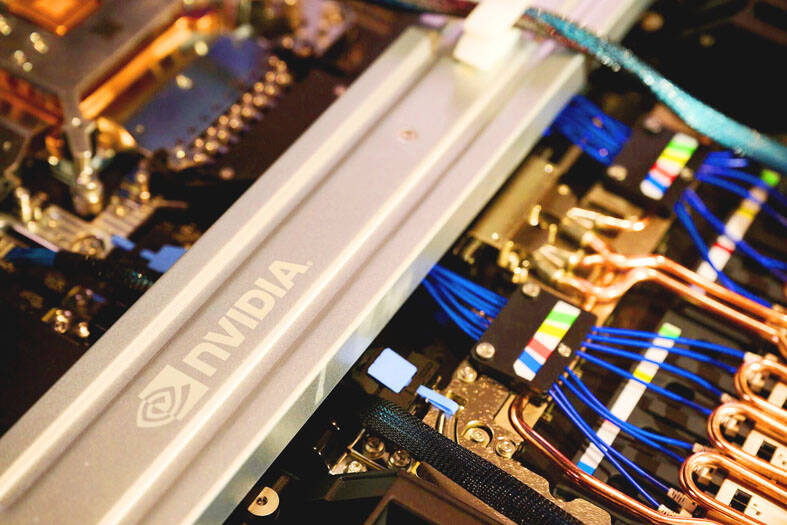
Photo: Bloomberg
The rules depart markedly from former US president Joe Biden’s approach, which was based on the premise that close US allies should be exempted from most restrictions on exports of the coveted chips.
The proposed rules would not affect blacklisted countries such as Russia, which cannot obtain US AI chips under rules set by the Biden administration. China, which was among those countries, got a greenlight in December to receive Nvidia’s second-most advanced AI chips. Those shipments have been held up by national security requirements that could convince China not to go through with the purchases.
According to a document seen by Reuters, even small chip installations of less than 1,000 chips could need a license.
To qualify for an exemption, the exporter of the chips, such as Nvidia or Advanced Micro Devices, would have to monitor them, and the recipient would have to agree to use software that would not allow the chips to be linked to other chips to form a “cluster,” it says.
Foreign firms that want up to 100,000 chips would need to provide government-to-government assurances, it says.
The Trump administration already required Saudi Arabia to provide such assurances in order to purchase advanced chips, it says.
Installations of up to 200,000 chips could also require visits from US export control officials, the document says.
“The rule could help the US government address chip diversion to China and ensure a more secure buildout of the most powerful AI supercomputers,” said Saif Khan, a former national security official in the Biden administration now at the Washington think tank Institute for Progress.
“But the license requirements are overly broad, applying globally, raising concerns that the administration intends to use the controls as negotiation leverage with allies rather than for security,” Khan said.
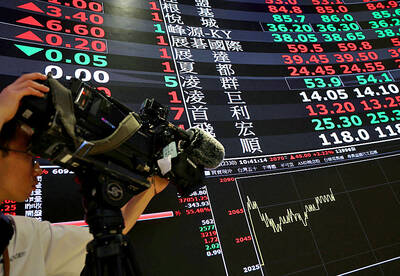
After several years flying high as Asia’s best Nvidia Corp proxy, Taiwan Semiconductor Manufacturing Co (TSMC, 台積電) is increasingly vying with other artificial intelligence (AI) stocks for investor attention. Stock traders are chasing a wider array of beneficiaries as mainstream usage of AI creates demand for hardware beyond the most-advanced chips TSMC makes for Nvidia. Subthemes from the deepening memory crunch to advances in robotics are also luring bids. At the same time, investment caps on single stocks are pushing funds to diversify, while retail investors long familiar with TSMC through its US depositary receipts are being offered a broader set of
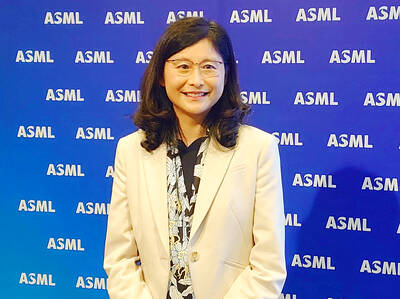
Netherlands-based semiconductor equipment supplier ASML Holding NV yesterday said that it is planning to hire an additional 1,000 people in Taiwan this year in response to growing demand from clients. ASML had previously planned to recruit 600 people this year, but that the plan has been adjusted upward, ASML vice president and ASML Taiwan general manager Grace Wang (汪佳慧) told reporters. ASML has a workforce of more than 4,500 in Taiwan, accounting for about 10 percent of its global total, Wang said. This year’s recruitment campaign would focus on adding people in the customer support, manufacturing and supply chain domains to assist ASML

UNDER MICROSCOPE: Taiwan detained three people who allegedly conspired to buy servers in Taiwan and export them using fraudulent documentation, prosecutors said Nvidia Corp chief executive officer Jensen Huang (黃仁勳) on Saturday urged Super Micro Computer Inc to tighten up on compliance after Taiwan detained three people this week for allegedly making fraudulent declarations about artificial intelligence (AI) servers made by its US partner. The development marked the nation’s first crackdown on semiconductor smuggling, which grew after the US slapped restrictions on exports of high-end chips such as Nvidia AI accelerators to China. Nvidia is “rigorous” in explaining regulations to all of its partners, Huang told reporters after arriving in Taipei. “Ultimately Super Micro has to run their own company,” he said in response to

Nvidia Corp yesterday announced that CEO Jensen Huang (黃仁勳) would attend an employee meeting in Taipei tomorrow to celebrate the launch of the company’s Taiwan headquarters project. Huang would attend a gathering at the site of Nvidia’s planned headquarters in Beitou Shilin Technology Park (北投士林科技園區), the company said in a statement. After arriving in Taiwan on Saturday last week, Huang told reporters that he plans to meet with Quanta Computer Inc (廣達) chairman Barry Lam (林百里) and Taiwan Semiconductor Manufacturing Co (TSMC, 台積電) chairman C.C. Wei (魏哲家), and would attend the groundbreaking ceremony for Nvidia’s Taiwan headquarters tomorrow. Nvidia has not yet applied


 RSS
RSS