


A new worry has been rippling across the stock market lately: Entire businesses, not just their employees, might be thrown out of work. While most economists say fears of an artificial intelligence (AI) job apocalypse are overblown, seismic shifts have happened in the past after big tech breakthroughs.
The IT revolution of the 1990s led to a surge in productivity that sped up the US economy for several years. It also rendered companies or even industries largely redundant — from travel agents and stockbrokers to classified advertising and newspapers, or video rental stores.
Economists expect AI would deliver higher productivity, which is key to raising growth rates in the long run.

Photo: AFP
However, investors are growing nervous about what damage might be done on the way, in capital markets as well as labor markets — especially because AI threatens disruptions on a broader scale than the Internet boom.
“Is this time bigger? Yes,” said Anton Korinek, an AI expert at the University of Virginia, adding that it is perhaps by a factor of 10 bigger.
“The key difference from the 1990s is that the Internet only disrupted information distribution,” Korinek said. “AI disrupts cognitive production at large. That’s a much bigger economic surface area.”
To be sure, all of this is early-days speculation over a fast-changing and largely untested technology, whose ultimate promise is to make workers more productive.
Productivity is essentially a measure of how much output workers can deliver with the available tools, so it tends to surge upward when someone invents important new ones such as the Internet or AI.
The trend has been ticking up. After big swings in the COVID-19 pandemic period, productivity has grown at an average pace of 2.6 percent since the start of 2023. That is more than double the average for the decade through 2019.
There is intense debate over how much of this acceleration is due to AI, but even analysts who reckon the new technology is not yet making a big contribution mostly expect it would do so before long.
A more productive workforce drives the kind of efficiency gains that can allow corporations and their employees to boost earnings, without triggering inflation. Historically, economies adapt to big tech breakthroughs — creating new industries and professions that nobody could have envisioned before — and living standards rise.
That is the long-run view — which smooths out lots of bumps on the road.
”Having some boom-bust in a sector is normal,” said Simon Johnson, the Nobel prize-winning economist at the Massachusetts Institute of Technology.
“Maybe even how it has to be,” he added.
However, as companies go under, it can create wider risks — especially if the failed businesses borrowed lots of money, Johnson said.
“What you don’t want is to infect the credit, and you definitely don’t want to get inside the banking system,” he added.
As of now, on US capital markets, what has become known as the “AI scare trade” is barely a blip.
The S&P 500 is up by about two-thirds since the release of ChatGPT in November 2022. A big chunk of those gains has been driven by the surging value of AI companies and their suppliers — giants such as Meta Platforms Inc and Nvidia Corp — which creates one set of risks if their technology disappoints.
However, there is another set — the one behind recent market wobbles — which is different. It stems from the possibility that AI does deliver the promised productivity leap, and then some. That idea, captured in a research note by the little-known firm Citrini, sent the S&P into a brief nosedive two weeks ago.
Citrini’s scenario of massive white-collar layoffs driven by AI was basically science fiction, set in 2028. There is no sign of anything like that now, with US unemployment at historically low levels.
Still, Columbia Business School’s Daniel Keum, who has studied how automation technologies such as AI change the balance within firms, said he saw signs of a shift.
Keum’s research, based on comments in earnings calls and annual reports, found that bosses become more likely to refer to their employees as costs, among other evidence of a tilt in power away from workers.
Even if companies are not yet cutting jobs or wages, they are trimming in areas such as healthcare, remote work and even free snacks, Keum said. “These side benefits is what the companies go after first, before they go after reducing your paycheck.”
When businesses can cut payroll costs, because technology enables them to do more with less, that is often good news for their profits and shareholders.
Take Block, the fintech firm run by Twitter founder Jack Dorsey, said on Feb. 26 that it was slashing almost half its staff in a bet on AI productivity.
Its shares are up more than 15 percent since then.
However, last month also offered an example of how productivity gains can have a downside for investors — involving the storied International Business Machines Corp (IBM). The start-up Anthropic said its AI tool can do something that once needed “armies of consultants”: modernize COBOL, a dated programming language run on IBM computers. IBM shares plunged the most in a quarter-century, before recouping most of the losses.
Past technology booms have seen household-name businesses fall by the wayside — such as camera-maker Kodak and video-rental chain Blockbuster, left behind by the Internet. It is all part of what the economist Joseph Schumpeter called the “creative destruction” which leads to progress. Federal Reserve Bank of Richmond President Tom Barkin referenced that phrase last week when asked if the Fed should be trying to counter AI disruption to businesses and the labor market.
“That’s been happening for hundreds of years in this country,” he said. “It’s part of the essence of capitalism.”
That is not necessarily reassuring for industries — and their investors and employees — confronting the short-term risk. Korinek listed some of them, including back-office services, content production, customer support, legal and financial analysis, and coding.
“Eventually, the disruption will extend to any firm whose competitive advantage lies in human expertise that AI can replicate,” he said. “The transition period may involve stranded assets, debt overhang and the potential for sharp market corrections.”
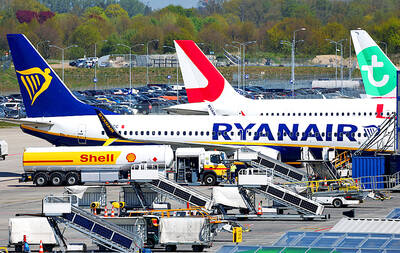
Ryanair, Transavia, Volotea and other low-cost airlines are feeling the financial pain from high jet fuel prices as a result of the Middle East war and are cutting flights. The closure of the Strait of Hormuz has taken a huge chunk of oil supplies off the market, sending the price of jet fuel soaring and triggering fears of shortages that could force airlines to cancel flights. Airlines are not waiting for a lack of supplies to react. “Travel alert: Airlines are cutting thousands of flights right now,” Travel Therapy host Karen Schaler said in an Instagram reel this past weekend.

MANAGING RISKS: Taiwan has secured LNG sufficient to cover 95 percent of electricity demand for next month, UBS said, describing the government’s approach as proactive UBS Group AG has raised its forecast for Taiwan’s economic growth this year to 8 percent, up from 6.9 percent previously, and said expansion could reach as high as 8.6 percent if external energy shocks are avoided. The upgrade reflects a stronger-than-expected first-quarter performance and sustained momentum in artificial intelligence (AI)-driven exports, which UBS said are providing a firm foundation for growth despite geopolitical and energy risks. Taiwan’s GDP expanded 13.69 percent year-on-year in the first quarter, the fastest growth since the second quarter of 1987, the Directorate-General of Budget, Accounting and Statistics (DGBAS) reported on Thursday. On a seasonally
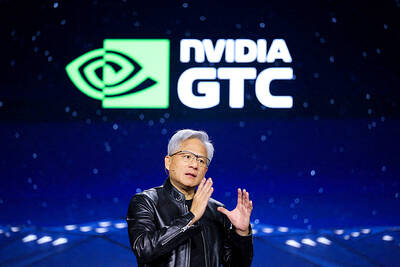
The list of Asian stocks that benefit from business partnership with Nvidia Corp is getting longer, as the region further integrates into the artificial intelligence (AI) chip giant’s business ecosystem. Just in the past week, South Korea’s LG Electronics Inc, Taiwan’s Nanya Technology Corp (南亞科技), as well as China’s Huizhou Desay SV Automotive Co (德賽西威) and Pateo Connect Technology Shanghai Corp (博泰車聯) have become the latest to rally on news of tie-ups, supply-chain participation or product collaboration with the US chip designer. Asian suppliers account for about 90 percent of Nvidia’s production costs, up from about 65 percent last year, data compiled

The Fair Trade Commission’s (FTC) ongoing review of Grab Holdings Ltd’s US$600 million acquisition of Foodpanda Taiwan’s operations, announced on March 23, has taken on fresh urgency as industry experts warn that the transaction could embed significant Chinese cybersecurity vulnerabilities into Taiwan’s digital infrastructure through Grab’s deep ties to autonomous-driving firm WeRide (文遠知行). Less than 16 months after the FTC blocked Uber Eats’ direct attempt to acquire Foodpanda Taiwan — citing potential combined market shares of 80 to 90 percent — the emergence of Grab as the buyer has prompted questions about whether the same competitive harm is simply being rerouted


 RSS
RSS