


Ryanair, Transavia, Volotea and other low-cost airlines are feeling the financial pain from high jet fuel prices as a result of the Middle East war and are cutting flights.
The closure of the Strait of Hormuz has taken a huge chunk of oil supplies off the market, sending the price of jet fuel soaring and triggering fears of shortages that could force airlines to cancel flights.
Airlines are not waiting for a lack of supplies to react.
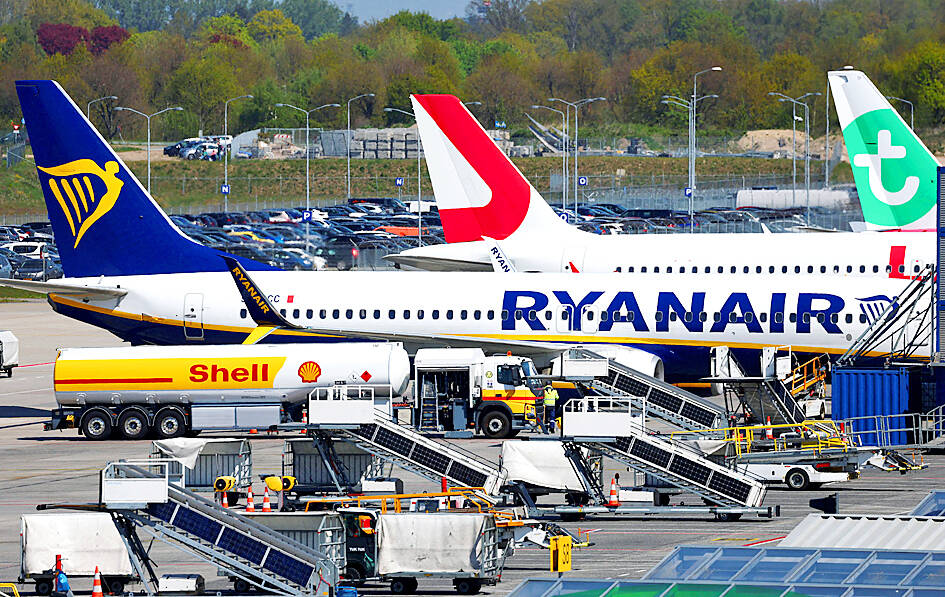
Photo: Reuters
“Travel alert: Airlines are cutting thousands of flights right now,” Travel Therapy host Karen Schaler said in an Instagram reel this past weekend.
“Book early,” Schaler added.
That advice would win the approval of Ryanair chief executive officer Michael O’Leary, who expressed concern last month that fears of fuel shortages were making people put off booking flights.
Low-cost carriers — which control a little more than one-third of the global market, according to various estimates — are feeling the pinch first due to the nature of their business model.
With cheaper tickets, they have less capacity to absorb the rise in fuel costs.
Some of the cancelations might be the normal adjustments airlines tend to make when demand does not meet expectations on certain routes.
“It is not unusual for carriers to adjust their schedules at this time of the year,” Goodbody financial analyst Dudley Shanley said.
However, “if jet fuel prices remain at this level, there will have to be a little bit more trimming for low-cost airlines,” he added.
If before the war airlines were able to maintain marginally profitable routes or even unprofitable routes, the surge in jet fuel prices would force them to make difficult choices.
That would start with many during the peak summer travel season.
“Unfortunately, it’s very likely that many people’s holidays will be affected, either by flight cancellations or very, very expensive tickets,” European Commissioner for Energy and Housing Dan Jorgensen told Sky News last month.
The speed with which airlines are reacting depends in part upon the extent to which they secured fuel supplies in advance at fixed prices.
European airlines tend to do this to a greater extent than their rivals in other parts of the world.
Air Transat, a low-cost Canadian airline, has cut 6 percent of its May-October flight schedule.
Southeast Asia’s largest low-cost carrier, AirAsia X, on Friday announced that it was cutting more flights and even some connections, without providing an overall figure.
Last month the Malaysia-based no-frills airline said that it was raising fares by up to 40 percent, and about 10 percent of its overall flights had been cut so far. Hungary’s low-cost airline Wizz Air has so far resisted cutting flights.
“We are not taking capacity out, because I think the other guys will take capacity out,” Wizz Air chief executive officer Jozsef Varadi was quoted as saying recently by trade magazine Aviation Week.
“You don’t have to run faster than the bear, but faster than the guy next to you,” he added.
He might have been thinking of the most spectacular cuts made in the industry by German group Lufthansa, which had just announced it was chopping 20,000 flights from its schedule through October, along with halting its regional feeder airline CityLine.
Its European rival, Air France-KLM, has trimmed 2 percent of flights in this month and next month at its low-cost Transavia subsidiary. KLM has kept cancelations down to 1 percent of its European flights.
Ryanair did not cite fuel prices, but high costs and taxes when announcing last month it would reduce flights to and from Berlin starting in October.
It is also cutting 10 percent of flights from Dublin, criticizing limited capacity at the airport.
Since the beginning of last month, Spain’s Volotea has trimmed about 1 percent of flights from its summer schedule.

SECOND-RATE: Models distilled from US products do not perform the same as the original and undo measures that ensure the systems are neutral, the US’ cable said The US Department of State has ordered a global push to bring attention to what it said are widespread efforts by Chinese companies, including artificial intelligence (AI) start-up DeepSeek (深度求索), to steal intellectual property from US AI labs, according to a diplomatic cable. The cable, dated Friday and sent to diplomatic and consular posts around the world, instructs diplomatic staff to speak to their foreign counterparts about “concerns over adversaries’ extraction and distillation of US AI models.” Distillation is the process of training smaller AI models using output from larger, more expensive ones to lower the costs of training a powerful new
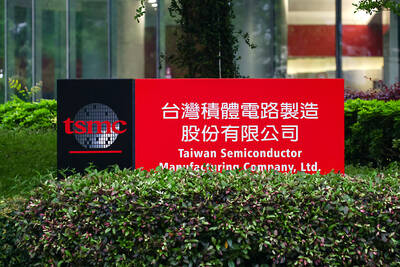
Shares of Taiwan Semiconductor Manufacturing Co (TSMC, 台積電) have repeatedly hit new highs, but an equity analyst said the stock’s valuation remains within a reasonable range and any pullback would likely be technical. The contract chipmaker’s historical price-to-earnings (P/E) ratio has ranged between 20 and 30, Cathay Futures Consultant Co (國泰證期) analyst Tsai Ming-han (蔡明翰) told Central News Agency. With market consensus projecting that TSMC would post earnings per share of about NT$100 (US$3.17) this year, supported by strong global demand for artificial intelligence (AI) applications, and the stock currently trading at a P/E ratio of below 25, Tsai said the valuation

The artificial intelligence (AI) boom has triggered a seismic reshuffling of global equity markets, with Taiwan and South Korea muscling past European nations one by one. With its stock market now valued at nearly US$4.3 trillion, Taiwan surpassed the UK, Europe’s biggest market, earlier this month, data compiled by Bloomberg showed. South Korea is about US$140 billion away from doing the same. The tech-heavy Asian markets have shot past Germany and France in the past seven months. The shift is largely down to massive gains in shares of three companies that provide essential hardware for AI: Taiwan Semiconductor Manufacturing Co (TSMC, 台積電),

The US Department of Commerce last week ordered multiple chip equipment companies to halt shipments of certain tools to China’s second-largest chipmaker, Hua Hong Semiconductor Ltd (華虹半導體), its latest action to slow the country’s development of advanced chips, two people familiar with the matter said. The department sent letters to at least a handful of companies informing them of restrictions on tools and other materials destined for two Hua Hong facilities US officials believe make China’s most sophisticated chips, the people said. Top US chip equipment companies Lam Research Corp, Applied Materials Inc and KLA Corp, each of which has significant


 RSS
RSS