


The list of Asian stocks that benefit from business partnership with Nvidia Corp is getting longer, as the region further integrates into the artificial intelligence (AI) chip giant’s business ecosystem.
Just in the past week, South Korea’s LG Electronics Inc, Taiwan’s Nanya Technology Corp (南亞科技), as well as China’s Huizhou Desay SV Automotive Co (德賽西威) and Pateo Connect Technology Shanghai Corp (博泰車聯) have become the latest to rally on news of tie-ups, supply-chain participation or product collaboration with the US chip designer.
Asian suppliers account for about 90 percent of Nvidia’s production costs, up from about 65 percent last year, data compiled by Bloomberg showed.
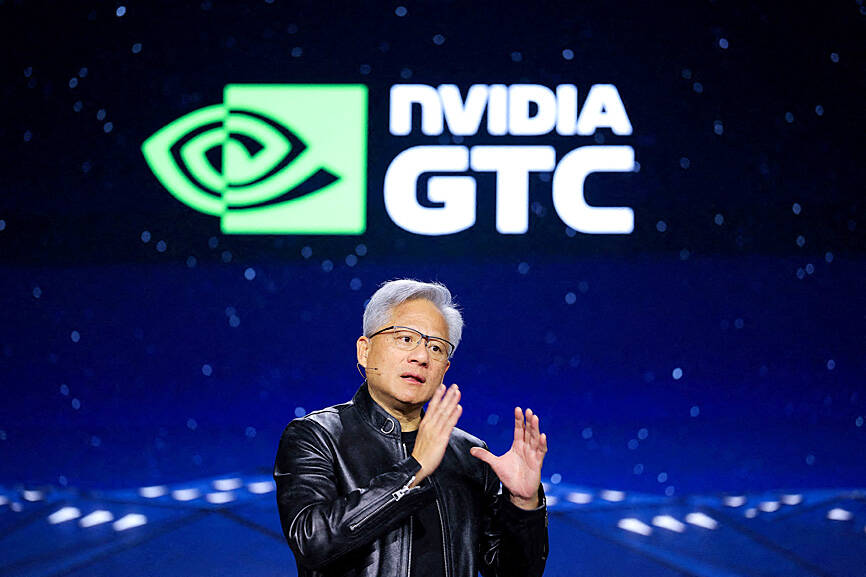
Photo: Reuters
The explosive growth of the chip designer’s products has intensified its reliance on Asian partners that dominate manufacturing, assembly and key components.
“It’s inevitable that global tech companies like Nvidia will continue to ramp up their reliance on Asia supply chain,” Union Bancaire Privee SA managing director Ling Vey-sern (凌煒森) said.
Physical AI “can add on top of the already burgeoning demand from Asia’s supply chains for AI chips,” he added.
Nvidia has expanded its roster of Asian partners over the past few years, primarily through deeper chip-focused ties with suppliers such as Taiwan Semiconductor Manufacturing Co (台積電), SK Hynix Inc and Samsung Electronics Co. While those partnerships concentrated on scaling AI computing power, the latest wave of collaborations in the region pointed to a shift beyond semiconductors into physical AI.
The company’s push into physical AI — spanning robotics, autonomous systems and AI-enabled manufacturing — extends its influence beyond chips into real-world deployment, positioning Asia as a critical partner in that expansion.
Nvidia CEO Jensen Huang (黃仁勳) has framed physical AI as the next wave after generative AI.
“Increasing and broadening demand is creating opportunities across industries for more tech suppliers to join the supply chain as AI buildout continues globally,” Bloomberg Intelligence strategist Marvin Chen (陳明康) said. “It means that tech heavy north Asian markets may continue to outperform.”
The latest capital expenditure guidance from US tech giants showed that AI spending is accelerating, with Amazon.com Inc, Microsoft Corp and Alphabet Inc each committing about US$190 billion to US$200 billion for this year, and Meta Platforms Inc raising its outlays to as much as US$145 billion.
Nvidia accounts for about half of Microsoft’s capital expenditure and roughly one-quarter of Amazon’s, with a smaller but still leading share at Meta and Alphabet, based on calculations of data compiled by Bloomberg.
Meanwhile, Hon Hai Precision Industry Co (鴻海精密), known internationally as Foxconn Technology Group (富士康科技集團), is a consistent secondary beneficiary, particularly at Microsoft and Amazon, while SK Hynix takes a mid-single-digit share across companies.
“Asia’s technology base is a structurally important advantage, particularly as AI creates new demand across semiconductors, components, servers and broader hardware infrastructure,” Gama Asset Management SA portfolio manager Rajeev De Mello said. “Asia has already developed significant experience and supply chains to build advanced semiconductors and robots, which is a strong base for implementing physical AI.”
Shares of Taiwan Semiconductor Manufacturing Co (TSMC, 台積電) have repeatedly hit new highs, but an equity analyst said the stock’s valuation remains within a reasonable range and any pullback would likely be technical. The contract chipmaker’s historical price-to-earnings (P/E) ratio has ranged between 20 and 30, Cathay Futures Consultant Co (國泰證期) analyst Tsai Ming-han (蔡明翰) told Central News Agency. With market consensus projecting that TSMC would post earnings per share of about NT$100 (US$3.17) this year, supported by strong global demand for artificial intelligence (AI) applications, and the stock currently trading at a P/E ratio of below 25, Tsai said the valuation
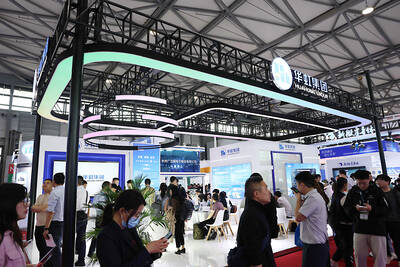
The US Department of Commerce last week ordered multiple chip equipment companies to halt shipments of certain tools to China’s second-largest chipmaker, Hua Hong Semiconductor Ltd (華虹半導體), its latest action to slow the country’s development of advanced chips, two people familiar with the matter said. The department sent letters to at least a handful of companies informing them of restrictions on tools and other materials destined for two Hua Hong facilities US officials believe make China’s most sophisticated chips, the people said. Top US chip equipment companies Lam Research Corp, Applied Materials Inc and KLA Corp, each of which has significant
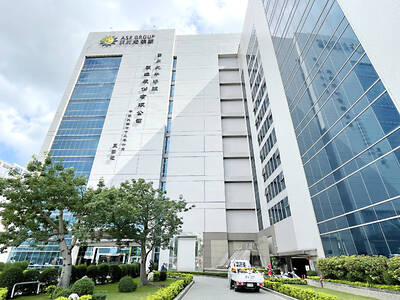
‘HEAVY SPENDING’: Net profit last quarter beat company predictions at 87 percent, with an extra US$1.5 billion to be spent on new facilities, the company said ASE Technology Holding Co (日月光投控) yesterday raised its capital expenditure for this year by 20 percent in response to stronger customer demand for leading-edge advanced packaging (LEAP) this year and next. The company, headquartered in Kaohsiung, plans to spend US$1.5 billion on new facilities and machinery equipment this year on top of an estimate of US$7 billion made in February, it said. ASE has not ruled out the possibility of hiking spending again this year, the company said, adding that it expects another “heavy spending” year next year. LEAP services revenue is expected to grow 10 percent to US$3.5 billion this year, ASE
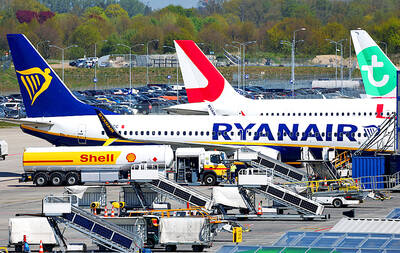
Ryanair, Transavia, Volotea and other low-cost airlines are feeling the financial pain from high jet fuel prices as a result of the Middle East war and are cutting flights. The closure of the Strait of Hormuz has taken a huge chunk of oil supplies off the market, sending the price of jet fuel soaring and triggering fears of shortages that could force airlines to cancel flights. Airlines are not waiting for a lack of supplies to react. “Travel alert: Airlines are cutting thousands of flights right now,” Travel Therapy host Karen Schaler said in an Instagram reel this past weekend.


 RSS
RSS