


Japanese Prime Minister Sanae Takaichi’s comment last year on Tokyo’s potential reaction to a Taiwan-China conflict has forced Beijing to rewrite its invasion plans, a retired Japanese general said.
Takaichi told the Diet on Nov. 7 last year that a Chinese naval blockade or military attack on Taiwan could constitute a “survival-threatening situation” for Japan, potentially allowing Tokyo to exercise its right to collective self-defense.
Former Japan Ground Self-Defense Force general Kiyofumi Ogawa said in a recent speech that the remark has been interpreted as meaning Japan could intervene in the early stages of a Taiwan Strait conflict, undermining China’s previous assumptions for military action against Taiwan and compelling it to revise its plans.
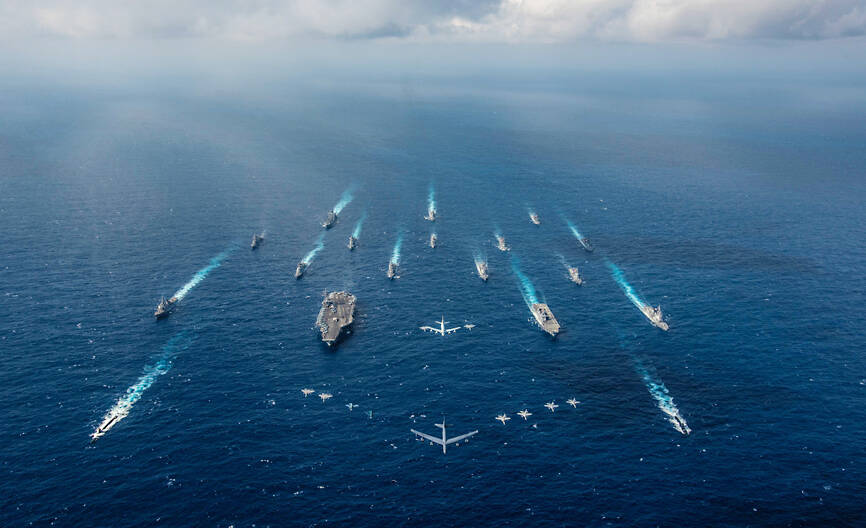
Photo: Reuters
Ogawa, a former commander of the Japan Ground Self-Defense Force’s Western Army who is now a researcher at a Japanese think tank, said China’s military operations against Taiwan could broadly be divided into three phases.
The first phase would involve peacetime operations, with Beijing using cognitive warfare to create public panic while massing forces under the guise of military drills and surrounding Taiwan with warships to deter foreign intervention and impose a blockade.
The second phase would see exercises transition into actual combat, with missile strikes targeting Taiwan’s military facilities and cyberwarfare aimed at crippling command systems.
The third phase would involve a full-scale amphibious landing after China had secured air and naval superiority, he said.
During a House of Representatives Budget Committee session in November last year, Takaichi was asked what circumstances would be considered a “survival-threatening situation” if the Taiwan Strait were blockaded.
She said that if Taiwan were attacked militarily and warships were used to impose a maritime blockade alongside other measures, it could constitute such a scenario and justify the use of force.
Ogawa said the key to China’s strategy is securing a quick victory before outside powers such as the US and Japan can intervene.
However, Takaichi’s remarks effectively moved the threshold for a “survival-threatening situation” forward to the first-stage blockade scenario.
That would be a major blow to China, as its original plans were based on avoiding foreign intervention before the third phase, he said.
Under the new interpretation, it could face intervention from Japan and the US from the outset.
Military operational planning is typically based on assumptions about how a conflict would unfold, Ogawa said.
Once those assumptions change, troop deployments and operational plans must also be revised, he said.
If foreign intervention is now expected earlier, China would have to reassess the overall pace of an invasion and the allocation of forces, he said, adding that this is why Takaichi’s remarks had major strategic significance and triggered a strong backlash from China.
Ogawa added that under general military principles, an attacking force typically needs at least three times the strength of the defender to break through defenses effectively.
Based on the Taiwanese army’s strength of about 100,000 troops, China would need to mobilize at least 300,000 soldiers for an amphibious assault, while also bearing enormous transportation and logistical burdens, increasing the difficulty of such an operation, he said.
Taiwan, by contrast, has adopted a strategy of protracted warfare and in-depth defense, using coastal and layered defensive systems to buy time while awaiting outside support, creating a sharp contrast with China’s concept of a swift victory.
Even if China were to seize Taiwan, it would still face follow-up pressure from Japan, the Philippines and US forces, and would need to deploy additional resources toward Okinawa and the Philippines, potentially widening the conflict further, Ogawa said.
Overall, it would be highly difficult for China to take Taiwan easily, he said.


UPGRADE: The Kang Ding-class frigate is replacing its Chaparall missiles with Tien Chien II and Hua Yang VLS, which would provide it with long-range, 360° air defense Taiwan plans to produce 1,200 to 1,376 Hai Chien II missiles (海劍二, Sea Sword II) — also known as TC-2N — to serve as the standard air defense system of the navy’s surface combatant fleet, a source said yesterday. Last week, the Hai Chien II, the naval version of the Tien Kung II missile (天劍二, Sky Sword II), completed a live-fire test in waters off the National Chungshan Institute of Science and Technology’s Jiupeng facility (九鵬) in Pingtung County’s Manjhou Township (滿州). The MIM72 Chaparral and other dated air defense missiles that currently arm Taiwanese ships have inadequate range to combat Chinese

REASONS FOR TRAVEL: An assistant professor said that proposed amendments to penalize drivers if they used drugs overseas would not deter people from traveling People who operate a motor vehicle under the influence of marijuana would have their driver’s license revoked, even if they used the substance while overseas, the Ministry of Transportation and Communications said yesterday, citing proposed amendments to the Road Traffic Management and Penalty Act (道路交通管理處罰條例). The amendments would also authorize the government to revoke the licenses of people determined to have used Category 1 or Category 2 narcotics, even if they were not operating a vehicle while under the influence of drugs, as well as ban them from taking the license test for three years, the ministry said. People aged 18 or

Johanne Liou (劉喬安), a Taiwanese woman who shot to unwanted fame during the Sunflower movement protests in 2014, returned to Taiwan last night after being deported from the US. She is to stand trial in Taiwan for charges involving embezzlement, fraud and drug crimes. The Criminal Investigation Bureau (CIB) said it took her into custody at Taiwan Taoyuan International Airport and would first question her before transferring her to the New Taipei District Prosecutors’ Office. She was arrested upon disembarking a flight from San Francisco that landed shortly before 7pm. Liou absconded to the US in 2019 after jumping bail
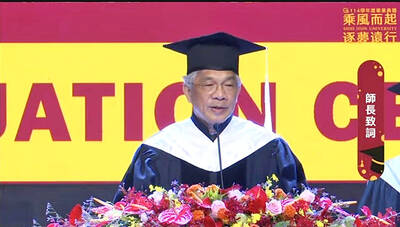
Shih Hsin University President Chen Ching-he (陳清河) yesterday issued a public apology for comments made in his commencement speech last week, stating that he has asked the school to suspend his duties and halt his wages for two months as a show of contrition. At the commencement ceremony on May 30, Chen said, “If you don’t manage your time well, or your own emotions, or your health, then I am telling every one of you — put a quick end to ‘you,’ because the world has no need for ‘you.’” The comments have sparked significant controversy online, and Chen through an open


 RSS
RSS