


The Fair Trade Commission’s (FTC) ongoing review of Grab Holdings Ltd’s US$600 million acquisition of Foodpanda Taiwan’s operations, announced on March 23, has taken on fresh urgency as industry experts warn that the transaction could embed significant Chinese cybersecurity vulnerabilities into Taiwan’s digital infrastructure through Grab’s deep ties to autonomous-driving firm WeRide (文遠知行).
Less than 16 months after the FTC blocked Uber Eats’ direct attempt to acquire Foodpanda Taiwan — citing potential combined market shares of 80 to 90 percent — the emergence of Grab as the buyer has prompted questions about whether the same competitive harm is simply being rerouted through a complex web of interlocking stakes, board seats and a still-active non-compete agreement.
UBER’S SHADOW OVER THE DEAL
Photo: Taipei Times file photo
Uber Technologies Inc remains structurally entwined with Grab. CEO Dara Khosrowshahi has served continuously on Grab’s board since 2018 — precisely the type of interlocking directorate US antitrust law has long prohibited between competitors. Uber also holds approximately 13.2 percent of Grab’s ordinary shares (5.7 percent of voting rights) and, because the stake exceeds 10 percent, filed a Schedule 13D with the US Securities and Exchange Commission (SEC), a legally operative admission that its investment is held with the purpose of exerting influence rather than as a passive investor.
A non-compete agreement between Uber and Grab remains legally effective to this day; under Grab’s 2021 SEC filings, it expires no earlier than one year after Uber disposes of all its Grab shareholdings. Since Uber continues to hold roughly 13 percent, the restriction has never lapsed.
The non-compete arrangement traces back to Uber’s 2018 sale of its Southeast Asian operations to Grab. In Infringement Decision No. 500/001/18, Singapore’s Competition and Consumer Commission (CCCS) concluded that the transaction itself caused Uber’s immediate exit from the market — not a prior decision to withdraw — and that Grab’s payment of over 27 percent equity as consideration directly refuted any claim that Uber would have left regardless. Observers note that the current structure could allow similar competitive dynamics to re-emerge through indirect channels.
The structure grew even more intricate on April 17, when Uber acquired an additional 4.5 percent of Delivery Hero SE — Foodpanda’s German parent company — bringing its total stake to approximately 7 percent. This creates what experts describe as a “triangular stake”: Uber is now simultaneously a shareholder of both the buyer (Grab) and the seller (Delivery Hero), while Uber Eats continues to operate as the nominal competitor in Taiwan.
“The interlocking directorates and the still-effective non-compete agreement are mutually reinforcing, and the triangular shareholding structure allows Uber to benefit from both sides of the transaction through capital linkages alone,” Taiwan Food Delivery Industry Rights Promotion Alliance spokesperson Su Po-hao (蘇柏豪) said. “If these competition law concerns are confirmed, the downstream regulatory consequences — including mandatory divestiture of Uber’s stake in Grab, a prohibition on interlocking directorates, and the launch of a cross-agency cybersecurity review — could extend well beyond this transaction and set off a chain reaction across Southeast Asia.”
WERIDE CYBERSECURITY GAP MORE CONCEALED THAN AMAP
If complex shareholding structures and non-compete parties aren’t complicated enough for the deal, their shared decision to both invest in a Hong Kong initial public offering (IPO) will certainly raise the eyebrow of Taiwanese government. Both Grab and Uber are strategic anchor investors in WeRide, which completed its Hong Kong IPO last year. WeRide’s Form 20-F filed with the US SEC on April 23 discloses three material facts that have alarmed Taiwan’s national security community.
First, WeRide outsources all high-definition map collection, storage and transmission to Guangzhou Yuji (廣州禹跡) — a company substantially controlled by the WeRide CEO’s own brother — with all operations conducted within China’s legal framework and all data stored in a Guangzhou data center.
Second, WeRide has received conditional government subsidies from Chinese authorities exceeding 192 million yuan, the “timing, amount and criteria” of which are “determined within the sole discretion of the local government authorities,” giving Beijing effective financial leverage over WeRide’s data compliance conduct.
Third, GrabMaps has signed a memorandum of cooperation with Huawei Technologies Co’s (華為) Petal Maps, supplying it with high-definition Southeast Asian mapping data. Huawei appears on the US Department of Commerce Entity List and is obligated under Article 7 of China’s National Intelligence Law to support state intelligence operations.
Taiwan’s Ministry of Digital Affairs recently classified AMap (高德地圖) as a product hazardous to national cybersecurity precisely because “under Chinese law, the Chinese government has the right to access corporate data, and location and movement data are transmitted back to servers in China.” Experts say the WeRide architecture presents an even greater risk due to its concealment and scale.
“The WeRide architecture that Grab’s acquisition introduces into the Taiwan market has a concealment and scale that far exceed those of AMap,” Market Intelligence & Consulting Institute senior strategy director Wang Jui-min (王瑞民) said. “None of these three data channels involves direct Chinese equity, none appears in any shareholding registry, and all fall outside the current review frameworks of Department of Investment Review (DIR) and FTC. Coordinated action by the FTC, the DIR and the National Security Council is imperative.”
The FTC has already required Grab to submit additional materials, signaling that the review has entered a substantive phase. As Su Po-hao noted, regulators “should consider whether requiring Uber to divest its Grab shareholding and terminate the interlocking directorate is a prerequisite before any discussion of approval can meaningfully proceed.”
The commission, which has a guideline to complete review in 30 days and extendable for another 60 days, is likely to adhere to ruling party’s mandate to safeguard Taiwan against China influence and filtration.
“The regulatory barrier established by the Fair Trade Commission’s rejection of Uber Eats’ acquisition of Foodpanda in December 2024 should not be easily circumvented simply because of the change in transaction structure in Grab’s acquisition of Foodpanda. The Fair Trade Commission must strictly oversee this matter and must not allow Taiwan’s food delivery market to become a pawn that can be easily devoured on the chessboard of transnational platform capital,” Democratic Progressive Party Legislator Tsai Yi-yu (蔡易餘) said.
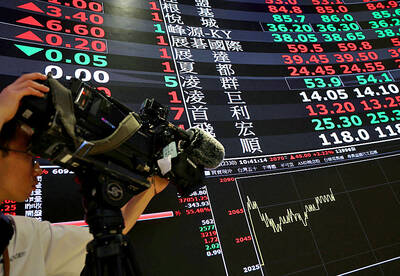
After several years flying high as Asia’s best Nvidia Corp proxy, Taiwan Semiconductor Manufacturing Co (TSMC, 台積電) is increasingly vying with other artificial intelligence (AI) stocks for investor attention. Stock traders are chasing a wider array of beneficiaries as mainstream usage of AI creates demand for hardware beyond the most-advanced chips TSMC makes for Nvidia. Subthemes from the deepening memory crunch to advances in robotics are also luring bids. At the same time, investment caps on single stocks are pushing funds to diversify, while retail investors long familiar with TSMC through its US depositary receipts are being offered a broader set of
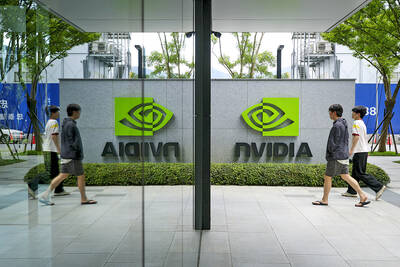
UNDER MICROSCOPE: Taiwan detained three people who allegedly conspired to buy servers in Taiwan and export them using fraudulent documentation, prosecutors said Nvidia Corp chief executive officer Jensen Huang (黃仁勳) on Saturday urged Super Micro Computer Inc to tighten up on compliance after Taiwan detained three people this week for allegedly making fraudulent declarations about artificial intelligence (AI) servers made by its US partner. The development marked the nation’s first crackdown on semiconductor smuggling, which grew after the US slapped restrictions on exports of high-end chips such as Nvidia AI accelerators to China. Nvidia is “rigorous” in explaining regulations to all of its partners, Huang told reporters after arriving in Taipei. “Ultimately Super Micro has to run their own company,” he said in response to
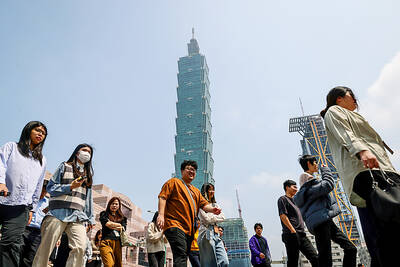
TECH RELIANCE: Growth is increasingly reflecting an unequal K-shaped distribution, where technology sectors outperform and other industries struggle, an expert said Standard Chartered Bank has significantly raised its forecast for Taiwan’s economic growth to 9.5 percent this year, up from 7.6 percent previously, citing surging artificial intelligence (AI) demand driving exports, semiconductor production and investment. The upgrade reflects a sustained AI supercycle that continues to fuel demand for advanced chips and technology infrastructure, which form the backbone of Taiwan’s exports, the bank said in a report this week. “We raise our 2026 growth forecast to reflect a much stronger-than-expected first-quarter GDP figure,” Standard Chartered senior economist for greater China and Asia Tommy Wu (胡東安) said in the report. Driven largely by a 35.3 percent

Two of Taiwan’s international carriers, Starlux Airlines Co (星宇航空) and EVA Airways Corp (長榮航空), have retained the five-star airline rating awarded by international airline review organization Skytrax. Starlux was awarded the distinction for a second consecutive year, while EVA Air received it for the 11th straight year, Skytrax said in statements released yesterday and on Thursday last week, respectively. The five-star rating is considered one of the airline industry's highest honors and is awarded following professional audits of airline product and frontline service standards, Skytrax said. The ratings are based on in-depth assessments using unified global quality standards rather than customer review scores


 RSS
RSS