


Last week gave us the droll little comedy of People’s Republic of China’s (PRC) consul general in Osaka posting a threat on X in response to Japanese Prime Minister Sanae Takaichi saying to the Diet that a Chinese attack on Taiwan may be an “existential threat” to Japan. That would allow Japanese Self Defence Forces to respond militarily. The PRC representative then said that if a “filthy neck sticks itself in uninvited, we will cut it off without a moment’s hesitation. Are you prepared for that?”
This was widely, and probably deliberately, construed as a threat to behead Takaichi, though it was probably intended as a violent metaphor describing how the PRC would destroy any attempt by Japan to intervene, not a personal threat to Takaichi. The PRC representative later deleted his post, which was again widely read as a confession of guilt.
Beijing was also whining because Takaichi had met Lin Hsin-i (林信義), Taiwan’s envoy at the APEC summit in South Korea, and posted a picture of the meeting on X.
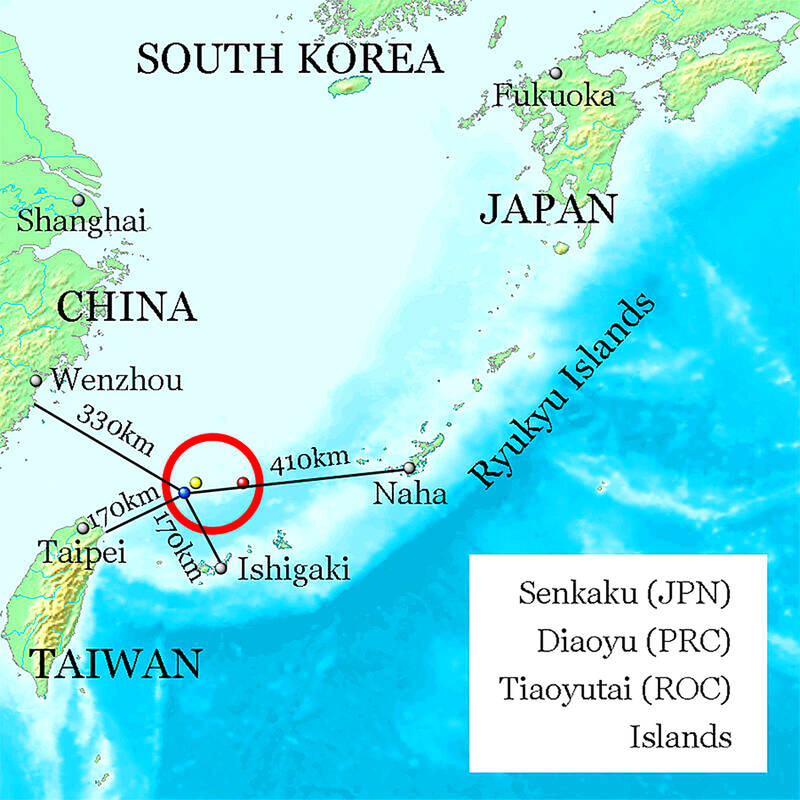
Photo courtesy of Wikimedia Commons
It is important to situate Takaichi, usually portrayed as a hawk or hardliner, as part of the mainstream evolution in Japanese security thinking. Indeed, her comments on Taiwan and on softening a key principle of Japan’s anti-nuclear principles have long had support in Japanese security circles. For example, in 2017 future Prime Minister Shigeru Ishiba, called for an Asian version of NATO, which likely would have required stationing US nuclear weapons in Japan. Takaichi’s comments about Taiwan are also supported by much of the Japanese public.
Japan has also made many other moves to signal that it would intervene in an invasion or blockade of Taiwan. In March, it unveiled a plan to evacuate 20,000 people a day over six days from the island municipalities of Ishigaki, Miyako, Taketomi, Yonaguni and Tarama east of Taiwan. Japan administrates them as part of Okinawa prefecture. The government also announced plans to place missiles on those islands.
These decisions are fruit of over a decade of PRC threats to attack Japan over the Senkaku Islands — known as the Diaoyutai Islands (釣魚台) in Taiwan — and Okinawa, and its creeping sovereignty claims and incursions, typified by the Air Defense Identification Zone (ADIZ) it announced in November of 2013 that included the Senkakus. That event opened many eyes in Japan. The continual presence of PRC ships in the waters off Okinawa and Senkakus has also forced Japan to reshape its military presence in the area.
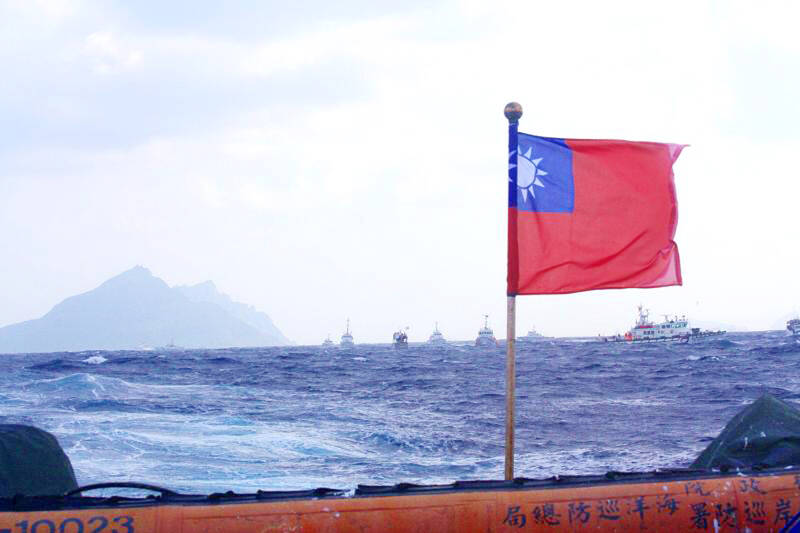
Photo: Chiang Chih-hsiung, Taipei Times
OBVIOUS THREAT
Takaichi was simply pointing out the obvious: a PRC occupation of Taiwan is a mortal threat to Japan. Taiwan sits astride the sea lanes to Japan. Its economy is closely linked to Japan’s. Moreover, the PRC has promised follow-on wars against Japan over the Senkakus and Okinawa once it occupies Taiwan, and it will likely cast longing glances at the Japanese islands to the east of Taiwan as well.
Commentators have often discussed a PRC blockade of Taiwan as a cheaper but still effective alternative to a full-blown invasion. However, any blockade would likely require PRC military ships and aircraft operating routinely in Japanese air and sea spaces, something no power can tolerate. It would also cut off Japan’s trade with Taiwan, worth US$72 billion last year.
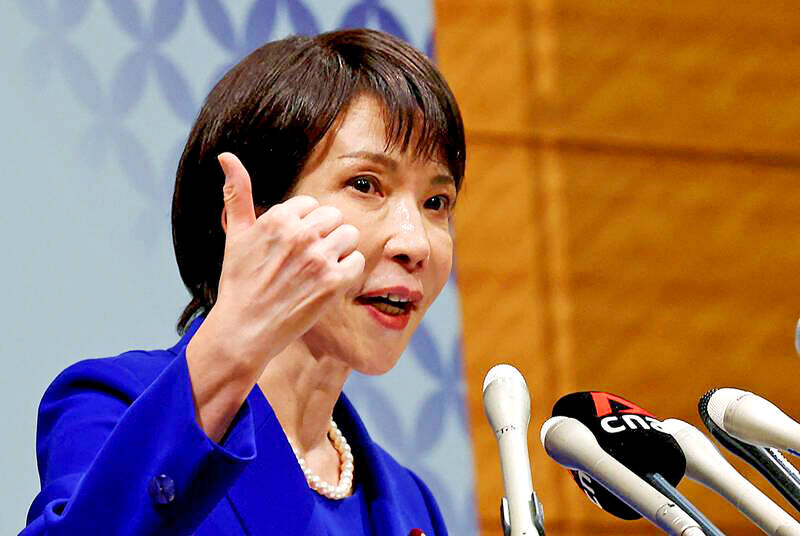
Photo: Reuters
Many experts are skeptical of the possibility of a PRC blockade, simply because it gives Taipei an indefinite amount of time to respond, while sympathy builds for Taiwan. That is in part why PRC doctrine calls for attacks on key infrastructure as part of a blockade, to induce Taipei to capitulate before the blockade goes on too long.
Yet, it should also be noted that the amount of time required for a successful blockade presents temptations for the aggressor to expand it. Given the PRC’s fake history, would a PRC blockade include the Senkaku Islands? In PRC propaganda, the Senkakus are connected to Taiwan. A China Daily piece from 2004 reviews the complete Chinese expansionist set of claims on the Senkakus, observing that “China has historically viewed the Diaoyu [Senkakus] as part of the Chinese province of Taiwan.” It even says that the islands are “part of the Chinese continental shelf.”
These claims are commonly made by the PRC’s Republic of China (ROC) true believer counterparts, including former president Ma Ying-jeou (馬英九), who produced a thesis arguing that the Senkakus belong to China. In an Associated Press Interview on this issue in 2010, Ma said the Senkakus “are geologically connected with Taiwan. They are separate from the continental shelf of Taiwan and the mainland, away from the Ryukyu Islands [Okinawa].”
This ideological catechism suggests that the PRC, if not from the beginning of a blockade, will eventually expand the blockade to include the Senkakus, which it routinely states are Chinese territory. Indeed, since including them in the blockade will reinforce the view that the islands are Chinese, the temptation may be irresistible to PRC planners.
Are PRC planners more likely to expand the blockade to include the Senkakus if Japan does not intervene, responding to a signal of weakness? Or if Japan does intervene, to punish Tokyo? Or will the PRC do it to deliberately provoke a war with Japan? Either way, not enough thinking — and I suspect, gaming — of this issue has been done by writers imagining a PRC blockade of Taiwan.
The Senkakus are important because US leaders have repeatedly stated that they lie within the purview of the US-Japan Treaty of Mutual Cooperation and Security. This adds another layer to the Senkaku Islands issue. If the PRC attempts to include them in a blockade, will the US regard that as triggering the defense treaty? The PRC claim that the islands are part of Taiwan gives a US president the ability to evade coming to their defense, especially if the US has decided not to intervene in a blockade.
‘GRAY ZONE’ ACTIVITIES
At the same time, south of Taiwan, PRC air and sea units will be operating in the Philippines air and sea spaces, areas they already contest via “gray zone” activities in the South China Sea. PRC lust for islands in the Bashi Channel may well tempt Beijing to expand a blockade to Batanes, which a few true believer Chinese expansionists have long argued belong to Taiwan. For years Beijing has been trying to get a “smart city” economic and tourism complex built on Fuga Island, just north of the coast of Luzon. Since the national security implications are obvious (the PRC has also tried to do the same on Grande and Chiquita islands in Subic Bay), instead, a military base is going in there.
The US also has a mutual defense treaty with the Philippines, implying that Washington will face the same set of choices south of Taiwan as it does to the north in a PRC blockade.
We have already seen the PRC’s slowly expanding “gray zone” activities in real time with. Once the ships are out there, interdicting trade routes right next to islands the PRC covets, the temptation to expand their presence will only grow.
Notes from Central Taiwan is a column written by long-term resident Michael Turton, who provides incisive commentary informed by three decades of living in and writing about his adoptive country. The views expressed here are his own.
A recent report from the Environmental Management Administration of the Ministry of Environment highlights a perennial problem: illegal dumping of construction waste. In Taoyuan’s Yangmei District (楊梅) and Hsinchu’s Longtan District (龍潭) criminals leased 10,000 square meters of farmland, saying they were going to engage in horticulture. They then accepted between 40,000 and 50,000 cubic meters of construction waste from sites in northern Taiwan, charging less than the going rate for disposal, and dumped the waste concrete, tile, metal and glass onto the leased land. Taoyuan District prosecutors charged 33 individuals from seven companies with numerous violations of the law. This

As mega K-pop group BTS returns to the stage after a hiatus of more than three years, one major market is conspicuously missing from its 12-month world tour: China. The omission of one of the group’s biggest fan bases comes as no surprise. In fact, just the opposite would have been huge news. China has blocked most South Korean entertainment since 2016 under an unofficial ban that also restricts movies and the country’s popular TV dramas. For some Chinese, that means flying to Seoul to see their favorite groups perform — as many were expected to do for three shows opening
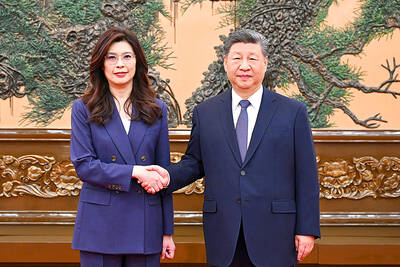
What is the importance within the Chinese Nationalist Party (KMT) of the meeting between Xi Jinping (習近平), the leader Chinese Communist Party (CCP), and Cheng Li-wun (鄭麗文), the leader of the KMT? Local media is an excellent guide to determine how important — or unimportant — a news event is to the public. Taiwan has a vast online media ecosystem, and if a news item is gaining traction among readers, editors shift resources in near real time to boost coverage to meet the demand and drive up traffic. Cheng’s China trip is among the top headlines, but by no means
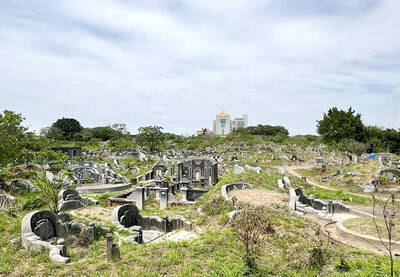
Apr. 13 to Apr. 19 From 17th-century royalty and Presbyterian missionaries to White Terror victims, cultural figures and industrialists, Nanshan Public Cemetery (南山公墓) sprawls across 95 hectares, guarding four centuries of Taiwan’s history. Current estimates show more than 60,000 graves, the earliest dating to 1642. Besides individual tombs, there are also hundreds of family plots, one of which is said to contain around 1,000 remains. As the cemetery occupies valuable land in the heart of Tainan, the government in 2018 began asking families to relocate the graves to make way for development. That


 RSS
RSS