


Taiwan and Japan are two like-minded countries willing to work together to form a “safety barrier” in the Indo-Pacific region, Premier Cho Jung-tai (卓榮泰) yesterday said at the opening ceremony of the 35th Taiwan-Japan Modern Engineering and Technology Symposium in Taipei.
Taiwan and Japan are close geographically and closer emotionally, he added.
Citing the overflowing of a barrier lake in the Mataian River (馬太鞍溪) in September, Cho said the submersible water level sensors given by Japan during the disaster helped Taiwan monitor the lake’s water levels more accurately.
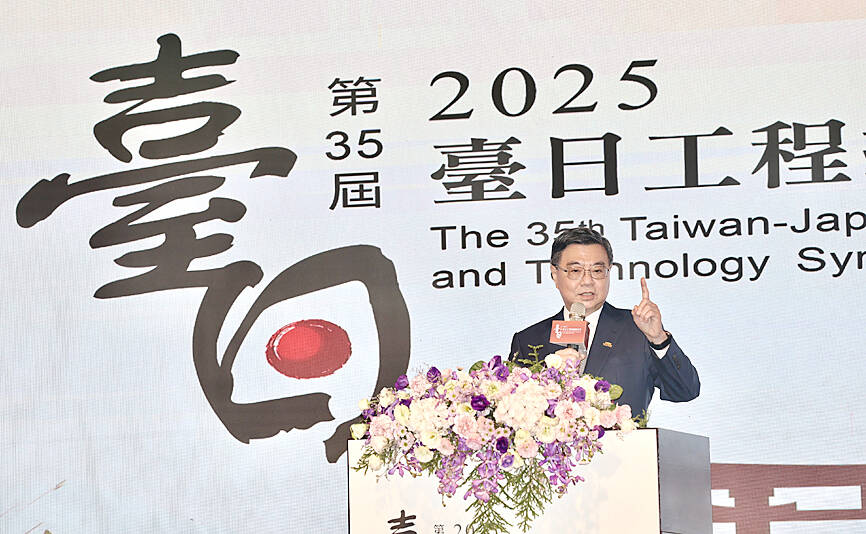
Photo: Chen Yi-kuan, Taipei Times
Japan also provided a lot of vaccines early in the outbreak of the COVID-19 pandemic, Cho said, adding that such caring actions were deeply heartwarming to Taiwanese.
Taiwan-Japan collaborations in engineering have been fruitful overseas, including an MRT project in Jakarta and the North-South Commuter Railway project in the Philippines, Cho said.
Taiwan and Japan should expect more win-win collaborations, he said, adding that both sides should cooperate more closely in response to the new trade landscape formed amid global tariff impacts.
Aside from exchanges regarding industries, economy, culture and tourism, Taiwan and Japan are also devoted to maintaining regional peace and stability, he said.
Taiwan would take responsibility and demonstrate its ability to defend national sovereignty and security, he said.
Cho said he expects Taiwan to stand side by side with aligned countries across the world to fight together for freedom, democracy and human rights.
Japan-Taiwan Exchange Association Taipei Office Deputy Representative Gen Kawai said that Taiwan is a geographical neighbor and a partner with common core values for Japan, adding that the strong bilateral bond has been forged through numerous face-to-face communications by people of both sides.
Taiwan and Japan face similar social and geographical challenges, including frequent natural disasters such as earthquakes, scarce natural resources, low birthrates and aging societies, he said.
Engineers from both sides can contribute their knowledge and skills to jointly address such challenges, Kawai said, adding that he expects this year’s symposium to consolidate such mutually beneficial ties.

FUKUOKA SITUATION: Japanese media reported that the pathogen is expected to be identified by the summer, while the CDC downplayed the idea that it was hMPV A “mysterious cold-like illness” reported in Japan’s Fukuoka Prefecture does not seem to be a new disease, but Japanese authorities have been asked about the situation, the Centers for Disease Control (CDC) said yesterday. The Fukuoka Prefectural Medical Association on Wednesday told a news conference that a “mystery cold” that has become a hot topic on social media is “highly likely to be caused by some kind of viral infection,” Japan’s KBC News reported. “Many people are experiencing symptoms starting with a sore throat, followed by a runny nose, phlegm and a severe cough,” KBC News reported, citing association officials. Health authorities are

Nvidia Corp CEO Jensen Huang (黃仁勳) arrived in Taiwan yesterday ahead of upcoming AI and technology events, saying he plans to meet with clients and Taiwan Semiconductor Manufacturing Co Chairman C.C. Wei (魏哲家) during his visit. After landing at Taipei Songshan Airport, Huang posed for photos with fans and handed out Yakult drinks to reporters and supporters waiting at the scene, saying he has “a lot to do” during the trip. Asked about reports that Nvidia’s planned headquarters site in Taipei’s Beitou Shilin Technology Park could break ground on May 27, Huang said that if the company holds an event, he would

The Ministry of Finance this afternoon announced the winning numbers for the March-April uniform invoice lottery. The winning number for the NT$10 million (US$318,060) special prize is 19531471, and the winning number for the NT$2 million grand prize is 85941329. Three numbers were drawn for the NT$200,000 first prize: 07225810, 20231230 and 83518781. Those with receipts matching the last seven digits of any of the first-prize numbers will win the NT$40,000 second prize, while those matching the last six digits will win the NT$10,000 third prize. Those whose receipts match the last five digits of the first-prize numbers can claim the NT$4,000 fourth prize,
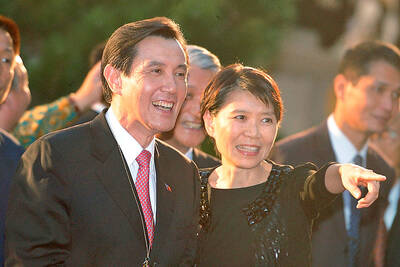
Former president Ma Ying-jeou (馬英九) yesterday expressed “shock and regret” over a statement issued by his wife without his consent, and rejected her assertion that his eldest sister, Ma Yi-nan (馬以南), would manage his medical care or act as his spokesperson amid an ongoing embezzlement probe into his foundation. Ma Ying-jeou in a statement said he was shocked by a statement by his wife, Chou Mei-ching (周美青), regarding his affairs. Ma Yi-nan “must not” be in charge of his healthcare and other personal affairs, nor can she be allowed to represent the Ma family, the former president said. He said he was also


 RSS
RSS