


Chinese President Xi Jinping’s (習近平) latest purge of the Chinese People’s Liberation Army (PLA) leadership might have been prompted by the military’s opposition to plans of invading Taiwan, the Epoch Times said.
The Chinese military opposes waging war against Taiwan by a large consensus, putting it at odds with Xi’s vision, the Falun Gong-affiliated daily said in a report on Thursday, citing anonymous sources with insight into the PLA’s inner workings.
The opposition is not the opinion of a few generals, but a widely shared view among the PLA cadre, the Epoch Times cited them as saying.
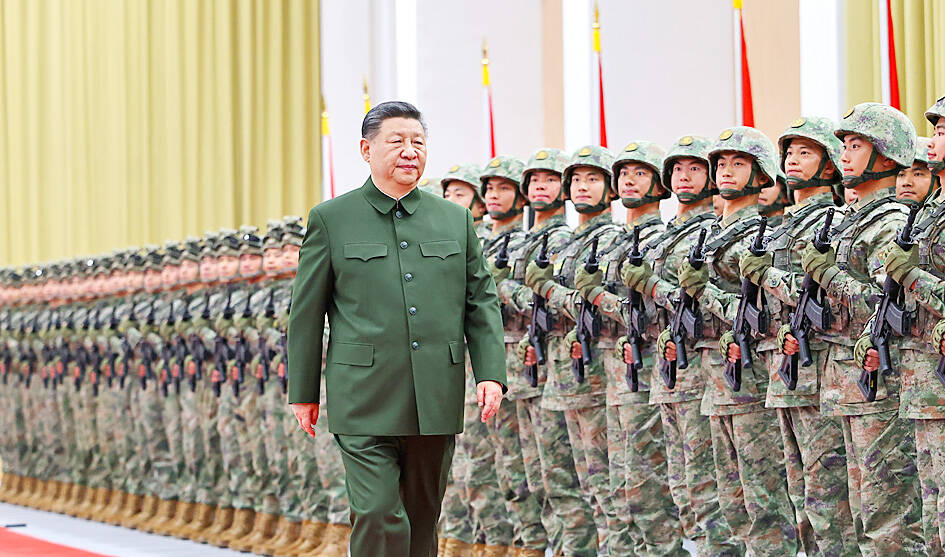
Photo: EPA
“Chinese forces know full well that a real war would lead to heavy casualties and attrition that could wipe out an entire branch of arms,” one source was quoted as saying.
The PLA regards staging military exercises to coerce Taiwan as completely distinct from initiating a conflict, and considers Xi’s policies to be guided by personal political considerations rather than professional military assessment, the sources said.
A military officer surnamed Wang (王), who serves in the PLA’s Southern Theater Command, was quoted as saying that millions of predominantly civilian casualties resulting from the Russia-Ukraine conflict had made China’s military leaders reluctant to start a war.
Commanders responsible for leading troops in battle are not willing to accept the responsibility of war, he said.
Many sources in healthcare interviewed for the report said that China’s blood banks and medical stockpiles do not have enough reserves to sustain a large-scale conventional conflict.
Chinese military analyst Wu Man (吳滿) told the Epoch Times that confrontational actions undertaken by the US in the past few years have exerted significant pressure on the government in Beijing.
Combining the external threat posed by the US with constant purges from Xi to secure personal control over the PLA has sown fear and resentment in the military that could jeopardize its ability to fight, he said.
Xi’s attempts to replace professionalism with loyalty has antagonized the PLA and it is not clear if the generals would lead troops if a conflict with Taiwan breaks out, he said.
“Should the Chinese military refuse to fight, would the public security apparatus be charged to command the invasion?” Wu asked.

Considering that most countries issue more than five denominations of banknotes, the central bank has decided to redesign all five denominations, the bank said as it prepares for the first major overhaul of the banknotes in more than 24 years. Central bank Governor Yang Chin-lung (楊金龍) is expected to report to the Legislative Yuan today on the bank’s operations and the redesign’s progress. The bank in a report sent to the legislature ahead of today’s meeting said it had commissioned a survey on the public’s preferences. Survey results showed that NT$100 and NT$1,000 banknotes are the most commonly used, while NT$200 and NT$2,000

The Centers for Disease Control (CDC) yesterday reported the first case of a new COVID-19 subvariant — BA.3.2 — in a 10-year-old Singaporean girl who had a fever upon arrival in Taiwan and tested positive for the disease. The girl left Taiwan on March 20 and the case did not have a direct impact on the local community, it said. The WHO added the BA.3.2 strain to its list of Variants Under Monitoring in December last year, but this was the first imported case of the COVID-19 variant in Taiwan, CDC Deputy Director-General Lin Ming-cheng (林明誠) said. The girl arrived in Taiwan on

ANNUAL EVENT: Two massive Pokemon balloons are to be set up in Daan Park, with an event zone operating from 10am to 6pm This year’s Taipei Floral Picnic is to be held at Daan Park today and tomorrow, featuring an exclusive Pokemon Go event, a themed food market, a coffee rave picnic area and stage performances, the Taipei Department of Information and Tourism said yesterday. Two massive Pokemon balloons are to be set up in the park as attractions, with an exclusive event zone operating from 10am to 6pm, it said. Participants who complete designated tasks on-site would have a chance to receive limited-edition souvenirs, it added. People could also try the newly launched game Pokemon Pokopia in the trial area, the department said. Three PokeStops are

South Korea is planning to revise its controversial electronic arrival card, a step Taiwanese officials said prompted them to hold off on planned retaliatory measures, a South Korean media report said yesterday. A Yonhap News Agency report said that the South Korean Ministry of Foreign Affairs is planning to remove the “previous departure place” and “next destination” fields from its e-arrival card system. The plan, reached after interagency consultations, is under review and aims to simplify entry procedures and align the electronic form with the paper version, a South Korean ministry official said. The fields — which appeared only on the electronic form


 RSS
RSS