


Two Taiwanese prosecutors were questioned by Chinese security personnel at their hotel during a trip to China’s Henan Province this month, the Mainland Affairs Council (MAC) said yesterday.
The officers had personal information on the prosecutors, including “when they were assigned to their posts, their work locations and job titles,” MAC Deputy Minister and spokesman Liang Wen-chieh (梁文傑) said.
On top of asking about their agencies and positions, the officers also questioned the prosecutors about the Cross-Strait Joint Crime-Fighting and Judicial Mutual Assistance Agreement, a pact that serves as the framework for Taiwan-China cooperation on combating crime and providing judicial assistance, Liang added.

Photo: Chen Chih-chu, Taipei Times
The prosecutors were asked to add the officers on WeChat to stay in contact, but the prosecutors “remained vigilant” and refused the request, Liang said, adding that they were not threatened during the questioning.
However, in some cases, Chinese authorities have used a Taiwanese’s relatives in China to pressure or threaten them, he said.
As for the prosecutors’ backgrounds, Liang said that they were relatively new to the job and had not handled cases involving national security or alleged Chinese espionage.
On how the officers obtained the prosecutors’ information, Liang said that Beijing has “many ways” to obtain such details, citing China’s “many infiltration channels” in Taiwan.
He did not rule out cyberattacks.
The prosecutors reported the incident upon returning to Taiwan, he said, adding that the council has detailed rules requiring public servants who travel to China to file relevant information after they return and to report any “unusual situations.”
“We want to remind public servants nationwide not to assume there is no risk of being monitored or investigated when traveling to China, simply because they do not have access to state secrets or do not hold senior positions,” Liang added.
Chinese authorities are exploiting Taiwanese public servants’ “lack of risk awareness and vigilance” to continuously expand their infiltration networks, he said.
On Jan. 16, Liang said the council had “recently” received reports from public servants at central government agencies saying that during trips to China, they were questioned by immigration officers.
Chinese state security personnel also entered their hotel rooms to question them about their duties, supervisors and colleagues, the reports said.
At the time, Liang did not disclose how many such cases had been reported.
Yesterday, he said that the two prosecutors’ cases were separate from the cases he referred to on Jan. 16.
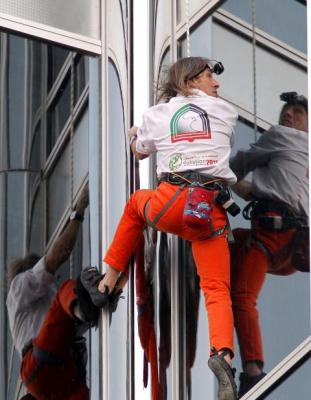
Alain Robert, known as the "French Spider-Man," praised Alex Honnold as exceptionally well-prepared after the US climber completed a free solo ascent of Taipei 101 yesterday. Robert said Honnold's ascent of the 508m-tall skyscraper in just more than one-and-a-half hours without using safety ropes or equipment was a remarkable achievement. "This is my life," he said in an interview conducted in French, adding that he liked the feeling of being "on the edge of danger." The 63-year-old Frenchman climbed Taipei 101 using ropes in December 2004, taking about four hours to reach the top. On a one-to-10 scale of difficulty, Robert said Taipei 101
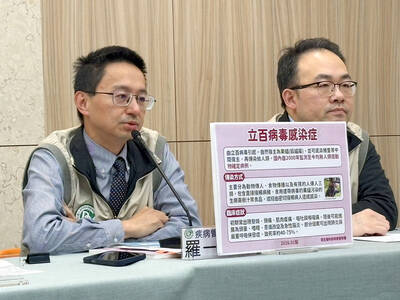
Nipah virus infection is to be officially listed as a category 5 notifiable infectious disease in Taiwan in March, while clinical treatment guidelines are being formulated, the Centers for Disease Control (CDC) said yesterday. With Nipah infections being reported in other countries and considering its relatively high fatality rate, the centers on Jan. 16 announced that it would be listed as a notifiable infectious disease to bolster the nation’s systematic early warning system and increase public awareness, the CDC said. Bangladesh reported four fatal cases last year in separate districts, with three linked to raw date palm sap consumption, CDC Epidemic Intelligence
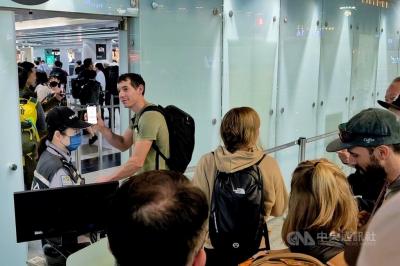
US climber Alex Honnold left Taiwan this morning a day after completing a free-solo ascent of Taipei 101, a feat that drew cheers from onlookers and gained widespread international attention. Honnold yesterday scaled the 101-story skyscraper without a rope or safety harness. The climb — the highest urban free-solo ascent ever attempted — took just more than 90 minutes and was streamed live on Netflix. It was covered by major international news outlets including CNN, the New York Times, the Guardian and the Wall Street Journal. As Honnold prepared to leave Taiwan today, he attracted a crowd when he and his wife, Sanni,
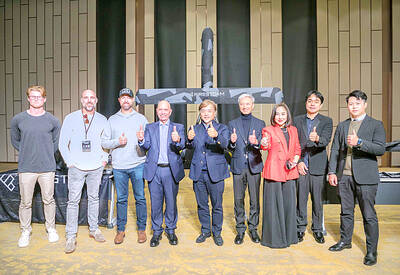
Taiwanese and US defense groups are collaborating to introduce deployable, semi-autonomous manufacturing systems for drones and components in a boost to the nation’s supply chain resilience. Taiwan’s G-Tech Optroelectronics Corp subsidiary GTOC and the US’ Aerkomm Inc on Friday announced an agreement with fellow US-based Firestorm Lab to adopt the latter’s xCell, a technology featuring 3D printers fitted in 6.1m container units. The systems enable aerial platforms and parts to be produced in high volumes from dispersed nodes capable of rapid redeployment, to minimize the risk of enemy strikes and to meet field requirements, they said. Firestorm chief technology officer Ian Muceus said


 RSS
RSS