


Taiwanese and US defense groups are collaborating to introduce deployable, semi-autonomous manufacturing systems for drones and components in a boost to the nation’s supply chain resilience.
Taiwan’s G-Tech Optroelectronics Corp subsidiary GTOC and the US’ Aerkomm Inc on Friday announced an agreement with fellow US-based Firestorm Lab to adopt the latter’s xCell, a technology featuring 3D printers fitted in 6.1m container units.
The systems enable aerial platforms and parts to be produced in high volumes from dispersed nodes capable of rapid redeployment, to minimize the risk of enemy strikes and to meet field requirements, they said.
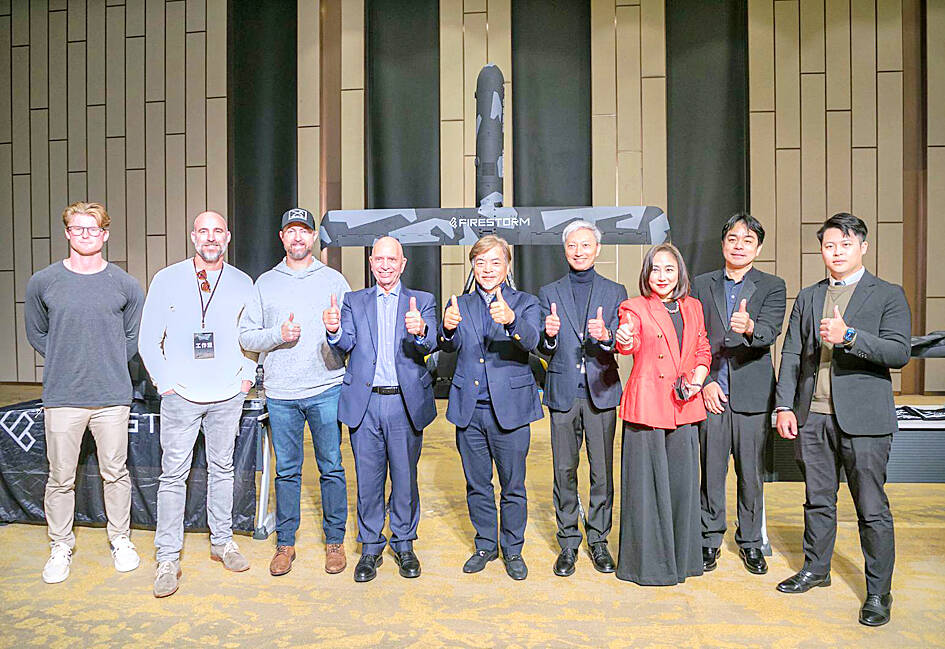
Photo: Fang Pin-chao, Taipei Times
Firestorm chief technology officer Ian Muceus said xCell’s integrated industrial-grade 3D printers and container units could be transported by almost any vehicle and go online within 24 hours of being deployed.
Combined with GTOC’s capabilities, the systems would enable Taiwan to speedily modify and manufacture uncrewed aerial vehicles (UAVs) to suit shifting operational needs, he said.
Firestorm CEO Dan Magy said that the Russian invasion of Ukraine has demonstrated the importance of drones in modern warfare.
China and Russia could each produce up to 300,000 UAVs a month, compared with 30,000 a year for the US, which has long and vulnerable supply chains in the Indo-Pacific region, he said.
Taiwan’s strategic reserve of military supplies have insufficient depth, as stockpiles could run out after anywhere from six hours to 30 days of continuous combat without resupply, Magy said.
Firestorm’s technology is capable of boosting drone production, and furnishing badly-needed parts and components, he said, adding that US Marines have already used xCell to repair GPS devices.
GTOC general manager Chung Yu-hsin (鍾又新) said the three groups are in the process of integrating their capabilities to establish self-sufficient supply chains.
Two facilities that produce glass-based antenna technology are under construction in Miaoli County, he said.
Applying the technology on drone wings could significantly reduce drag, increasing airspeed and battlefield survivability, he said.

Kenting National Park service technician Yang Jien-fon (楊政峰) won a silver award in World Grand Prix Photography Awards Spring Season for his photograph of two male rat snakes intertwined in combat. Yang’s colleagues at Kenting National Park said he is a master of nature photography who has been held back by his job in civil service. The awards accept entries in all four seasons across six categories: architectural and urban photography, black-and-white and fine art photography, commercial and fashion photography, documentary and people photography, nature and experimental photography, and mobile photography. Awards are ranked according to scores and divided into platinum, gold and

More than half of the bamboo vipers captured in Tainan in the past few years were found in the city’s Sinhua District (新化), while other districts had smaller catches or none at all. Every year, Tainan captures about 6,000 snakes which have made their way into people’s homes. Of the six major venomous snakes in Taiwan, the cobra, the many-banded krait, the brown-spotted pit viper and the bamboo viper are the most frequently captured. The high concentration of bamboo vipers captured in Sinhua District is puzzling. Tainan Agriculture Bureau Forestry and Nature Conservation Division head Chu Chien-ming (朱健明) earlier this week said that the
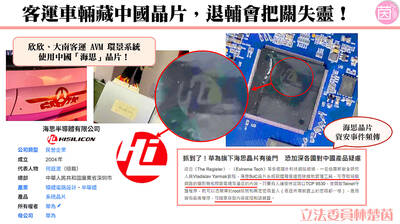
BREACH OF CONTRACT: The bus operators would seek compensation and have demanded that the manufacturer replace the chips with ones that meet regulations Two bus operators found to be using buses with China-made chips are to demand that the original manufacturers replace the systems and provide compensation for breach of contract, the Veterans Affairs Council said yesterday. Democratic Progressive Party Legislator Michelle Lin (林楚茵) yesterday said that Da Nan Bus Co and Shin-Shin Bus Co Ltd have fielded a total of 82 buses that are using Chinese chips. The bus models were made by Tron-E, while the systems provider was CYE Electronics, Lin said. Lin alleged that the buses were using chips manufactured by Huawei subsidiary HiSilicon Co, which presents a national security risk if the

The National Immigration Agency has banned two Chinese from returning to Taiwan, after they published social media content it described as disrespectful to national sovereignty. The agency imposed a two-month ban on a Chinese man surnamed Liang (梁) and a permanent ban on a woman surnamed Yang (楊), an influencer with 23 million followers, in October last year and last week respectively. Minister of the Interior Liu Shyh-fang (劉世芳) yesterday said on the sidelines of a legislative meeting that Chinese visitors to Taiwan are required to comply with the rules and regulations governing their entry permits. The government has handled the ban and


 RSS
RSS