


On the rolling hills of Winona, a fine merino sheep stud, a quiet revolution is taking place which Australian farmers hope will eventually see them selling soil carbon credits in the fight against climate change.
Winona’s Colin Seis is one of the country’s leading “carbon farmers” and has for the past 10 years been encouraging the extraction of greenhouse gas CO² from the atmosphere and increasing the carbon content of his soil to improve pastures.
Seis estimates he has sequestered a total of 73,786 tonnes of CO² equivalent, or 7,386 tonnes each year. As he only emits 2,200 tonnes farming, he has a credit of 5,186 tonnes of carbon.
Under Australia’s planned carbon emissions trading scheme, if Seis continues sequesting carbon and maintains his credit, he could sell 5,186 tonnes for US$40,706 to US$102,086, depending if the price is US$8 a tonne or US$20 a tonne.
Australia wants a formal carbon trading scheme running by 2011, with agriculture possibly included in 2015.
Australia’s planned Emissions Trading Scheme (ETS) will have a fixed US$8 a tonne price in the first year, followed by an open market with an expected price of US$20 a tonne. But it is unclear what type of credit farmers would be allocated in a future ETS.
“Soil is the largest carbon sink we have control of. It’s a major answer [to climate change] yet it’s been overlooked,” said Seis. “It’s so obvious because plants are the only thing taking CO² out of the atmosphere.”
The Chicago Climate Exchange in the US has been trading soil carbon since 2005 but it is not an official offset under the Kyoto Protocol. The UN food and agriculture organization and conservation farmers are pushing for the rules to be changed at the Copenhagen climate conference in December.
The Chicago Climate Exchange traded contracts worth 16.4 million tonnes of CO² equivalent in the year to end April 2009, with prices ranging from US$1.55 to US$2.05 per tonne.
A BREAK FROM TRADITION
Fifth generation farmer Seis said there are about 2,000 “carbon farmers” now in Australia.
Farmers are turning their backs on centuries-old practices brought from England, where paddocks were continually cropped and ploughed and drenched with fertilizer and weed killer, and are adopting eco-friendly farming to repair damaged soils.
Carbon farmers are adopting zero or minimum tillage, which does not plough the soil, increasing stock rotation to allow land to rest, sometimes for years, and avoiding bare earth with year-round cover with crops, native grasses and weeds.
All these measures increase the biomass in the soil, making it more fertile, and in turn increase the carbon in the soil.
Seis “pasture crops” his 840 hectare farm near Gulgong in eastern Australia, planting cereals amongst native grasses to ensure paddocks are covered all year round to allow plants to constantly absorb carbon and limit erosion.
“We do not kill the grasslands, we sow the crop when the grass is in its winter dormant phase. When we harvest, the grass comes back,” said Seis. “What I have done is encourage nature to function as designed — to work with nature not against it.”
Seis has also reduced the size of his paddocks and rotates his 4,000 sheep regularly, what is called high-density short-duration grazing or pulse grazing, ensuring paddocks are given long periods of rest from grazing in order to revive.
Despite a long running drought, Seis has enough ground cover to last the dry winter and no need to buy in feed. He can also run four sheep per hectare, double his neighbor’s stocking rate.
SOIL CARBON FIGHTS DROUGHT
Increasing soil carbon allows paddocks to retain more moisture for crops — a vital advantage for Australian farmers who have been battling decades of drought.
A one percent increase in soil carbon means an extra 144,000 liters per hectare water capacity, says Seis, who has increased his soil carbon from 2.5 percent to 4 percent, giving him an average of 300,000 liters of extra water per hectare.
“It’s like putting your farm under a different rain zone. Carbon farming means your farm comes into drought later and comes out of drought sooner,” said Louisa Kiely, a fellow sheep farmer and founder of the lobby group Carbon Coalition.
Across the valley from Kiely’s homestead stand three tombstones marking the graves of the property’s original owners, the Lahys from Tipperary, Ireland. Michael Lahy died in 1859.
But those tombstones, surrounded by rotting, dead weeds, are the only remnants of the old farming ways on Uamby. The Kiely’s have turned their property into a pure carbon farm.
“We have turned the farm over to native vegetation and grazing and we can get carbon credits for it. There is a whole new economy developing,” said Michael Kiely, surveying his farm from the top of a hill.
CARBON AUDITING
Seis and other Australian farmers are being hindered from selling carbon credits due to a lack of a formal protocol for measuring the increase in carbon in their soils and a formal market. Australia has only a small voluntary carbon market.
Australia’s annual greenhouse emissions currently total 553 million tonnes of CO²-equivalent, but it would require only a 0.5 percent increase in soil carbon in two percent of farmland to sequester all the annual CO² emissions, said Christine Jones, founder of Australian Soil Carbon Accreditation Scheme.
“Australia’s single greatest comparative advantage in the battle to reduce CO² emissions is our enormous land mass — over 770 million hectares,” said opposition leader Malcolm Turnbull, who’s Liberal Party supports a policy of biosequestration. “The opportunities for CO² abatement here are gigantic.”
Australia’s carbon farmers argue that the country’s depleted soils can be repaired to once again store more carbon.
Since white settlement in Australia in 1788 more than 70 percent of farmland has been seriously degraded, with a loss of percent 50 to 80 percent of organic carbon from surface soil, says Jones.
Broker Prime Carbon currently lists carbon credit units on Australia’s National Environment Registry and aims to convert 1 million hectares into sustainable farming by 2013 and provide wholesale carbon credits for national and international markets.
Prime Carbon has registered 200,000 tonnes of CO² in the past 18 months but sold only 10 percent, said founder Bellamy.
Measuring soil carbon gains is difficult as carbon levels vary between different soils and different rainfall areas. Soil carbon can differ from one end of a paddock to the other.
“It is dynamic and always cycling and fluxing and cannot be measured like house bricks,” said Michael Kiely.
Another sticking point is how to ensure the carbon credit stays in the ground, as farming emits carbon. Agriculture accounts for 16 percent of Australia’s emissions. Farmers argue that if they remain in credit then they are storing carbon.

By global standards, the traffic congestion that afflicts Taiwan’s urban areas isn’t horrific. But nor is it something the country can be proud of. According to TomTom, a Dutch developer of location and navigation technologies, last year Taiwan was the sixth most congested country in Asia. Of the 492 towns and cities included in its rankings last year, Taipei was the 74th most congested. Taoyuan ranked 105th, while Hsinchu County (121st), Taichung (142nd), Tainan (173rd), New Taipei City (227th), Kaohsiung (241st) and Keelung (302nd) also featured on the list. Four Japanese cities have slower traffic than Taipei. (Seoul, which has some
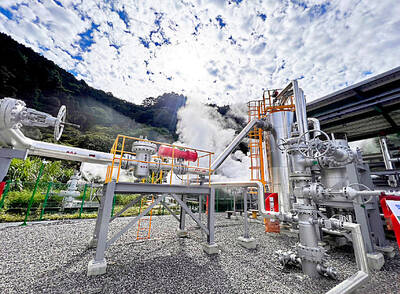
Taiwan’s semiconductor industry consumes electricity at rates that would strain most national grids. Taiwan Semiconductor Manufacturing Co (TSMC) alone accounted for more than 9 percent, or 2,590 megawatts (MW), of the nation’s power demand last year. The factories that produce chips for the world’s phones and servers run around the clock. They cannot tolerate blackouts. Yet Taiwan imports 97 percent of its energy, with liquefied natural gas reserves measured in days. Underground, Taiwan has options. Studies from National Taiwan University estimate recoverable geothermal resources at more than 33,000 MW. Current installed capacity stands below 10 MW. OBSTACLES Despite Taiwan’s significant geothermal potential, the

In our discussions of tourism in Taiwan we often criticize the government’s addiction to promoting food and shopping, while ignoring Taiwan’s underdeveloped trekking and adventure travel opportunities. This discussion, however, is decidedly land-focused. When was the last time a port entered into it? Last week I encountered journalist and travel writer Cameron Dueck, who had sailed to Taiwan in 2023-24, and was full of tales. Like everyone who visits, he and his partner Fiona Ching loved our island nation and had nothing but wonderful experiences on land. But he had little positive to say about the way Taiwan has organized its

The entire Li Zhenxiu (李貞秀) saga has been an ugly, complicated mess. Born in China’s Hunan Province, she moved to work in Shenzhen, where she met her future Taiwanese husband. Most accounts have her arriving in Taiwan and marrying somewhere between 1993 and 1999. She built a successful career in Taiwan in the tech industry before founding her own company. She also served in high-ranking positions on various environmentally-focused tech associations. She says she was inspired by the founding of the Taiwan People’s Party (TPP) in 2019 by Ko Wen-je (柯文哲), and began volunteering for the party soon after. Ko


 RSS
RSS