


For two years British troops staked out a presence in this small district center in southern Afghanistan and fended off attacks from the Taliban. The constant firefights left it a ghost town, its bazaar broken and empty but for one baker, its houses and orchards reduced to rubble and weeds.
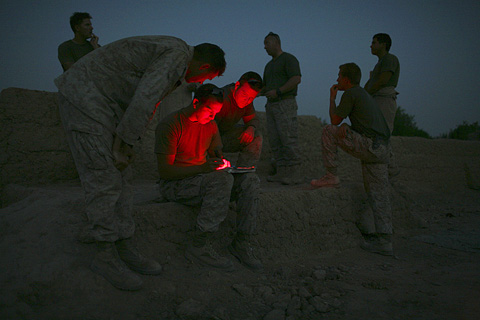
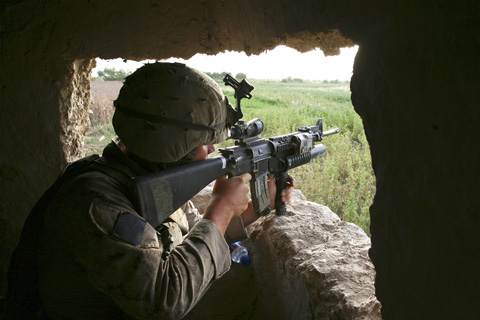
But it took the US Marines, specifically the 24th Marine Expeditionary Unit, about 96 hours to clear out the Taliban in a fierce battle in the past month and push them back about 10km.
It was their first major combat operation since landing in March, and it stood in stark contrast to the events of a year earlier, when a Marine unit was removed in disgrace within weeks of arriving because its members shot and killed 19 civilians after a suicide bombing attack.
PHOTOS: NY TIMES NEWS SERVICE
This time, the performance of the latest unit of Marines, here in Afghanistan for seven months to help bolster NATO forces, will be under particular scrutiny. The NATO-led campaign against the Taliban has not only come under increasing pressure for its slow progress in curbing the insurgency, but it has also been widely criticized for the high numbers of civilian casualties in the fighting.
The Marines’ drive against the Taliban in this large farming region is certainly not finished, and the Taliban have often been pushed out of areas in Afghanistan only to return in force later. But for the British forces and Afghan residents here, the result of the recent operation has been palpable.
The district chief returned to his job from his refuge in the provincial capital within days of the battle and 200 people — including 100 elders of the community — gathered for a meeting with him and the British to plan the regeneration of the town.
PHOTOS: NY TIMES NEWS SERVICE
“They have disrupted the Taliban’s freedom of movement and pushed them south, and that has created the grounds for us to develop the hospital and set the conditions for the government to come back,” said Major Neil Den-McKay, the officer commanding a company of the Royal Regiment of Scotland based here. People have already started coming back to villages north of the town, he said, adding: “There has been huge optimism from the people.”
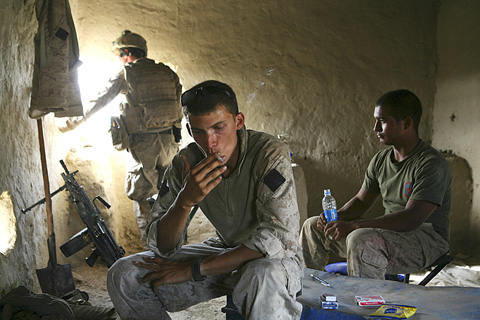
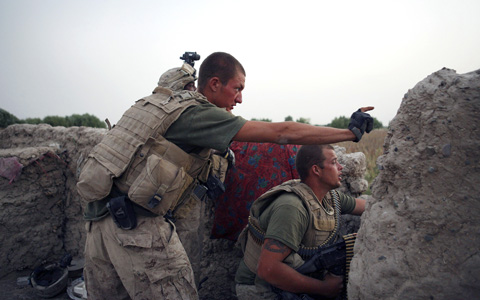
For the Marines, it was a chance to hit the enemy with the full panoply of their firepower in places where they were confident there were few civilians. The Taliban put up a tenacious fight, rushing in reinforcements in cars and vans from the south and returning repeatedly to the attack, but they were beaten back in four days by three companies of Marines, two of which were dropped in by helicopter to the southeast.
In the days after the assault began, hundreds of families, their belongings packed high on tractor-trailers, fled north from villages in the southern part of the battle zone, according to Marines staffing a checkpoint. The Taliban told them to leave as the fighting began, they said. Hospital officials in the provincial capital, Lashkar Gah, reported receiving eight civilian casualties as a result of the fighting, including a 14-year-old boy who died from his injuries. The Marines did not sustain any casualties, but one was killed and two were wounded in subsequent clashes.
PHOTOS: NY TIMES NEWS SERVICE
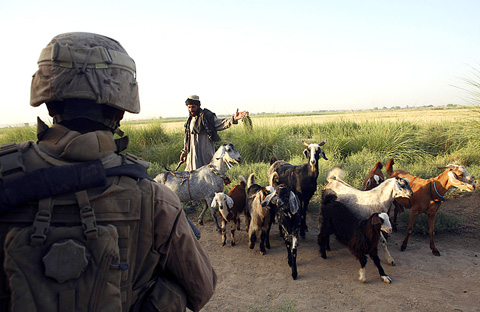
Marines from the unit’s Charlie Company said the reaction from the returning civilians, mostly farmers, had been favorable. “Everyone says they don’t like the Taliban,” said Captain John Moder, 34, the commander of the company. People had complained that the Taliban stole food, clothes and vehicles from them, he said.
There are about 34,000 US troops in Afghanistan, with more than 3,000 Marines having been sent into the country after NATO requested additional help in the south, where the Taliban are particularly strong.
The deployment occurred almost a year after up to 19 unarmed civilians were killed and 50 people wounded on March 4, 2007, when a Marine convoy opened fire after a suicide car bomb wounded one Marine. On Friday, the Marine Corps said it would not bring charges against two of the commanding officers from the 26th Marine Expeditionary Unit for the episode, a decision that was greeted with dismay in Afghanistan. The commander of NATO forces in Afghanistan, General Dan K. McNeill, had a checklist of tasks around the country for the 3,200 Marines when they arrived in March. But the majority of them have spent a month in Garmser after changing their original plan, which was to secure a single road here, when they realized how important the area was to the Taliban as an infiltration and supply route to fighters in northern part of Helmand province.
PHOTOS: NY TIMES NEWS SERVICE
“This is an artery, and we did not realize that when we squeezed that artery, it would have such an effect,” said First Lieutenant Mark Matzke, the executive officer of Charlie Company.
They also realized it was worth exploiting their initial success. The whole area was unexpectedly welcoming to the American forces and eager for security and development, Moder said. “Us pushing the Taliban out allows the Afghan National Army to come in,” he said. “This is a real breadbasket here. There’s a lot of potential here.”
This southern part of Helmand province, along the Helmand River valley, is prime agricultural land and still benefits from the large-scale irrigation plan kicked off by US government assistance in the 1950s and 1960s. It has traditionally been the main producer of wheat and other crops for the country. During the last 30 years of war, however, the area has given way to poppy production, providing a large percentage of the crop that has made Afghanistan the producer of 98 percent of the world’s opium.
PHOTOS: NY TIMES NEWS SERVICE
The region has long been an infiltration route for insurgents coming across the southern border with Pakistan, crossing from Baluchistan province in Pakistan via an Afghan refugee camp known as Girdi Jungle. The Taliban, and the drug runners, then race across a region known ominously as the desert of death until they reach the river valley, which provides the ideal cover of villages and greenery.
With such a large area under their control, the Taliban were able to gather in numbers, stockpile weapons and provide a logistics route to send fighters and weapons into northern Helmand and the provinces of Kandahar and Oruzgan beyond.
The Taliban, who kicked out villagers and took over their farmhouses, were also mixed with an unusual proportion of Arabs and Pakistanis, Den-McKay said.
“The majority of elements in this area are Arab and Pakistani, and the locals detest them,” he said. The insurgent commanders were from Iran, which shares a border with Afghanistan to the southwest, as well as Saudi Arabia and Pakistan, he said.
Afghan villagers confirmed that there were local Afghan Taliban fighting, too. But they also said that there were Pakistanis, ethnic Baluchis from southern Iran and Arabs fighting as well.
Locals complained that the Taliban taxed them heavily on the opium harvest. They said the Taliban demanded up to about 14kg of opium from every farmer, which was more than the entire harvest of some, so they were forced to go and buy opium to meet the demand, said Abdul Taher, a 45-year-old farmer.
“We had a lot of trouble these last two years,” said Sher Ahmad, 32. “We are very grateful for the security,” said his father, Abdul Nabi, the elder of a small hamlet in the village of Hazarjoft, a few kilometers south of Garmser. “We don’t need your help, just security,” he said.
Villagers were refusing humanitarian aid offered by the Marines because the Taliban were already infiltrating back and threatening anyone who took it, Matzke said.
After a month in the region, the Marines have secured only half of a roughly 16km2 area south of Garmser. Taliban forces operating out of two villages are still attacking the southern flank of the Marines and are even creeping up to fire at British positions on the edge of the town.
But the bigger test will come in the next few weeks as the Marines move on and the Afghans, supported by the British, take over. The concern here is that the Taliban will try to blend in among the returning villagers and orchestrate attacks.
Den-McKay said they were ready. “The threat will migrate from direct attacks to suicide attacks,” and roadside bombs, he said.
Now on his fourth tour in Afghanistan, Den-McKay said he had seen considerable progress in the confidence and ability of the Afghan security forces. Reinforcements of the police, trained and mentored by the British and Americans, have already moved in and are working well with border police and intelligence service personnel, he said.
The Marines, meanwhile, prepare for their next move. To the south lay kilometers upon kilometers of uncontrolled territory where the Taliban still operate freely, as well as a dozen other districts around the country demanding their attention.

The US war on Iran has illuminated the deep interdependence of Asia on flows of oil and related items as raw materials that become the basis of modern human civilization. Australians and New Zealanders had a wake up call. The crisis also emphasizes how the Philippines is a swatch of islands linked by jet fuel. These revelations have deep implications for an invasion of Taiwan. Much of the commentary on the Taiwan scenario has looked at the disruptions to world trade, which will be in the trillions. However, the Iran war offers additional specific lessons for a Taiwan scenario. An insightful

The problem with Marx’s famous remark that history repeats itself, first as tragedy, the second time as farce, is that the first time is usually farce as well. This week Chinese Nationalist Party (KMT) Chair Cheng Li-wun (鄭麗文) made a pilgrimage to the People’s Republic of China (PRC) “to confer, converse and otherwise hob-nob” with Chinese Communist Party (CCP) officials. The visit was an instant international media hit, with major media reporting almost entirely shorn of context. “Taiwan’s main opposition leader landed in China Tuesday for a rare visit aimed at cross-strait ‘peace’”, crowed Agence-France Presse (AFP) from Shanghai. Rare!

April 6 to April 13 Few expected a Japanese manga adaptation featuring four tall, long-haired heartthrobs and a plucky heroine to transform Taiwan’s television industry. But Meteor Garden (流星花園) took the nation by storm after premiering on April 12, 2001, single-handedly creating the “idol drama” (偶像劇) craze that captivated young viewers across Asia. The show was so successful that Japan produced its own remake in 2005, followed by South Korea, China and Thailand. Other channels quickly followed suit, with more than 50 such shows appearing over the following two years. Departing from the melodramatic

Sunflower movement superstar Lin Fei-fan (林飛帆) once quipped that the Democratic Progressive Party (DPP) could nominate a watermelon to run for Tainan mayor and win. Conversely, the DPP could run a living saint for mayor in Taipei and still lose. In 2022, the DPP ran with the closest thing to a living saint they could find: former Minister of Health and Welfare Chen Shih-chung (陳時中). During the pandemic, his polling was astronomically high, with the approval of his performance reaching as high as 91 percent in one TVBS poll. He was such a phenomenon that people printed out pop-up cartoon


 RSS
RSS