


There Will Be Blood, Paul Thomas Anderson's epic American nightmare, arrives belching fire and brimstone and damnation to Hell. Set against the backdrop of the Southern California oil boom of the late-19th and early-20th centuries, it tells a story of greed and envy of biblical proportions - reverberating with Old Testament sound and fury and New Testament evangelicalism - which Anderson has mined from Upton Sinclair's 1927 novel Oil! There is no God but money in this oil-rich desert and his messenger is Daniel Plainview, a petroleum speculator played by a monstrous and shattering Daniel Day-Lewis.
Plainview is an American primitive. He's more articulate and civilized than the crude, brutal title character in Frank Norris' 1899 novel McTeague, and Erich von Stroheim's masterly version of the same, Greed. But the two characters are brothers under the hide, coarse and animalistic, sentimental in matters of love and ruthless in matters of avarice. Anderson opens his story in 1898, closer to Norris' novel than Sinclair's, which begins in the years leading up to World War I. And the film's opener is a stunner - spooky and strange, blanketed in shadows and nearly wordless. Inside a deep, dark hole, a man pickaxes the hard-packed soil like a bug gnawing through dirt. This is the earth mover, the ground shaker: Plainview.
Over the next two and a half mesmerizing hours Plainview will strike oil, then strike it rich and transform a bootstrapper's dream into a terrifying prophecy about the coming American century. It's a century he plunges into slicked in oil, dabbed with blood and accompanied by H.W. (eventually played by the newcomer Dillon Freasier), the child who enters his life in 1902 after he makes his first strike and seems to have burbled from the ground like the liquid itself. The brief scenes of Plainview's first tender, awkward moments with H.W. will haunt the story. In one of the most quietly lovely images in a film of boisterous beauty, he gazes at the tiny, pale toddler, chucking him under the chin as they sit on a train very much alone.
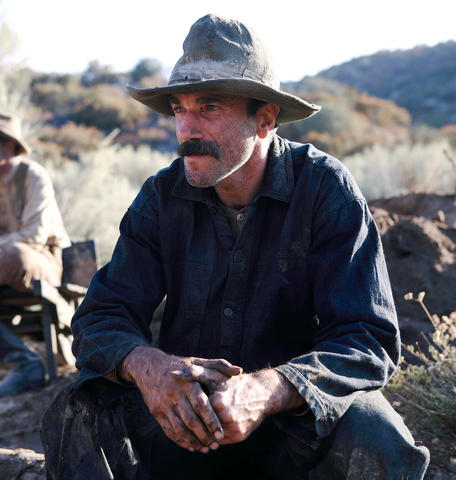
PHOTO: COURTESY OF PARAMOUNT VANTAGE
There Will Be Blood involves a tangle of relationships, mainly intersecting sets of fathers and sons and pairs of brothers. (Like most of the finest American directors working now, Anderson makes little onscreen time for women.) But it's Plainview's intense, needful bond with H.W. that raises the stakes and gives enormous emotional force to this expansively imagined period story with its pictorial and historical sweep, its raging fires, geysers of oil and inevitable blood. (Rarely has a film's title seemed so ominous.) By the time H.W. is about 10, he has become a kind of partner to his father, at once a child and a sober little man with a jacket and neatly combed hair who dutifully stands by Plainview's side as quiet as his conscience.
A large swath of the story takes place in 1911, by which point Plainview has become a successful oilman with his own fast-growing company. Flanked by the watchful H.W., he storms through California, sniffing out prospects and trying to persuade frenzied men and women to lease their land for drilling. One day a gangling, unsmiling young man, Paul Sunday (Paul Dano), arrives with news that oil is seeping out of the ground at his family's ranch. The stranger sells this information to Plainview, who promptly sets off with H.W. to a stretch of California desert where oil puddles the ground among the cactus, scrub and human misery.
Not long afterward oil is gushing out of that desert. The eruption rattles both the earth and the local population, whom Plainview soothes with promises. Poor, isolated, thirsting for water (they don't have enough even to grow wheat), the dazed inhabitants gaze at the oilman like hungry baby birds. He promises schools, roads and water, delivering his sermon with a carefully enunciated, sepulchral voice that Day-Lewis seems to have largely borrowed from the director John Huston. Plainview is preaching a new gospel, though one soon challenged by another salesman, Paul Sunday's Holy Roller brother, Eli (also Dano). A charismatic preacher looking to build a new church, Eli slithers into the story, one more snake in the desert.
Anderson has always worn his influences openly, cribbing from Martin Scorsese and Robert Altman among others (he helped the ailing Altman with his final film, A Prairie Home Companion), but rarely has his movie love been as organically integrated into his work as it is here. Movie history weighs on every filmmaker, informs every cut, camera angle and movement. There Will Be Blood is very much a personal endeavor for Anderson; it feels like an act of possession. Yet it is also directly engaged with our cinematically constructed history, specifically with films like Citizen Kane that have dismantled the mythologies of American success and, in doing so, replaced one utopian ideal for another, namely that of the movies themselves.
This is Anderson's fifth feature and it proves a breakthrough for him as a filmmaker. Although there are more differences than similarities between it and the Sinclair book, the novel has provided him with something he has lacked in the past, a great theme. It may also help explain the new film's narrative coherence. His first feature, Sydney (also known as Hard Eight), showed Anderson to be an intuitively gifted filmmaker, someone who was born to make images with a camera. His subsequent features - Boogie Nights, Punch-Drunk Love - have ambition and flair, though to increasingly diminished ends. Elliptical, self-conscious, at times multi-threaded, they contain passages of clarity and brilliance. But in their escalating stylization you feel the burdens of virtuosity, originality, independence.
The movie exhibits much the same qualities as Anderson's previous work - every shot seems exactly right - but its narrative form is more classical and less weighted down by the pressures of self-aware auteurism. It flows linearly, building momentum and unbearable tension. Day-Lewis' outsize performance, with its footnote references to Huston and strange, contorted Kabuki-like grimaces, occasionally breaks the skin of the film's surface like a dangerous undertow. It's a thrilling performance, purposefully alienating and brilliantly located between cinematic realism and theatrical spectacle.
This tension between realism and spectacle runs like a fissure through the film and invests it with tremendous unease. You are constantly being pulled away from and toward the charismatic Plainview, whose pursuit of oil reads like a chapter from this nation's grand narrative of discovery and conquest. His 1911 strike puts the contradictions of this story into graphic, visual terms.
With a story of and for our times, There Will Be Blood can certainly be viewed through the smeary window that looks onto the larger world. It's timeless and topical, general and specific, abstract and as plain as the name of its fiery oilman. It's an origin story of sorts. The opening images of desert hills and a droning electronic chord allude to the beginning of 2001: A Space Odyssey, whose murderous apes are part of a Darwinian continuum with Daniel Plainview. But the film is above all a consummate work of art, one that transcends the historically fraught context of its making, and its pleasures are unapologetically aesthetic. It reveals, excites, disturbs, provokes, but the window it opens is to human consciousness itself.

Taiwan’s overtaking of South Korea in GDP per capita is not a temporary anomaly, but the result of deeper structural problems in the South Korean economy says Chang Young-chul, the former CEO of Korea Asset Management Corp. Chang says that while it reflects Taiwan’s own gains, it also highlights weakening growth momentum in South Korea. As design and foundry capabilities become more important in the AI era, Seoul risks losing competitiveness if it relies too heavily on memory chips. IMF forecasts showing Taiwan widening its lead over South Korea have fueled debate in Seoul over memory chip dependence, industrial policy and

“China wants to unify with Taiwan at the lowest possible cost, and it currently believes that unification will become easier and less costly as time passes,” wrote Amanda Hsiao (蕭嫣然) and Bonnie Glaser in Foreign Affairs (“Why China Waits”) this month, describing how the People’s Republic of China (PRC) is playing the long game in its quest to seize Taiwan. This has been a favorite claim of many writers over the years, easy to argue because it is so trite. Very obviously, if the PRC isn’t attacking Taiwan, it is waiting. But for what? Hsiao and Glaser’s main point is trivial,
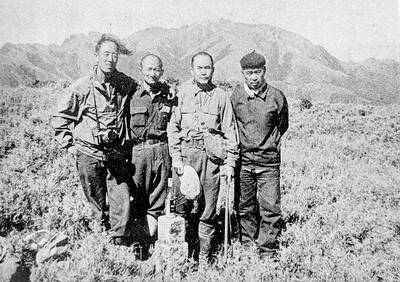
May 18 to May 24 Gathered on Yangtou Mountain (羊頭山) on Dec. 5, 1972, Taiwan’s hiking enthusiasts formally declared the formation of the “100 Peaks Club” (百岳俱樂部) and unveiled the final list of mountains. Famed mountaineer Lin Wen-an (林文安) led this effort for the Chinese Alpine Association (中華山岳協會). Working with other experienced climbers, he chose 100 peaks above 10,000 feet (3,048m) that featured triangulation points and varied in difficulty and character. The list sparked an alpine hiking craze, inspiring many to take up mountaineering and competing to “conquer” the summits. A common misconception is that the 100 Peaks represent Taiwan’s 100 tallest

Yesterday, the Democratic Progressive Party (DPP) nominated legislator Puma Shen (沈伯洋) as their Taipei mayoral candidate, the Chinese Nationalist Party (KMT) put their stamp of approval on Wei Ping-cheng (魏平政) as their candidate for Changhua County commissioner and former legislator Tsai Pi-ru (蔡壁如) of the Taiwan People’s Party (TPP) has begun the process to also run in Changhua, though she has not yet been formally nominated. All three news items are bizarre. The DPP has struggled with settling on a Taipei nominee. The only candidate who declared interest was Enoch Wu (吳怡農), but the party seemed determined to nominate anyone


 RSS
RSS