


Less than a year after France's decimated bee populations showed signs of recovery, beekeepers here are once again in a panic as their income-generating worker drones are disappearing by the tens of millions.
The banning in 2005 of two potent pesticides used on sunflower and corn crops, suspected of killing off the bees, appeared to have stemmed the massive die-offs and reversed nearly a decade of declining honey harvests.
But end-of-winter mortality rates have shot up once again, with up to 60 percent of some hives missing in action.
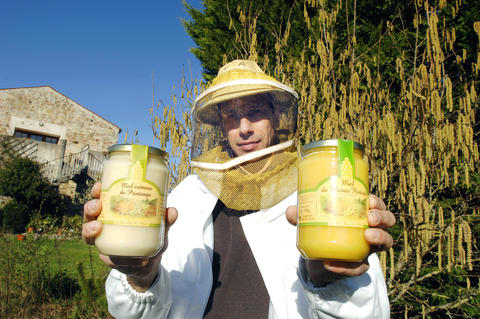
PHOTO: AFP
"We don't know what is going on, and we are calling everything into question," said beekeeper and honey producer Franck Aletru, whose 2,200 hives are in the Vendee region in western France.
Worries have extended across Europe, where 30 percent of bee species are threatened by an as-yet poorly understood combination of factors, said Bernard Vaissiere of France's national agricultural research institute.
There are more than 1,000 bee species in France, including the domesticated honey-producing variety, and about 20,000 worldwide, he said.
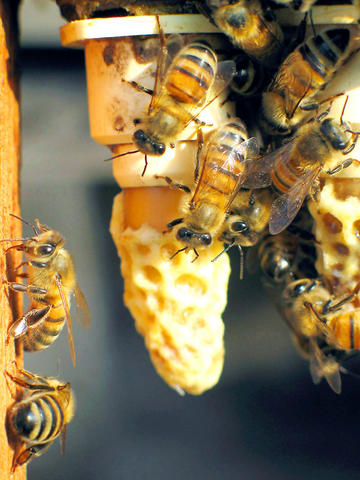
PHOTO: AFP
The apiculture industry in the US - and dozens of agricultural crops, from almonds to apples to avocados, that depend on bees for pollination - has also been devastated, though experts say the reasons, while related, may not be exactly the same.
In France, honey production in the US$150 million sector dropped by half over a nine-year period to 18,000 tonnes in last year, according to agriculture ministry statistics.
Average income for the sector's 75,000 beekeepers has dropped by 65 percent, forcing many to take on second jobs just to make ends meet.
"One of my fellow apiculturists committed suicide, and families have been torn apart," said Aletru.
But last winter, bee populations in France only shed about 10 percent of their numbers - a normal seasonal loss.
Many scientists, and most beekeepers, attributed the first good news in a decade of decline to the banning of Regent and Gaucho, two pesticides thought to enter the hives through the pollen collected by the bees, especially from France's ubiquitous sunflowers.
The manufacturers, German chemical giants BASF and Bayer, have denied that their products are toxic for humans or bees.
"It is difficult to imagine that these insecticides had no impact," said Vaissiere. "They were in the pollen and the nectar - I don't see how the pollinating bees could have failed to ingest them."
But a nest of other factors, experts say, have also contributed to colony collapse disorder: reduced biodiversity stemming from monoculture farming, bacterial parasites such as Varroa destructor and Nosema ceranae and a deadly pathogen called Israeli Acute Paralysis Virus (IAPV).
IAPV has struck the US as well, and is thought to have originated in bees imported from Australia to repopulate hives, and from royal jelly, a honey-derived product manufactured in China.
Another parasite, the varroa mite, may weaken bee's immune systems to the point that they become vulnerable to these diseases, experts say.
The most recent threat to bees is the Asian hornet, Vespa velutina, which probably arrived in southern France in a shipment of pottery sometime in 2004.
The hornet, which preys on honeybees, has already spread through much of southwestern France, and could eventually colonize much of the Mediterranean coastal area, experts say.
"Thirty-five percent of the world's vegetal food resources depend on bees for pollination - we cannot ignore this problem," said Beatrice Robrolle-Marcy, president of the association Bee Planet.
Ajay Verma, a consultant gastroenterologist at Kettering general hospital in Northamptonshire, says our gut is a “complex machine.” “It is constantly providing us with the nutrition we need, initially to grow and develop, and then for us to survive, thrive and repair from injury and illness.” How can we keep it functioning well? Put simply: “Make sure what you put into it is balanced, and that you clear out its waste products adequately,” Verma says. “In a general gastroenterology clinic, the most common conditions we see are irritable bowel syndrome (IBS), gastroesophageal reflux disease, inflammatory bowel disease and constipation,” says Nisha

And so, in the wake of US President Donald Trump’s trip to the People’s Republic of China (PRC), all the experts on the Strait of Hormuz suddenly became experts on US-China-Taiwan relations. The Internet has certainly expanded human knowledge. Lots of these sudden experts made noise this week about Trump’s words after the meeting with PRC dictator Xi Jin-ping (習近平). Trump is going to sell out Taiwan! Longtime Taiwan commentator J. Michael Cole summed the situation up neatly in the Guardian: “We need to keep in mind that he has a tendency to say many things — sometimes contradicting himself within

Last week US President Donald Trump was asked by a reporter whether he would speak on the phone to the President of Taiwan. “l’ll speak to him. I speak to everybody. We have that situation very well in hand,” Trump said. This marked the second time in a couple of weeks he had said he would talk to the President of Taiwan. In 2016 he famously took a call from then-president Tsai Ing-wen (蔡英文), when he was president-elect. Despite warnings that the apocalypse was nigh because of a phone call, the world quickly forgot about the conversation between two democratically-elected presidents.
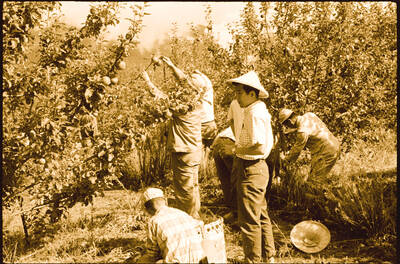
May 25 to May 31 Few believed that apples could be cultivated on a commercial scale in Taiwan’s high mountains. When horticulturalist Cheng Chao-hsiung (程兆熊) first proposed the idea in 1955, both American and Taiwanese colleagues dismissed it as implausible, arguing that temperate fruit could not be reliably grown on a subtropical island, especially on rugged terrain. However, it was this terrain in the Central Mountain Range where many Chinese Civil War veterans were resettled in the late 1950s. With limited job prospects and no family in Taiwan, they were placed on cooperative farms aimed toward self-sufficiency. Some say the conditions


 RSS
RSS