


Bertrand Delanoe's favorite dish is, apparently, a blanquette de veau, the creamy stew that is a staple of old-style French bistro cooking. It is the sort of dish that is served for cheap lunches in the cheaper cafes or occasionally, with some irony, in a good restaurant. The gastronomic historians who proliferate in France say the dish is associated with mothers placing steaming pots on checkered tablecloths, traditional family values, farmers returning from fields, a mythic vision of France of yesteryear. It is not necessarily what you would expect the solidly socialist gay mayor of France's capital, since 2001, to tuck into on his days off.
But that is the sort of counterintuitive double bluff that Delanoe excels at. The 57-year-old politician, who will be standing again for mayor at the end of his six-year mandate in March and has hopes to be the next French president if the left can shunt Sarkozy aside in 2012, is a difficult man to pin down. A brutally effective political instinct is concealed beneath his smooth, impeccably tailored exterior and charm. A vicious streak too lies alongside an argumentative affability. Principles lie alongside an impatience with ideological dogma. He is not particularly charismatic, but sees that as a virtue.
Last week was an eventful one for Delanoe. First, it was revealed that he is planning an autolib to supplement the highly successful free bicycle system, the velib introduced last year. Two thousand small cars will be available for short-term users from stands on street corners in the same way that bicycles in Paris are now. The velib has already provoked Europe-wide interest and the audacious new plan boosted a profile that was flagging internationally.
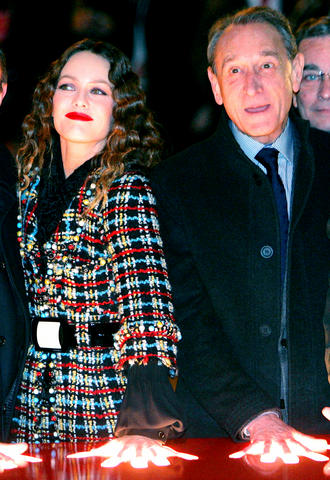
Then, jumping neatly from the municipal to the national, Segolene Royal, the defeated socialist candidate in last year's presidential elections, announced that she would take on Delanoe, a former ally, in a battle for the leadership of the Socialist party next year. If Delanoe wants to use his current post as a trampoline to the Elysee palace, as Jacques Chirac did, he needs to beat Royal first. The mayor of Paris never speaks openly about the presidency, but few doubt his ambition.
Delanoe, who lives in a large flat in the chic literary quarter, was born in Tunisia to French parents in 1950, the son of a conservative atheist surveyor father and a pious nurse mother. A solitary, dreaming, inattentive child, the experience of growing up in a country where religious communities from the three major monotheistic faiths lived in relative harmony marked him deeply, he has often said, adding that it was the sight of French troops violently repressing a local protest that first sent him towards the left.
His family returned to France when he was 14 and, based near the southern city of Rodez, he joined the Socialist party at the age of 21, starting his political career with the local party federations soon afterwards.
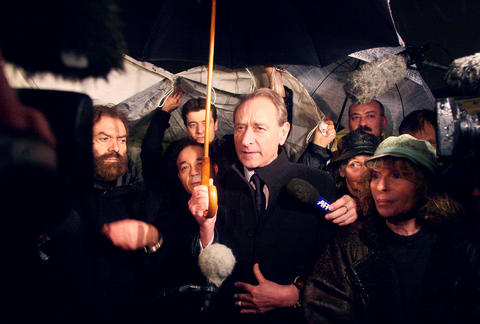
His first major break came when Francois Mitterand recognized his talent as a public speaker. The patronage of the leader of the French left helped the aspirant politician win a seat as a Paris city councilor in 1977 and then election to the National Assembly four years later as member for Montmartre. The young politician rose fast - perhaps too fast. "I wound people up," he later told an interviewer. The result was a period in the political wilderness, a job as a PR man and wealth. Delanoe, the grandson of sailors, bought himself a yacht.
Then it was time for the comeback. In 1995, he faced his first real fight, leading an assault by the left on the Paris town hall, a bastion of conservatism since 1871. Though he lost, he managed to win six arrondissements out of 20, all in the poorer and more ethnically mixed north and the east of the city. Next time, in 2001, he faced a divided right and won, just, with 49.5 percent of the vote.
Paris, despite all its resistance to change, was evolving and Delanoe was well-placed to exploit the shifts. Critics also implied that his homosexuality - he came out in a television interview in November 1998 - helped him. Though he makes an annual appearance at Paris Gay Pride and has increased subsidies to gay and lesbian campaign groups, he plays down his sexuality, keeping his private life out of politics.
In Paris, his overall record is seen as steady, rather than inspirational, which is not necessarily a bad thing after the scandal-ridden 1990s.
If Delanoe is cautious, it may not be entirely his fault. He has two handicaps, both of which contribute to a certain lack of personal and political clarity. The first is the parlous state of the French left. The mayor of Paris has little time for the rejectionism or idealism of many other French socialists. "I am going to be provocative," he told a recent interviewer. "Why shouldn't we learn from the American model when it is a matter of public subsidies for research and development? Why not admit that Tony Blair is right to say that to share wealth, you have to create it first? Let's not be demagogues, promising everyone that we will fix everything." But such views do not win you support within the Socialist party machine. His praise for Pope John Paul II earned him brickbats from party hardliners.
The second problem is Paris itself. For all Delanoe's criticism of London - he used the term "London-ization" to describe the gentrification of entire city centers - Paris is much less socially and ethnically mixed than the British capital. It is less open, tolerant and confident too. There is a sense that the cultural legacy of the 20th century is exhausted and that the city is drifting away from the mainstream of global commercial and political life. Delanoe has pledged to battle "the museum-ification" of his city.
The latest major issue is that of the tower blocks that are being considered around the edges of Paris to ease the crisis of affordable housing. The question of how and where to break up the City of Light's famous skyline is sufficiently important for Sarkozy to get involved. At a recent joint press conference, the mayor and the head of state stood side by side. A battle of egos played out before the TV cameras. "This is not an ideological question," said Sarkozy. "If the towers look good, we will build them. I believe Mr Delanoe agrees with me."
The mayor flinched. "No," he said to the president. "I believe you agree with me."

This is the year that the demographic crisis will begin to impact people’s lives. This will create pressures on treatment and hiring of foreigners. Regardless of whatever technological breakthroughs happen, the real value will come from digesting and productively applying existing technologies in new and creative ways. INTRODUCING BASIC SERVICES BREAKDOWNS At some point soon, we will begin to witness a breakdown in basic services. Initially, it will be limited and sporadic, but the frequency and newsworthiness of the incidents will only continue to accelerate dramatically in the coming years. Here in central Taiwan, many basic services are severely understaffed, and
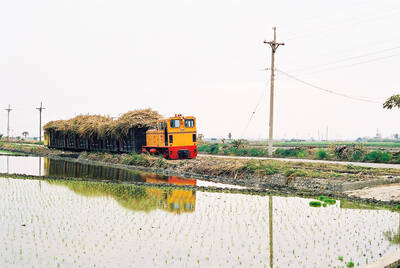
Jan. 5 to Jan. 11 Of the more than 3,000km of sugar railway that once criss-crossed central and southern Taiwan, just 16.1km remain in operation today. By the time Dafydd Fell began photographing the network in earnest in 1994, it was already well past its heyday. The system had been significantly cut back, leaving behind abandoned stations, rusting rolling stock and crumbling facilities. This reduction continued during the five years of his documentation, adding urgency to his task. As passenger services had already ceased by then, Fell had to wait for the sugarcane harvest season each year, which typically ran from
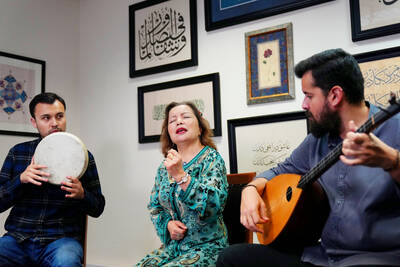
It is a soulful folk song, filled with feeling and history: A love-stricken young man tells God about his hopes and dreams of happiness. Generations of Uighurs, the Turkic ethnic minority in China’s Xinjiang region, have played it at parties and weddings. But today, if they download it, play it or share it online, they risk ending up in prison. Besh pede, a popular Uighur folk ballad, is among dozens of Uighur-language songs that have been deemed “problematic” by Xinjiang authorities, according to a recording of a meeting held by police and other local officials in the historic city of Kashgar in

It’s a good thing that 2025 is over. Yes, I fully expect we will look back on the year with nostalgia, once we have experienced this year and 2027. Traditionally at New Years much discourse is devoted to discussing what happened the previous year. Let’s have a look at what didn’t happen. Many bad things did not happen. The People’s Republic of China (PRC) did not attack Taiwan. We didn’t have a massive, destructive earthquake or drought. We didn’t have a major human pandemic. No widespread unemployment or other destructive social events. Nothing serious was done about Taiwan’s swelling birth rate catastrophe.


 RSS
RSS