


People born between 1981 and 1991 in Taiwan are colloquially referred to as the "strawberry generation."
The analogy, which draws a parallel between youngsters brought up with economic security and strawberries grown in a greenhouse, suggests that young people are less equipped to deal with pressure than their ancestors, who endured greater economic hardships. Those who hold this view believe that a comfortable upbringing leads to maladjusted children who are unable to hold down a job or appreciate the value of hard work, or community spirit later in life.
A local troupe, Creative Mist Body (嵐創作體) -- mainly composed of members of this supposedly work-shy, materialistic group -- is putting on a production of composer Stephen Sondheim and director and author James Lapine's Into the Woods beginning tonight.

PHOTO COURTESY OF THE ARTISTS
The musical, which is to be performed in English, combines the classic fairy tales of Jack and the Beanstalk,Cinderella, Rapunzel, and Little Red Riding Hood and carries a stark message: greed and gluttony are destructive traits whereas family and community values are constructive.
The Broadway hit, which first took to the stage in 1987, tells the tale of a baker and his wife who have been cursed by a witch so they are unable to have children. All is not lost, though, as the spell can be broken. The baker and his wife must bring the witch a milk-white cow and a blood-red cape among other gifts.
After a few botched attempts and some overt moralizing, the couple is able to perform the tasks necessary to break the spell.
The tale doesn't end on this happy note, however, as there is a twist involving a giant's wife who returns to exact revenge on the other characters. The moral being: only by banding together can they defeat her.
Into the Woods is at the Arts Dance Theater, Taipei National University of the Arts, 1, Xueyuan Rd, Peitou, Taipei (
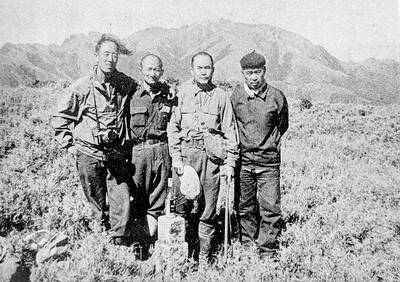
May 18 to May 24 Gathered on Yangtou Mountain (羊頭山) on Dec. 5, 1972, Taiwan’s hiking enthusiasts formally declared the formation of the “100 Peaks Club” (百岳俱樂部) and unveiled the final list of mountains. Famed mountaineer Lin Wen-an (林文安) led this effort for the Chinese Alpine Association (中華山岳協會). Working with other experienced climbers, he chose 100 peaks above 10,000 feet (3,048m) that featured triangulation points and varied in difficulty and character. The list sparked an alpine hiking craze, inspiring many to take up mountaineering and competing to “conquer” the summits. A common misconception is that the 100 Peaks represent Taiwan’s 100 tallest

Yesterday, the Democratic Progressive Party (DPP) nominated legislator Puma Shen (沈伯洋) as their Taipei mayoral candidate, the Chinese Nationalist Party (KMT) put their stamp of approval on Wei Ping-cheng (魏平政) as their candidate for Changhua County commissioner and former legislator Tsai Pi-ru (蔡壁如) of the Taiwan People’s Party (TPP) has begun the process to also run in Changhua, though she has not yet been formally nominated. All three news items are bizarre. The DPP has struggled with settling on a Taipei nominee. The only candidate who declared interest was Enoch Wu (吳怡農), but the party seemed determined to nominate anyone

In a sudden move last week, opposition lawmakers of the Chinese Nationalist Party (KMT) and Taiwan People’s Party (TPP) passed a NT$780 billion special defense budget as a preemptive measure to stop either Chinese leader Xi Jinping (習近平) or US President Donald Trump from blocking US arms sales to Taiwan at their summit in Beijing, said KMT heavyweight Jaw Shaw-kong (趙少康), speaking to the Taipei Foreign Correspondents Club on Wednesday night in Taipei. The 76-year-old Jaw, a political talk show host who ran as the KMT’s vice presidential candidate in 2024, says that he personally brokered the deal to resolve

The Chinese Nationalist Party (KMT), alongside their smaller allies the Taiwan People’s Party (TPP), are often accused of acting on behalf of the Chinese Communist Party (CCP). Some go so far as to call them “traitors.” It is not hard to see why. They regularly pass legislation to stymie the normal functioning of the ruling Democratic Progressive Party’s (DPP) administration, and they have yet to pass this year’s annual budget. They slashed key elements of the government’s proposed NT$1.25 trillion (US$40 billion) special military budget, and in the smaller NT$780 billion package they did pass, it is riddled with provisions that


 RSS
RSS