


Philip Roth does not look or act like a man who has just been canonized. He is still among us, and there is still a gleam in his eye. He still tosses off jokes with a rimshot quickness and gift for mimicry that would have guaranteed him -- had the writing career ever fizzled -- top billing as a stand-up act in Vegas. He used to have a great routine, for example, about why Jewish couples keep their sex manuals in the credenza.
Nevertheless, Roth, who grew up in the Weequahic section of Newark -- not exactly a cultural hotbed -- and who for a while in the 1960s was considered the wiseacre of American letters, has been admitted to this country's most exclusive literary club: The Library of America, that handsome series of uniform editions with dramatic black jackets, ribbon bookmarks and Bible-page-thin, acid-free paper. Even the typeface, crisp 10-point Galliard, confers on the volumes a kind of memorial dignity. This is an honor usually reserved for the long-dead, like Melville and Longfellow, and only two other living writers have been awarded membership: Eudora Welty in 1998 and Saul Bellow in 2003, when they were then 90 and 88, respectively, and had more or less stopped writing. Roth, now 72, is still reinventing himself.
The first two volumes are just out: Novels and Stories 1959 to 1962 (which includes Goodbye, Columbus and Five Short Stories and Letting Go) and Novels 1967 to 1972 (When She Was Good, Portnoy's Complaint, Our Gang and The Breast). The plan calls for six more to be issued, one every year or so, for a total of eight, which will put him second in Library of America shelf space only to Henry James, who has 14.
The last volume is scheduled to appear on Roth's 80th birthday in March 2013, at which time Max Rudin, the publisher of The Library of America, has promised to give him a party. On learning of this arrangement, Roth said, he told Rudin, "Max, maybe we should have the party sooner."
The volumes have full-size jacket photos of a young and darkly handsome Philip Roth with burning, Tyrone Power-like eyes. The publishing plan also calls for the photos to be updated in subsequent volumes, so that Roth will gradually age right before his readers' eyes, until by Volume 8, presumably, he looks much the way he does today -- still handsome, but thinner on top, bushier of brow and senatorially gray at the temples. He could pass these days for the president of Metropolitan Life, where his father toiled for so many years without ever being offered a promotion.
Roth, who at various times in his life has been a reluctant celebrity -- when Claire Bloom published her memoir blaming him for the breakup of their marriage, for example -- these days leads a life of Tolstoyan quietness and privacy, devoted to reading and writing. He spends most of his time at an 18th-century Connecticut farmhouse he bought in 1972 -- so long ago, he says, that he now almost qualifies as an honorary Yankee. The place is so out of the way that you need GPS to find it, and it includes stone walls, towering ash trees and a triangular, tree-rimmed clearing that Roth, a lifelong baseball fan, jokes about turning into a ball field. There is a spare, wood-paneled studio in back where he writes every day, standing up mostly, at a tall computer table.
Canonization has not carried Roth away. "The initial delight is wonderful," he says. "But after a while, it's just another edition of a book." On the other hand, the occasion has apparently caused him to take stock. In midcareer -- in novels like The Counterlife and Operation Shylock and the several Zuckerman stories -- Roth specialized in spinning off multiple
fictional versions of himself.
He wrote Goodbye, Columbus and the stories collected in that volume, he said, because that was what aspiring writers did in those days -- they wrote stories and hoped to publish them in places like The New Yorker and The Paris Review, which he succeeded in doing. Then, in the late 1950s, he deliberately set out to write a big, ambitious novel -- which turned out as Letting Go, his longest book by far, and one that combines elements of James, Bellow, and even Dostoyevsky.
From 1962 to 1967, Roth published hardly a word. It was the longest drought of his career. "I really didn't know where to go," he said, "and I had two or three false starts -- significant false starts of a hundred pages or so. They're down in the Library of Congress -- the Library of False Starts, they ought to call it. And then I decided I would just completely shift into this other tone, which was as unlike the other books as it could be."
Twenty-five years later, in the chaste pages of The Library of America, Portnoy's Complaint still goes off like a bomb. It's irreverent; brash and angry at times, full of feeling and affection at others; and in those censorious times, it surely contained more masturbation scenes than any book not sold from under the counter. It's a dirty book that happens to be extremely funny, and vice versa, and fairly or not, it may be the book for which Roth will always be best known, the one that got him labeled both a pervert and a betrayer of the Jews.
"So many people of the people who claimed to be offended by the book said they were offended by the masturbation," he recalled. "But that's silly. Everybody knew about masturbation. What they were really offended by was the depiction of this level of brutality in a Jewish family."
For Roth, and for US fiction in general, Portnoy's Complaint was the end of an era -- of apprenticing oneself to the old literary models and carefully observing the rules of literary procedure and decorum. And it was the beginning of a period, still going on, of figuring out what to do when there are no longer any rules.
A few years ago, some critics began to write off Roth. But starting with Sabbath's Theater, in 1995, and continuing through The Plot Against America, which came out a year ago, he has experienced an extraordinary burst of second wind. "I think I've gotten better," he said decisively, dismissing the notion that the young writer, the one with the burning eyes staring out from the Library of America jacket, might have been able to do things the older one can't. But he has been thinking lately about writers who weren't so lucky and who petered out -- about Hemingway, for example.
"Booze," he said. "Booze was the problem with Hemingway, with Faulkner and with so many others. They both died in their early 60s. It's almost inconceivable." At this time of year, Roth still reads outside in the early evenings, in a tent of mosquito netting, until the daylight fades, and his main vice is then slipping indoors to check on the Yankees for a couple of hours. "The canonized go on," he said, adding that he has just about finished a new piece, which he called "a very long story, 90 pages or so, and very dark." Pressed to describe it further he said, "That's it -- 90 dark pages."

Ajay Verma, a consultant gastroenterologist at Kettering general hospital in Northamptonshire, says our gut is a “complex machine.” “It is constantly providing us with the nutrition we need, initially to grow and develop, and then for us to survive, thrive and repair from injury and illness.” How can we keep it functioning well? Put simply: “Make sure what you put into it is balanced, and that you clear out its waste products adequately,” Verma says. “In a general gastroenterology clinic, the most common conditions we see are irritable bowel syndrome (IBS), gastroesophageal reflux disease, inflammatory bowel disease and constipation,” says Nisha

And so, in the wake of US President Donald Trump’s trip to the People’s Republic of China (PRC), all the experts on the Strait of Hormuz suddenly became experts on US-China-Taiwan relations. The Internet has certainly expanded human knowledge. Lots of these sudden experts made noise this week about Trump’s words after the meeting with PRC dictator Xi Jin-ping (習近平). Trump is going to sell out Taiwan! Longtime Taiwan commentator J. Michael Cole summed the situation up neatly in the Guardian: “We need to keep in mind that he has a tendency to say many things — sometimes contradicting himself within

Last week US President Donald Trump was asked by a reporter whether he would speak on the phone to the President of Taiwan. “l’ll speak to him. I speak to everybody. We have that situation very well in hand,” Trump said. This marked the second time in a couple of weeks he had said he would talk to the President of Taiwan. In 2016 he famously took a call from then-president Tsai Ing-wen (蔡英文), when he was president-elect. Despite warnings that the apocalypse was nigh because of a phone call, the world quickly forgot about the conversation between two democratically-elected presidents.
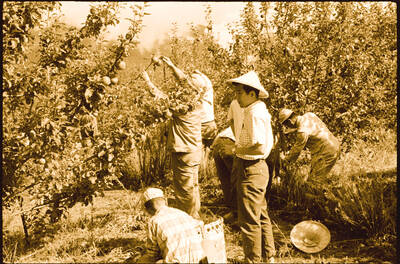
May 25 to May 31 Few believed that apples could be cultivated on a commercial scale in Taiwan’s high mountains. When horticulturalist Cheng Chao-hsiung (程兆熊) first proposed the idea in 1955, both American and Taiwanese colleagues dismissed it as implausible, arguing that temperate fruit could not be reliably grown on a subtropical island, especially on rugged terrain. However, it was this terrain in the Central Mountain Range where many Chinese Civil War veterans were resettled in the late 1950s. With limited job prospects and no family in Taiwan, they were placed on cooperative farms aimed toward self-sufficiency. Some say the conditions


 RSS
RSS