


It should not come as a surprise to anyone who has visited a doctor for even the most minor of medical complaints and been presented with a prescription for a vast array of colorful pills that the call for Western pharmaceuticals in Taiwan is huge.
The populace's reliance on modern Western medicine as a cure for everything from erectile dysfunction to the common cold means that Taiwan's pharmaceutical expenditure cashes in at a hefty NT$100 billion per year.
Patients don't, however, always get what they pay for.
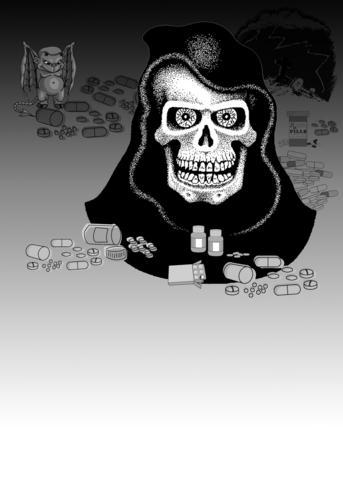
ILLUSTRATION: CONSTANCE CHOU
According to recent figures from the Department of Health (DOH), every year around NT$10 billion of the populace's pharmaceutical outlay goes towards lining the pockets of the organized criminal gangs that smuggle, manufacture and sell counterfeit pharmaceutical products to an unsuspecting public.
The problem is now so great that those who purchase any one of over a dozen popular name-brand pharmaceuticals from pharmacies and private clinics run the risk of inadvertently ingesting worthless and, or dangerous counterfeit medications.
"It is a huge problem. Nobody knows whether anyone has died as a direct result of taking counterfeit drugs, but taking these products certainly poses great risks," said Carol Cheng (
There are several ways in which counterfeit medications are classified, but the most commonly used are those employed by the WHO. The list includes any pharmaceutical product that is deliberately mislabeled in respect to identity or source; any product that contains incorrect quantities of or does not contain active ingredients; one that contains the wrong ingredients and any product that comes in fake packaging.
While the use of counterfeit medicines stands at 10 percent of Taiwan's annual consumption -- a number similar to the US FDA's estimates for the saturation of counterfeit medication on a global scale per-nation -- the penetration rate for some brand-name products in Taiwan is well above the norm.
The infiltration rates for counterfeit impotency medications Cialis and Viagra, the hypnotic Stilnox, Reductil slimming pills, the osteoarthritis drug Glucosamine, Centrum multi-vitamin tablets and the anti-diarrhea medication Seirogan are estimated to stand at a staggering 20 percent to 30 percent.
"In developing countries we see more medicinal pharmaceuticals counterfeited. Anti-malaria pills and so on, but in developed countries it tends to be what we refer to as `lifestyle' drugs and those aimed at curing chronic diseases," Cheng said. "People purchase a lot of these types of pharmaceuticals here and the counterfeiters are well aware of this."
"The fakes are sometimes easy to spot. If the packaging is not in Chinese, then it is a fake, as the Law states that all pharmaceuticals sold in Taiwan have to be printed in Chinese," said pharmacist Hsu Chao-lun (
The raw ingredients for the counterfeit medications produced in Taiwan are smuggled from China and, on average cost as little as NT$1,000 per kilogram. A large amount of the packaging used by counterfeiters is illegally imported from Singapore. Counterfeit medication can be produced, packaged and sent to market for between NT$1 and NT$20 per tablet.
Counterfeiters are also no longer deterred by regular alteration of security features on packaging as the drug manufacturing giant Eli Lilly discovered earlier this year. Having released new packaging for one of its well-known items in January the company was shocked to see that by April, forgers in Taiwan had already managed to copy the new security aspects verbatim.
"It's very well organized. The factories are run by organized crime [syndicates] who will use the same machines to produce [amphetamines] one week and blood pressure pills the next," said Jeffery Harris of the private investigations company, Orient Commercial Inquires. "The profit margin these guys are looking at is between 15 and 20 percent."
According to Pfizers' director of legal affairs William Tsai (蔡德揚), those who choose to use no active ingredients in knock-off Vaigra can make an even greater profit.
"Genuine [Viagra] costs NT$1,500 for a packet of four tablets so if somebody can produce the same thing, but with zero active ingredient then the profit margin can reach almost 100 percent," Tsai said. "We have the largest market share of all [erectile dysfunctional] pharmaceuticals so the demand is for Viagra is huge. If you think about how many people purchase it then the counterfeiters are making a lot of money."
Bending to pressure from the pharmaceutical industry and both the American Chamber of Commerce and the European Chamber of Commerce, whose most recent White Papers dedicated entire chapters to the need to clamp down on counterfeit pharmaceuticals, the Legislative Yuan passed amendments to Pharmaceutical Law in March of last year.
Whereas in the past the laws governing the sentencing of those convicted of pharmaceutical counterfeiting were lax, those who knowingly manufacture or import counterfeit products can now face up to seven years imprisonment and a fine of NT$10 million. Those who repeatedly flout the law can be sentenced to more than seven years and be fined NT$25 million. Sentences ranging from 10 years to life can now be handed down in circumstances where a consumer dies from taking bogus medication.
In addition to the ability to charge individuals with violations of the Pharmaceutical Law there are several other avenues open to the courts. Counterfeiters can be charged under the Trademark Law for the unlawful use of trademarks and logos, they can be charged under the Copyright Law, which states that any individual found guilty of the unauthorized reproduction of specification sheets of medicines can be sentenced to between six months and three years and the Criminal Law, which deals with the forging of pharmaceutical companies' names on packaging.
Sadly, the amendments look a whole lot better on paper than they are in reality. Those convicted for trading in or producing counterfeit pharmaceuticals still often receive insignificant sentences.
"In many cases it's a wrist slapping exercise. A majority of those found guilty still avoid prison. If they are sentenced then chances are they'll serve [a prison term] of no more than six months, which, of course can be altered to a fine of roughly NT$900 per day," said John Eastwood, an attorney with Wenger and Vieli. "It's a pittance and they simply pay their way out of prison."
Of a total of 263 cases that went before the courts from between January 2003 and July last year, 137 individuals were sentenced to no more than six months imprisonment. The toughest sentences handed down during the same period saw only one individual sentenced to more than three years in prison.
Catching and prosecuting those who manufacture and distribute knock-off medication is only one part of the problem. A gray area exists when it comes to the prosecution and revoking the licenses of pharmacists' accused of selling counterfeit products.
From early 2004 until mid-2005 a total of 28 pharmacists have been investigated. Of these, one defendant was fined and another released on probation. None have had their licenses revoked.
Currently the DOH is solely responsible for issuing licenses and lacks the power to revoke the license of any pharmacist accused of trading in counterfeit products. This is instead the job of the regional pharmacists' associations, all of which are highly hesitant to act and take away the livelihood of a member.
"You'd think that they'd act and take away licenses," Eastwood said. "If a member gets caught selling counterfeit [pharmaceuticals] you'd think that the pharmacists' associations would want to defend their integrity. Personally I'd like to see them banned for life."
While the legal wrangling continues, many of the international pharmaceutical giants based in Taiwan have decided to follow the route taken by the DOH and IRPMA. Along with continuing to purse the forgers, companies like Eli Lilly and Pfizer have also taken to educating the consumers.
The companies have established their own educational programs and like the DOH and IRPMA have developed Web pages on which photographs of genuine products allow the public to differentiate between the real and fake items.
"Education is a very important factor and is an area in which the industry can and should work together," said Melt van der Spuy, general manager of Eli Lilly in Taiwan. "We supply pharmacies with materials so that they can display it in the stores and run advertisements in the media. All of this helps consumers to tell the difference between real and fake drugs and feel safe in the knowledge that what they are taking is real."
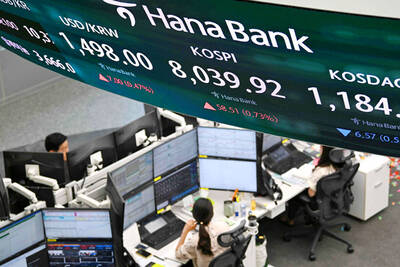
Taiwan’s overtaking of South Korea in GDP per capita is not a temporary anomaly, but the result of deeper structural problems in the South Korean economy says Chang Young-chul, the former CEO of Korea Asset Management Corp. Chang says that while it reflects Taiwan’s own gains, it also highlights weakening growth momentum in South Korea. As design and foundry capabilities become more important in the AI era, Seoul risks losing competitiveness if it relies too heavily on memory chips. IMF forecasts showing Taiwan widening its lead over South Korea have fueled debate in Seoul over memory chip dependence, industrial policy and
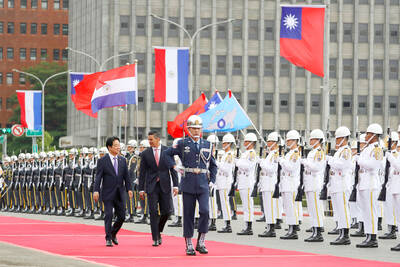
“China wants to unify with Taiwan at the lowest possible cost, and it currently believes that unification will become easier and less costly as time passes,” wrote Amanda Hsiao (蕭嫣然) and Bonnie Glaser in Foreign Affairs (“Why China Waits”) this month, describing how the People’s Republic of China (PRC) is playing the long game in its quest to seize Taiwan. This has been a favorite claim of many writers over the years, easy to argue because it is so trite. Very obviously, if the PRC isn’t attacking Taiwan, it is waiting. But for what? Hsiao and Glaser’s main point is trivial,
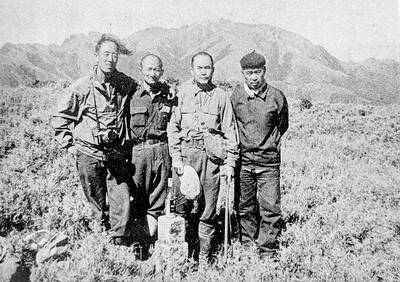
May 18 to May 24 Gathered on Yangtou Mountain (羊頭山) on Dec. 5, 1972, Taiwan’s hiking enthusiasts formally declared the formation of the “100 Peaks Club” (百岳俱樂部) and unveiled the final list of mountains. Famed mountaineer Lin Wen-an (林文安) led this effort for the Chinese Alpine Association (中華山岳協會). Working with other experienced climbers, he chose 100 peaks above 10,000 feet (3,048m) that featured triangulation points and varied in difficulty and character. The list sparked an alpine hiking craze, inspiring many to take up mountaineering and competing to “conquer” the summits. A common misconception is that the 100 Peaks represent Taiwan’s 100 tallest

Yesterday, the Democratic Progressive Party (DPP) nominated legislator Puma Shen (沈伯洋) as their Taipei mayoral candidate, the Chinese Nationalist Party (KMT) put their stamp of approval on Wei Ping-cheng (魏平政) as their candidate for Changhua County commissioner and former legislator Tsai Pi-ru (蔡壁如) of the Taiwan People’s Party (TPP) has begun the process to also run in Changhua, though she has not yet been formally nominated. All three news items are bizarre. The DPP has struggled with settling on a Taipei nominee. The only candidate who declared interest was Enoch Wu (吳怡農), but the party seemed determined to nominate anyone


 RSS
RSS