


In the 1970s Kimbo, or Tuko Mackaruwane in his native Puyuma language, was known as Taiwan's Bob Dylan, blending Taiwanese Aboriginal sounds into his poetry and folk music.
Named Hu Defu (
Produced by Cheng Chieh-ren (
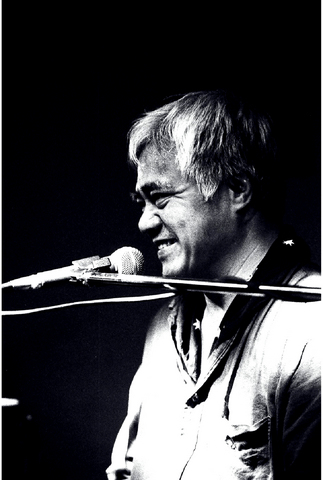
"It's hard not to be touched by Hu's natural yet powerful voice," said Lee Kun-yao (
Back then, Kimbo was Taiwan's highest paid folk singer, earning up to NT$25,000 a month -- at a time when the monthly salary of a Cabinet minister was NT$7,000 per month.
"Maybe my songs were too heavy for the market or to package for commercial record companies. They were written not for publishing purposes in the first place," Kimbo said in a cafe in Taipei, a cigarette constantly in one hand.
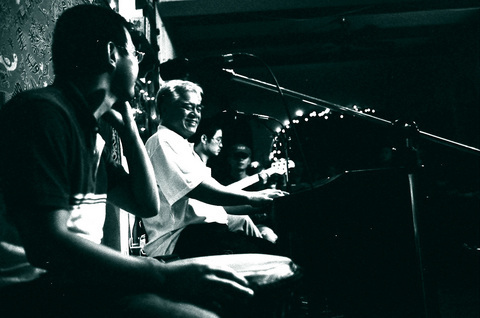
PHOTOS COURTESY OF IGNITE FIRE
Kimbo said he is not a prolific songwriter. He writes about one song a year, each one written, he said, after the pain in his body, heart and soul had reached a cresting point.
"If a song cannot move me to an unbearable degree, I would not publish the song," he said.
The blues he feels is from his 30-year involvement in Taiwan's political, social and Aboriginal movements. In all of these upheavals over the years, Kimbo's role hasn't been that merely of the protest singer, but rather he has been the frontman and organizer of many demonstrations.
In the 1980s Kimbo was a member of the tangwai (
Hu was among the first to talk about reclaiming land from Han Chinese-owned businesses and from the government, preserving Aboriginal names and raising the issue of Aboriginal girls being forced into prostitution.
Even in 1999, a decade after the peak of Taiwan's political and social movements, when the 921 earthquake devastated 90 percent of Aboriginal villages in central Taiwan, Kimbo emerged again, leading clashes with police over unfair treatment of Aboriginal villagers.
When Lien Chan (
All these actions and sentiments have been accumulated and encapsulated in his songs.
The Longest Road (
Darter, Clouded Leopard, The Basin Of Taipei (
Kimbo also wrote folk songs, such as The Boy On The Buffalo's Back (
Kimbo's singing talent took root in his high school years at Taipei's Tam-kang High School, a religious school set up by the missionary George Leslie Mackay. Students were trained to sing psalms and choral songs every morning and to play rugby every afternoon.
"I remember all the boys who loved to sing formed quartets and competed with each other every morning," Kimbo said.
He recalled a nun named Ms Taylor, who introduced Scottish folk songs and American Southern spirituals to the boys.
"I was naturally drawn to the rhythm of blues and spirituals and was gradually influenced by these vocal styles," Kimbo said.
"Little by little, I began to understand the content of spirituals and found lots of similarities with Taiwanese Aboriginal music. The repeating patterns of the blues are very similar to some music styles in Puyuma Paiwan music.
"The lyrics of Aboriginal folk music, like spirituals, tell about suffering. But I feel there is more praise to nature in Taiwanese Aboriginal music, instead of just telling about the pain," Kimbo said.
Romanticism and spontaneity seem to always drive Kimbo, making him a pioneer in many other businesses outside his folk music and social-movement activism.
He and friends opened Taiwan's first teppanyaki restaurant in Taipei in 1970. He was also once a partner in Taiwan's leading toy business. But these businesses were all flash-in-the-pan affairs, like many of the short-lived protest campaigns.
His free-spirited style demonstrates Kimbo's talent, but it is also sometimes a source of trouble for his producers. For instance, he never sings the same lyrics twice. Two years ago, it took him two hours to shoot a 20-second music video clip because he could not sing the same lyrics in front of the camera.
"I've sung that song tens of thousands of times. None of the times have I sung the same lyrics," he said.
Now Kimbo has decided to redirect his focus toward music, his one passion.
"I decided that this time I would lay down everything else and start to treat my music, especially Aboriginal music, with respect," Kimbo said.
As Time Flashes is meant to be a summing-up of his past musical career so that he can begin pursuing his new musical passions.
"I want to systematically explore the heritage of Aboriginal music, especially the abundant use in Aboriginal music of words like ho hai yan which don't actually have any meaning. I want to explore the beauty of these words and blend their usage into my own music,"
He will also work more closely with young Aboriginal musicians and music producers to help develop new talent.
"There are so many beautiful voices among the younger generation Aboriginal musicians. Unlike me. Only my heart still rocks," Kimbo said with a laugh.


The US war on Iran has illuminated the deep interdependence of Asia on flows of oil and related items as raw materials that become the basis of modern human civilization. Australians and New Zealanders had a wake up call. The crisis also emphasizes how the Philippines is a swatch of islands linked by jet fuel. These revelations have deep implications for an invasion of Taiwan. Much of the commentary on the Taiwan scenario has looked at the disruptions to world trade, which will be in the trillions. However, the Iran war offers additional specific lessons for a Taiwan scenario. An insightful

Polling data often confirms what we expect, but sometimes it throws up surprises. When examined over time, some patterns appear that speak to something bigger going on. In this column, whenever possible, Formosa’s polls are used. Despite the sometimes cringeworthy antics of Formosa’s Chairman, Wu Tzu-Chia (吳子嘉), the data produced includes detailed breakdowns crucial for analysis. It has also been conducted monthly 11-12 times a year for many years with many of the same questions, allowing for analysis over time. When big shifts do occur between one month and the next it is usually in response to some event in
The problem with Marx’s famous remark that history repeats itself, first as tragedy, the second time as farce, is that the first time is usually farce as well. This week Chinese Nationalist Party (KMT) Chair Cheng Li-wun (鄭麗文) made a pilgrimage to the People’s Republic of China (PRC) “to confer, converse and otherwise hob-nob” with Chinese Communist Party (CCP) officials. The visit was an instant international media hit, with major media reporting almost entirely shorn of context. “Taiwan’s main opposition leader landed in China Tuesday for a rare visit aimed at cross-strait ‘peace’”, crowed Agence-France Presse (AFP) from Shanghai. Rare!
April 6 to April 13 Few expected a Japanese manga adaptation featuring four tall, long-haired heartthrobs and a plucky heroine to transform Taiwan’s television industry. But Meteor Garden (流星花園) took the nation by storm after premiering on April 12, 2001, single-handedly creating the “idol drama” (偶像劇) craze that captivated young viewers across Asia. The show was so successful that Japan produced its own remake in 2005, followed by South Korea, China and Thailand. Other channels quickly followed suit, with more than 50 such shows appearing over the following two years. Departing from the melodramatic


 RSS
RSS