


One of the favorite places for Japanese businessmen visiting Taipei is a cozy place on the southern perimeter of the Combat Zone called Hatsuho.
The proprietress of Hatsuho is Tsai Bai-hui (蔡百惠), who, 16 years ago this week, decided that she liked Japanese food so much that she wanted to open a restaurant. So, although she didn't know very much about Japanese cooking at the time -- and knew even less about the language -- Tsai opened up her first location in a lane off Nanjing East Road. She chose the name "Hatsuho" (roughly translated, "fresh wheat") because she thought it "had a nice ring to it."
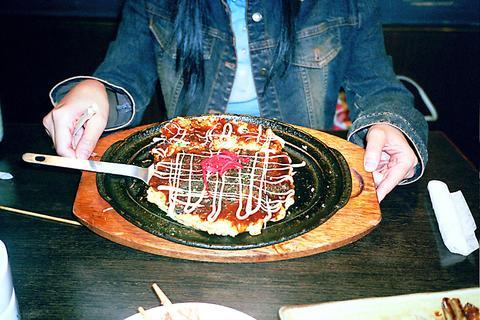
PHOTO: STEPHEN A. NELSON
Fortune, it would seem, favors the bold. Hatsuho became a magnet for Japanese businessmen, some of whom gave Tsai the chance to go Osaka to learn how to cook the right way (i.e., the Japanese way).
Hatsuho grew and moved around a few times before settling into its current digs where it is now attracting a lot of walk-in traffic as well.
On our recent visit, we started with the yakitori (marinated chicken pieces grilled on skewers, NT$80) and the grilled liver kebabs (NT$80). These were well-cooked, tender and tasty, although the latter were definitely for liver lovers only.
Then it was on to the next course -- a platter of sashimi (NT$320) which, in this case, comprised very thin, bite-size slices of very fresh, raw salmon. It was served with a potent mix of soy sauce and wasabi, and tasted -- my friend said -- "yummy and expensive."
But these starters were not what we had gone there for. Hatsuho is best-known for its okonomiyaki, a kind of Japanese potato pancake that can be filled with different kinds of meat and/or vegetables. Hatsuho has six kinds of okonomiyaki.
We opted for the one with a beef filling (NT$260). It was topped with a lacework of butter (or was that mayonnaise?) and what my friend called "Japanese HP sauce." It was savory and satisfying, without being too heavy.
If you decide to try it, be forewarned: it also comes with the traditional Japanese topping of fish flakes, which, if you're not ready for them, can be as off-putting as the very first time you saw hairy pork on your spaghetti.
To complete the Japanese experience, Hatsuho has a selection of Japanese beers, including a large draft beer for NT$140. It also has very good sake for about NT$160 a glass or NT$1,300 a bottle.
On the whole, the meal was an enjoyable and fulfilling experience, even if some might think it was a bit pricey. The budget-conscious can try the lunchtime set meals (NT$160-NT$250).
For us, there was only one real disappointment: Although Hatsuho is a "Japanese" restaurant, we could not get any Japanese green tea. Apparently, it's been given over in favor of Oolong tea, which is more popular with the regular clientele. The consolation is that the Oolong is complimentary with the meal.
Ajay Verma, a consultant gastroenterologist at Kettering general hospital in Northamptonshire, says our gut is a “complex machine.” “It is constantly providing us with the nutrition we need, initially to grow and develop, and then for us to survive, thrive and repair from injury and illness.” How can we keep it functioning well? Put simply: “Make sure what you put into it is balanced, and that you clear out its waste products adequately,” Verma says. “In a general gastroenterology clinic, the most common conditions we see are irritable bowel syndrome (IBS), gastroesophageal reflux disease, inflammatory bowel disease and constipation,” says Nisha
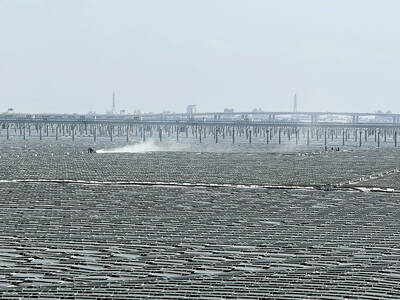
The arithmetic is straightforward and uncomfortable. By the end of 2025, Taiwan had committed itself to a 50-30-20 electricity mix — half natural gas, 30 per cent coal, 20 per cent renewables. The Ministry of Economic Affairs’s (MOEA) own monthly energy reports tell a different story. Natural gas reached 47.8 per cent of generation last year. Coal stood at 35.4 per cent, comfortably above its target ceiling. Renewables came in at 13.1 per cent, well short of the 20 per cent Taipei had pledged a decade earlier. Installed renewable capacity reached roughly half of the 12 gigawatts (GW) the government

Last week US President Donald Trump was asked by a reporter whether he would speak on the phone to the President of Taiwan. “l’ll speak to him. I speak to everybody. We have that situation very well in hand,” Trump said. This marked the second time in a couple of weeks he had said he would talk to the President of Taiwan. In 2016 he famously took a call from then-president Tsai Ing-wen (蔡英文), when he was president-elect. Despite warnings that the apocalypse was nigh because of a phone call, the world quickly forgot about the conversation between two democratically-elected presidents.
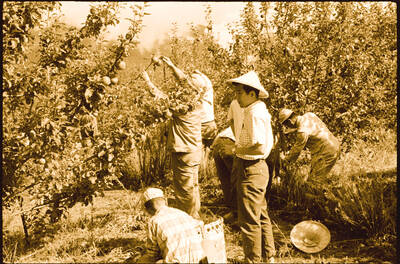
May 25 to May 31 Few believed that apples could be cultivated on a commercial scale in Taiwan’s high mountains. When horticulturalist Cheng Chao-hsiung (程兆熊) first proposed the idea in 1955, both American and Taiwanese colleagues dismissed it as implausible, arguing that temperate fruit could not be reliably grown on a subtropical island, especially on rugged terrain. However, it was this terrain in the Central Mountain Range where many Chinese Civil War veterans were resettled in the late 1950s. With limited job prospects and no family in Taiwan, they were placed on cooperative farms aimed toward self-sufficiency. Some say the conditions


 RSS
RSS