


Pope John Paul has a challenger.
Papal pretender "Gregorio XVII" is leader of a self-styled church in Spain who says God crowned him after Pope Paul VI's 1978 death, that Satan controls the Vatican and that the devil will crucify him at the start of an apocalyptic end of an era.
There were some 300 worshippers attending services on a recent visit to Gregorio's church in El Palmar de Troya, a vast cathedral-like complex of domes, columns and arches perched on a hill in Spain's dusty southern Andalusia region.
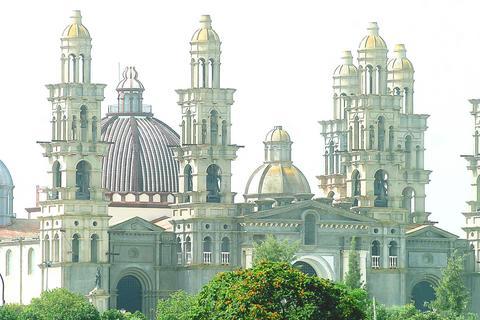
PHOTO: REUTERS
Church members say followers number several thousand and come from as far away as the Americas. But membership is clearly dwarfed by the 1 billion Roman Catholics around the world who recognize John Paul as head of the church.
"Rome ... is no longer the capital of Christianity; the new Rome is the Sacred Place of El Palmar de Troya," a booklet from Gregorio's church quotes God as telling him.
Gregorio's church has conferred sainthood on former Spanish dictator Francisco Franco for defending Catholicism in Spain's Civil War and four subsequent decades of fascist rule.
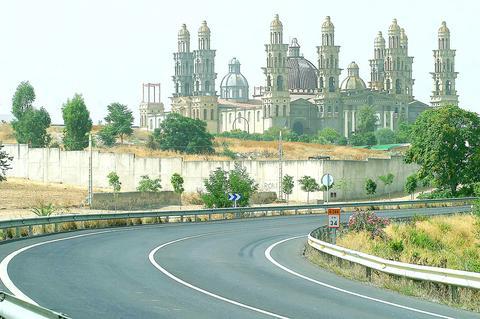
PHOTO: REUTER
Followers call 58-year-old Gregorio the last Pope and say he will be crucified. An electronic information package handed out at the church shows gory pictures of Gregorio with bleeding wounds in the hands, torso and forehead similar to those of Christ on the cross.
"At the end of his reign the anti-Christ appears and he will put the Pope to death, he will crucify him, and then Christ will appear and destroy the anti-Christ and a new era will begin," a middle-aged Irish man said on his way to mass.
Gregorio's congregation rejects reforms made by the Catholic Church at the 1962 to 1965 Second Vatican Council, such as saying mass in local languages instead of Latin and dialogue with other religions and branches of Christianity.
"We believe that he is the true Pope. We believe this is where the true church is," said a 21-year-old Irish man, who was visiting the parched, dusty village on a pilgrimage.
Faith no more
Pope John Paul has taken unprecedented steps toward reconciliation with Jews. He is the first pope to visit a synagogue, a mosque or a protestant church.
Mass is said in Latin and members of the congregation -- all wearing pictures of Christ's face and two bleeding hearts around their necks -- spend most of the service on their knees.
Men and women are separated in the nave and women dressed like nuns and wearing long black veils over their heads and faces sit behind a latticed wall.
A doorman in addition to the "nuns" and "priests," 150 people live in the complex. Followers are forbidden from visiting other churches. The faithful worship in their homes and traveling priests visit members of the church who live outside El Palmar.
Women must cover their heads, wrists and necks and wear skirts that come "at least four fingers below the knee." Trousers for women are
forbidden.
A "nun" posted at the entrance to the church checks women's skirts for transparency.
The dress code must also be
followed outside church.
"We can't go to the beach. We'd probably fall into sin if we went to the beach," the middle-aged Irish man said.
Before crowning himself "pope", the man formerly known as Clemente Dominguez said he had visions of the Virgin Mary and messages from God that the church in Rome, and Pope Paul VI, were being misled.
"Satan is governing in the Vatican," Gregorio was told in a vision in 1971, according to one booklet. A year later he was told, "Masons and Communism have infiltrated the Vatican."
Gregorio lost his sight in a 1976 car crash but the Virgin Mary promised he will regain it one day, church documents say.
Two years later Paul VI died and Clemente Dominguez, on a trip to Colombia, proclaimed himself pope.
Most of his followers -- who say their donations built the church -- come from abroad, where they say they heard about the movement in books or by word-of-mouth.
Spanish locals say they are unimpressed although some believe the Virgin Mary appeared there before the basilica -- which dwarfs the parish church -- was founded.
visions
Church documents say the young Clemente Dominguez went to El Palmar initially because he heard about the apparitions.
"The people in the village don't believe in these things although there are 70 witnesses, serious people, who have seen apparitions," said a 51-year-old man who declined to be named.
The Roman Catholic church in Seville takes neither the church nor the apparitions seriously.
These days "Pope Gregorio" rarely ventures beyond his walled complex although he used to be seen in bars and restaurants around town in El Palmar and nearby Seville, locals say.
The corpulent leader does not always lead services but appears for special occasions.
But Pura Hernandez, a 76-year-old woman from Barcelona, said that his presence was overwhelming.
"I saw him once in ecstasy. There were so many angels," she whispered piously.

Taiwan’s English education system is being pulled apart by three opposing forces. Bilingual Nation 2030 pulls students toward English and global communication. Artificial Intelligence (AI) readiness pulls them toward digital judgment, verification and AI-mediated work. But Taiwan’s old exam culture pulls them back toward memorization, grammar drills, timed reading and correct answers. If the education system keeps using old exams to define success, it risks producing graduates who are neither genuinely bilingual nor genuinely AI-ready, but trained for tasks machines can already perform. The first force is Bilingual Nation 2030. Launched in 2018, the policy aimed to “help Taiwan’s workforce connect

“Taiwan’s Opposition Leader Comes to US With a Message Straight Out of Beijing” read a May 31 headline in the Wall Street Journal. Top US administration officials and members of Congress almost certainly read the WSJ, and if there was a bullet point takeaway that people in Washington should absorb ahead of Chinese Nationalist Party (KMT) Chair Cheng Li-wun’s (鄭麗文) arrival in DC on June 9, that headline is it. The last few columns have discussed this very topic, and the timing is not coincidental. While those top officials likely do not read the Taipei Times, judging by the number

With weighty, anxiety-inducing geopolitical topics dominating the headlines, checking in on the wild and weird state of local politics can take some of the edge off. This November’s elections will determine who will be in charge of fixing potholes in your neighborhood, not the potholes in Taiwan’s complicated geopolitical space. Recently, after an online interview with a Taipei-based journalist, I commented that Taipei journalists never go further than the MRT can take them. He laughed and agreed. Naturally, the Taipei mayoral race is eating up much of the press attention. TAIPEI CITY Democratic Progressive Party (DPP) candidate Puma Shen (沈伯洋) has
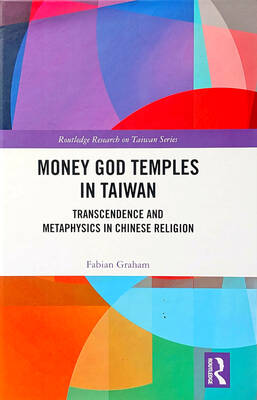
As someone who normally steers clear of books with “transcendence” or “metaphysics” in their subtitles, this reviewer — a casual observer of local belief systems since the 1990s — found Fabian Graham’s Money God Temples in Taiwan a challenging read. Those who’ve only dipped their toes into temple culture will likely need to parse several sections with special care if they’re to keep up with the author, a British ethnographic researcher whose previous books have investigated religious practices among ethnic Chinese in Southeast Asia. This scholarly volume examines a facet of Taiwan’s religious landscape that didn’t exist a century ago, and


 RSS
RSS