


Opened by French national Paco Sturbois -- of Mr. Paco's Pizzeria fame -- two weeks ago, Olala! is a French restaurant with a difference, floating in an urban sea awash with faux/quasi French joints charging NT$500-plus for half a dozen tinned snails or deep fried frogs a la KFC.
Punters won't find either escargot or frogs legs on the menu at Olala!. Instead diners will discover a heap of charmingly presented, expertly created, tastefully titillating, contemporary French/European-styled culinary treats. All of which are reasonably priced.
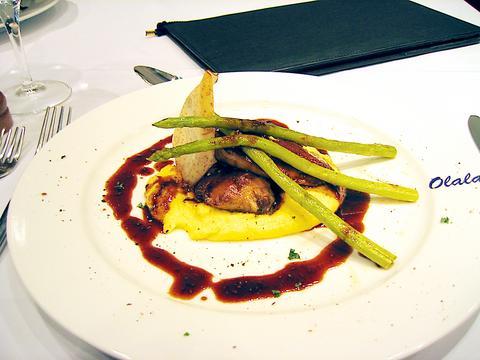
PHOTO: GAVIN PHIPPS, TAIPEI TIMES
"I've tried to create a restaurant that serves high quality food without being too expensive," explained the well-known restaurateur. "The restaurant is still evolving and I want to do something fun with a menu, instead of being too serious."
The menu maybe fun, but the food served up at Olala pure pleasure.
After only two weeks the joint and menu may be still evolving, but an evening of fine wining and dining at the only partially evolved Olala! is certainly something to tell others about. Be it appetizers, entrees or desserts, Sturbois has managed to create a menu that will have those with a passion for good food positively slavering.
For appetizers, Olala offers diners a light yet satisfying salmon tartar (NT$310), tuna/beef carpaccio (NT$290), fresh oysters (market price), goose liver pate (NT$390) as well as chorizo, or grilled Spanish sausages (NT$210) and merguez, or Moroccan sausages (NT$250). The entree dishes, such as the highly recommended pan-fried fois gras served on a bed of polenta with sauteed vegetables topped off with a rich raspberry balsamic sauce (NT$690), proves that haute cuisine can satisfy the eagerest of diners. While too numerous to list in full, other Olala entrees worth sampling include veal (NT$720), duck magret (NT$610), cote de boeuf with sun dried tomatoes (NT$620) and fresh Canadian lobster either grilled or broiled (NT$1,200).
For dessert Olala also comes up trumps, with creme brulee (NT$150) made with genuine fresh vanilla essence, crepes flambe (NT$180) and crispy lemon sorbet (NT$150).
As well as great food, there is also a pretty extensive wine list which features a varied selection of French, Spanish, Italian and Californian reds and a handful of whites.
Ajay Verma, a consultant gastroenterologist at Kettering general hospital in Northamptonshire, says our gut is a “complex machine.” “It is constantly providing us with the nutrition we need, initially to grow and develop, and then for us to survive, thrive and repair from injury and illness.” How can we keep it functioning well? Put simply: “Make sure what you put into it is balanced, and that you clear out its waste products adequately,” Verma says. “In a general gastroenterology clinic, the most common conditions we see are irritable bowel syndrome (IBS), gastroesophageal reflux disease, inflammatory bowel disease and constipation,” says Nisha
The arithmetic is straightforward and uncomfortable. By the end of 2025, Taiwan had committed itself to a 50-30-20 electricity mix — half natural gas, 30 per cent coal, 20 per cent renewables. The Ministry of Economic Affairs’s (MOEA) own monthly energy reports tell a different story. Natural gas reached 47.8 per cent of generation last year. Coal stood at 35.4 per cent, comfortably above its target ceiling. Renewables came in at 13.1 per cent, well short of the 20 per cent Taipei had pledged a decade earlier. Installed renewable capacity reached roughly half of the 12 gigawatts (GW) the government

Last week US President Donald Trump was asked by a reporter whether he would speak on the phone to the President of Taiwan. “l’ll speak to him. I speak to everybody. We have that situation very well in hand,” Trump said. This marked the second time in a couple of weeks he had said he would talk to the President of Taiwan. In 2016 he famously took a call from then-president Tsai Ing-wen (蔡英文), when he was president-elect. Despite warnings that the apocalypse was nigh because of a phone call, the world quickly forgot about the conversation between two democratically-elected presidents.
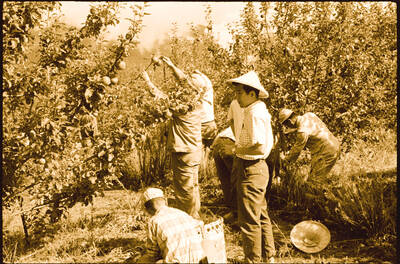
May 25 to May 31 Few believed that apples could be cultivated on a commercial scale in Taiwan’s high mountains. When horticulturalist Cheng Chao-hsiung (程兆熊) first proposed the idea in 1955, both American and Taiwanese colleagues dismissed it as implausible, arguing that temperate fruit could not be reliably grown on a subtropical island, especially on rugged terrain. However, it was this terrain in the Central Mountain Range where many Chinese Civil War veterans were resettled in the late 1950s. With limited job prospects and no family in Taiwan, they were placed on cooperative farms aimed toward self-sufficiency. Some say the conditions


 RSS
RSS