


Apple pie and oolong tea.
In the Houston home where rapper Jeremy Huang grew up, this is what his mother graciously offers a guest -- an East-meets-West treat that mirrors Huang's international urban music experiment.
After years of struggling in a US hip-hop scene with few other Asian-American artists, Huang, aka Witness, has taken his turntable beats and rhymes to his parents' homeland of Taiwan.
For more than three years, Huang commuted 17 hours by plane between Los Angeles, to record music, and Taipei, to get it heard. He finally moved to Taiwan's capital about two years ago to pursue a record deal.
Escaping rejection in the US and bidding to become the Eminem of Taiwan is a novel musical quest with its own barriers. In Taiwan, Huang will be a test case for Western hip-hop -- with the advantage of physically resembling his audience. If it doesn't work, he reasons he'll be no worse off than he was in the US.
"The first time I went to Taiwan and told record companies I wanted to do hip-hop, every one of them thought I was crazy," says Huang, 27, who is known only by his stage name overseas.
"No one had ever done a full hip-hop album there before. No one thought it would work."
That didn't stop Huang from finding a deal with Swed Records, a hip-hop subsidiary of the major Asian label Rock Records. His debut, tentatively titled WitnessThis, is scheduled to be in stores in Taiwan, China, Hong Kong, Malaysia and Singapore by October. The first single, Don't Cry, has already been released. There are currently no plans for a US release.
"Right now there aren't as many problems as before with getting a rap album released in Taiwan," says Witness' manager Roger Lee. "But most of the so-called hip-hop in Taiwan is based on dancing and party music.
"To a talented artist like Jeremy and to [Swed], the challenge lies in not going with the flow."
As he waits for the album to hit the streets, Witness is becoming known in Taipei music circles. Stories about him and Taiwan-born peers Dog G and MC Hot Dog ("The names sound better in Chinese," Huang says, laughing) have appeared on MTV Asia and a local Chinese-language daily.
Still, the blunt perspectives and aggressive approach of American rap can induce culture shock in Taipei, a city more influenced by China than by affluent Hong Kong or Singapore.
Long before Huang knew hip-hop would take him to Taiwan, his interest in the lifestyle was taking hold.
He was born in Houston and grew up in the early 1980s just outside the 610 West Loop, where he saw older kids breakdancing on cardboard to a blaring boombox. He watched them from his sister's bedroom window, fascinated more by the grooves than the moves.
As a student at T.H. Rogers School, Huang got his start as a disc jockey, spinning records for a school dance. He continued scratching and mixing while attending Stratford and Bellaire high schools in the early 1990s.
While at the University of Texas as a speech communications major, he made pocket money keeping beats alive at hotel parties and clubs in Austin and Houston.
"All my friends were really into math and science. [But] English was my forte. I liked writing essays and poems," Huang says. "In college I had no idea what I wanted to do. I just knew I loved to write and loved to perform."
His mother, Susan, a software engineer and his father, Floyd, a marketing and sales manager for a small Taiwanese security systems company, hoped their son would use his education in a literary or teaching profession.
Both came to the US in 1970, just as US ties with China were gaining strength and decades-old relations Taiwan were growing tense.
Even at a young age it was evident Jeremy was no bookworm. He was much happier in front of an audience.
Huang has found fulfillment communicating through rhymes backed by a hard bass beat. Influenced by the socially conscious and sometimes controversial rap of Dr. Dre, DJ Quik and Public Enemy, Huang moved from behind the turntables to the microphone in college.
As Witness, Huang was not interested in being a chest-thumping, gruff-growling party rapper. He wanted to emulate New York rappers such as Eric B & Rakim and A Tribe Called Quest, who have something to say about black history and current racial culture and politics.
A style of music created by black artists on the streets of New York City, rap has explored inner-city culture and black vs. white inequities for nearly a quarter of a century. In the past decade, artists such as Cypress Hill and Houston's South Park Mexican have expanded the popularity of Latin rap.
But no Asian-American rapper has crossed to the mainstream in the US. The veteran Philadelphia trio Mountain Brothers and the Chinese-American newcomer Jin Tha MC are the best-known -- and they are underground sensations at best.
Huang says that as a Taiwanese-American who has, at times, felt like an outcast in both places, he has a unique perspective to offer through his songs.
"My rap has to do with what I think about Taiwanese society and what I think about American society," says Huang, who addresses positives and negatives of both. "My lyrics talk about some of the things I faced growing up as an Asian kid in America, especially here in the South.
"It also talks about going to Taiwan and being thought of as different because I'm ABC [American-born Chinese] or ABT [American-born Taiwanese]." In casual speech, Huang uses the acronyms interchangeably.
In the song My Prayer, he raps: "These local gangstas mess with me just cuz I'm ABC/The police don't help me cuz I'm not from around here/I never thought Taiwan could be like America/And have this same kind of racism."
"I don't like playing the racial card, but it is kind of hard for Asian-Americans to do really well in the United States. The music industry [in the United States] is very tough to crack," Huang says.

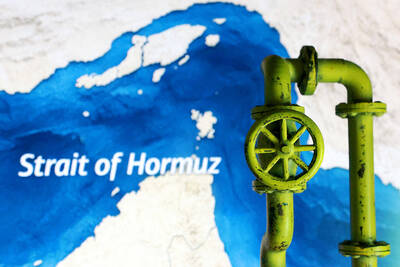
The US war on Iran has illuminated the deep interdependence of Asia on flows of oil and related items as raw materials that become the basis of modern human civilization. Australians and New Zealanders had a wake up call. The crisis also emphasizes how the Philippines is a swatch of islands linked by jet fuel. These revelations have deep implications for an invasion of Taiwan. Much of the commentary on the Taiwan scenario has looked at the disruptions to world trade, which will be in the trillions. However, the Iran war offers additional specific lessons for a Taiwan scenario. An insightful
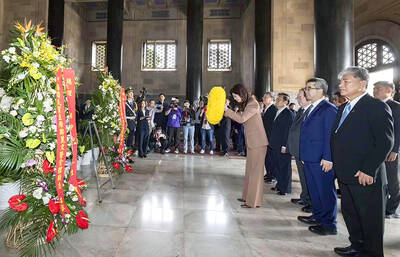
The problem with Marx’s famous remark that history repeats itself, first as tragedy, the second time as farce, is that the first time is usually farce as well. This week Chinese Nationalist Party (KMT) Chair Cheng Li-wun (鄭麗文) made a pilgrimage to the People’s Republic of China (PRC) “to confer, converse and otherwise hob-nob” with Chinese Communist Party (CCP) officials. The visit was an instant international media hit, with major media reporting almost entirely shorn of context. “Taiwan’s main opposition leader landed in China Tuesday for a rare visit aimed at cross-strait ‘peace’”, crowed Agence-France Presse (AFP) from Shanghai. Rare!
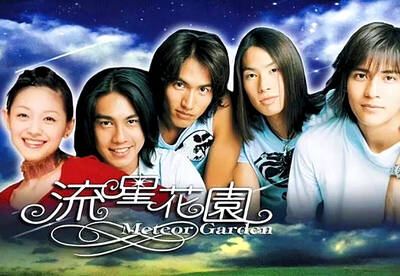
April 6 to April 13 Few expected a Japanese manga adaptation featuring four tall, long-haired heartthrobs and a plucky heroine to transform Taiwan’s television industry. But Meteor Garden (流星花園) took the nation by storm after premiering on April 12, 2001, single-handedly creating the “idol drama” (偶像劇) craze that captivated young viewers across Asia. The show was so successful that Japan produced its own remake in 2005, followed by South Korea, China and Thailand. Other channels quickly followed suit, with more than 50 such shows appearing over the following two years. Departing from the melodramatic
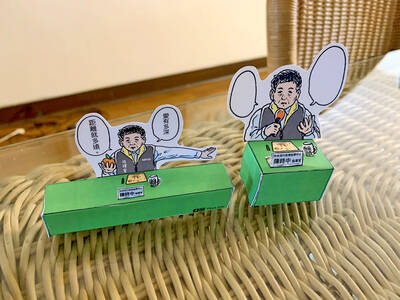
Sunflower movement superstar Lin Fei-fan (林飛帆) once quipped that the Democratic Progressive Party (DPP) could nominate a watermelon to run for Tainan mayor and win. Conversely, the DPP could run a living saint for mayor in Taipei and still lose. In 2022, the DPP ran with the closest thing to a living saint they could find: former Minister of Health and Welfare Chen Shih-chung (陳時中). During the pandemic, his polling was astronomically high, with the approval of his performance reaching as high as 91 percent in one TVBS poll. He was such a phenomenon that people printed out pop-up cartoon


 RSS
RSS