


Two days ago in Taipei's Foreign Affairs Police bureau, I ran into an odd dilemma while trying to renew my Alien Resident Certificate (ARC). I had entered Taiwan a day earlier at the unlikely admittance point of Hualien harbor, but Immigration failed to register my entry into the big computer they have for checking visa status, blacklists and who knows what else. And as they perfunctorily stamped my passport and waved me through, they also neglected to staple that little yellow card in my passport, the Point of Entry Information Form (
The reasoning behind this was fairly simple as far as I could tell: The little yellow sheet was supposed to be there but it wasn't, ergo: meltdown.
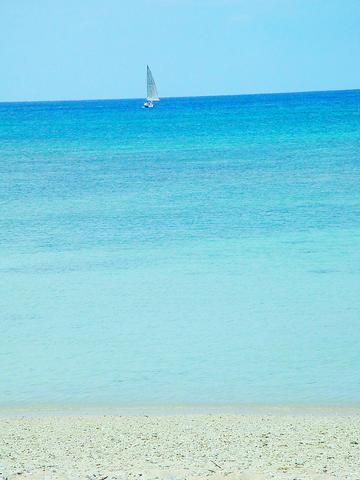
The clerk handling my case was also caught up in a late afternoon bureaucratic stupor, so while I was trying to explain to him that the problem was the result of a mistake by the Immigration authorities in Hualien, he more or less neglected the fact that Hualien has no international airport and went on to continue his pre-programmed question sequence with: "What was the flight number?"
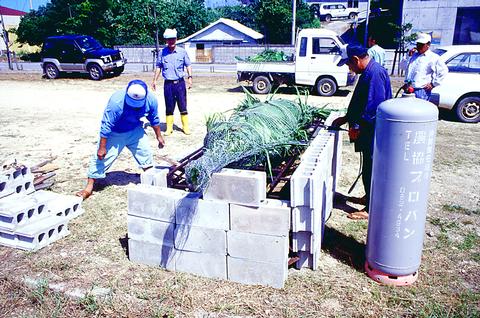
PHOTO: DAVID FRAZIER, TAIPEI TIMES
I told him I had sailed into Hualien harbor on a sailboat.
"A sailboat?"
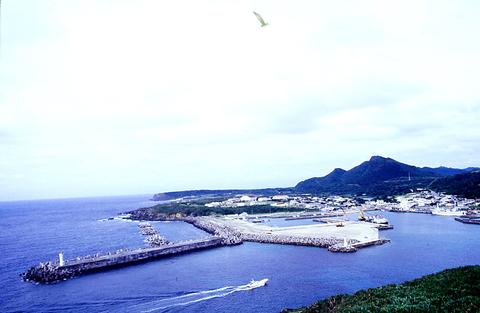
PHOTO: DAVID FRAZIER, TAIPEI TIMES
Then, turning to his nearest colleagues, "Hey, he came into Hualien on a sailboat! Does anybody know what to do for a flight number on a sailboat?"
Before long, three or four of the clerks were crowding around his desk as I showed them tourist brochures and digital photos of Yonaguni, the place I'd begun my ocean voyage to Taiwan. Yonaguni is a small Japanese island about 111km due east of Ilan on Taiwan's Pacific coast, the foreign possession nearest Taiwan proper. I explained that there had been a goodwill sailboat race from there to Hualien on the previous day, that I had been on one of the boats, and that the trip had taken around 15 hours.
"The water is really beautiful there, really green, really clear," commented one of the clerks, browsing through a glossy, magazine-sized tourist guide.
"Yes," I said, "it is."
In the end they were so enthralled that they called Immigration, filled out a pink form to replace the missing yellow form, and stapled it into my passport. As I left, my ad hoc liaison in the office sent me off, saying, "If you ever come into Taiwan on a sailboat again, you better find me. Now I'm the only one who knows how to deal with this situation."
And it was the truth. With only two international airports and four international harbors, traffic to and from Taiwan is highly controlled with the purpose, of course, of keeping the island's borders tightly sealed.
Given the situation, ignorance of Taiwan's neighbors is little wonder, especially when it comes to accessing them across the surface of the earth. As close as Yonaguni is to Taiwan, no one here has ever heard of the island -- aside, perhaps, from a slight few living along the coast in Ilan or Hualien. All the same, during the improved visibility preceding typhoons, the people of Yonaguni can see the mountains of Taiwan above the western horizon, and presumably, people in Taiwan might be able to catch a glimpse of Yonaguni as a speck on the Pacific.
More imposing than physical boundaries are political divisions. Yonaguni is separated from Taiwan by both national borders and one time zone. This makes getting there a little complicated. Currently, China Airlines runs the only available flight from Chiang Kai-shek Airport to Naha, the capital of Okinawa. It flies once a day and costs around NT$7,200 round trip. Three days a week, it is possible to connect from this flight to a 39-seat prop plane that will take you to Yonaguni.
By air, the total distance traveled in reaching the little-known island is over 1,000km, a distance that seems somewhat excessive considering that the end destination is only about 160km from my departure point of Taipei.
The flight, moreover, is almost impossible to book from Taiwan. I was only finally able to book the ticket with the help of the Okinawa Convention and Visitor Bureau, an Okinawa government sponsored office in Taipei. The ticket itself costs ?28,500, which is about NT$7,700, or slightly more than the cost of the Taipei-Naha leg.
Geographically, Yonaguni is part of a chain of volcanic islands that stretch from Japan's southernmost big island, Kyushu, to Turtle Island, a small volcano 11km off the coast of Ilan. Its land area covers about 27km2, which is more than Taiwan's Green Island (16km2), but less than Orchid Island (45km2). It is a small place, home to 1,800 people, 200 cars and one traffic light.
But my first impression upon landing didn't have anything to do with local flavor. Instead, I was struck by how Japanese everything seemed to be, a shock probably exacerbated by its geographical nearness. Only a few people on Yonaguni were able to communicate in very marginal English, and none I found spoke Chinese.
The food, which I consumed for four days, was by and large a pale imitation of mainstream Japanese food: lunchbox style meals of fish and pork, miso soup and, in one quaint-looking beach cafe, curry. It seemed a shame that much of what went into the cooking -- pork came with most meals but there were no pigs on the island -- must have been imported, and there was little to represent the fresh seafood which should have been plentiful on a small island in the middle of the Pacific.
Visitor accommodations are mostly limited to ryokans, traditional Japanese inns somewhat analogous to bed and breakfasts, and according to the brochures, there is only one hotel on the island that accepts credit cards.
In the tourism sector, there are only water sports: fishing and diving. As the clerk at Taipei's Foreign Affairs Police noticed, the water is incredibly transparent and green, and the island is ringed by reefs teeming with fish. Scuba diving is a natural draw, with visibility often exceeding 20m or 30m and the rare chance to observe migrations of hammerhead sharks each winter. In deeper water, there is game fishing for marlin (the biggest are up to 500kg), which seem to arrive at Yonaguni's Kubura harbor in a steady stream at the hands of leather-faced old men in motorboats.
The island's physical landscape largely resembles that of Taiwan's east coast as well as that of its outlying Pacific islands. There are central highlands, a forbidding coastline of cliffs and jagged, black volcanic rocks, and a few yellow sand beaches. Also, there are pastures and clumps of low scrubby vegetation, but no tall trees, not even palms.
Yonaguni's idiosyncrasies come more in the way of fauna -- any amateur Darwinian zoologist would have a field day. It is home to its own species of horse, the Yuyu horse, and what they claim to be the world's largest species of moth, a red, yellow and black-winged creature they reverentially refer to as Yonaguni-san. There is also a large and very beautiful red-backed cicada that's not found on Taiwan.
But all this, really, does not make Yonaguni much more than another small island in the East China Sea. Its only real claim to fame is a bizarre and totally unexplained complex of ruins -- possibly a castle or a shrine -- that was discovered submerged off the island's southern coast in 1985. Based on rising ocean levels in recent millennia, groups of international scholars have dated the site at between 6,000 and 10,000 years old. Fantastic material for believers in Atlantis and UFOs, the research has the potential to completely topple most theories of pre-ancient history, not to mention the claim that Asia's only ancient civilization was in China. And even weirder, no one has any idea as to what civilization created this older-than-the-pyramids edifice and what ever became of them.
More recent history indicates that Yonaguni, one of four islands in Okinawa Prefecture's Yaeyama group, was culturally similar to Taiwan up until about the 15th century. After that, it was incorporated into the Ryukyu kingdom, and the Ryukyu kingdom became a part of Japan in 1879.
It's likely that Yonaguni has maintained ties with Taiwan for all this time, but once Taiwan was ceded to Japan in 1895, inter-empire trade was possible and apparently flourished. This officially ended with World War II, but some links have remained.
Local efforts to improve communication, trade and interaction with Yonaguni took a major step in 1982, when Hualien initiated a sister city relationship with the island. Exchanges of teachers and students have followed, as well as other cultural resources. Then two years ago, Yonaguni's municipal government sponsored a sailboat race to Hualien. The event was held for the second time earlier this week, bringing 11 yachts to Hualien harbor.
Now, people in the Hualien City Government, like Luo Tzu-chang (羅子章), an advisor who has been active in promoting relations for years, are able to say: "We all know each other."
Earlier this week, officials from Yonaguni streamed into Hualien with the yachts (but not on them). And in Yonaguni, many residents can talk about past visits to Taiwan. One man who rents bicycles, for example, told me about a trip he'd taken to Taiwan to collect butterflies. And when others were asked about the big island to the west, they'd nod their heads and announce place names, like "Taipei" or "Keelung."
The sailboat race itself has done a terrific job in promoting low-key relations between eastern Taiwan and western Japan. Two of the boats in the race were Taiwanese (the first ever Taiwanese entries in any international sailing competition) and nine were Japanese -- eight were from the same yacht club in Okinawa.
Several on the yachts were interested in Taiwan for various reasons. One wanted to come and protest the building of Taiwan's fourth nuclear power plant while another, Katsuya Matsuda, hoped to extend to Taiwan tours by international performance groups he regularly brings to the Ryukyus.
At the docks on Wednesday morning, Hualien Mayor Tsai Chi-ta (
For the folks in Okinawa, that would be just fine. Because they, like their counterparts over here on this side of that invisible line in the Pacific, are starting to realize that they're neighbors.
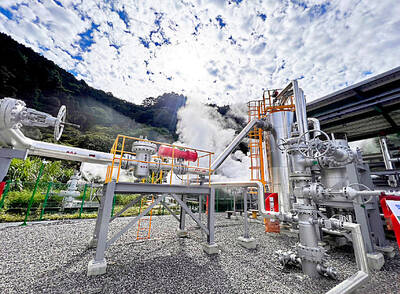
Taiwan’s semiconductor industry consumes electricity at rates that would strain most national grids. Taiwan Semiconductor Manufacturing Co (TSMC) alone accounted for more than 9 percent, or 2,590 megawatts (MW), of the nation’s power demand last year. The factories that produce chips for the world’s phones and servers run around the clock. They cannot tolerate blackouts. Yet Taiwan imports 97 percent of its energy, with liquefied natural gas reserves measured in days. Underground, Taiwan has options. Studies from National Taiwan University estimate recoverable geothermal resources at more than 33,000 MW. Current installed capacity stands below 10 MW. OBSTACLES Despite Taiwan’s significant geothermal potential, the

In our discussions of tourism in Taiwan we often criticize the government’s addiction to promoting food and shopping, while ignoring Taiwan’s underdeveloped trekking and adventure travel opportunities. This discussion, however, is decidedly land-focused. When was the last time a port entered into it? Last week I encountered journalist and travel writer Cameron Dueck, who had sailed to Taiwan in 2023-24, and was full of tales. Like everyone who visits, he and his partner Fiona Ching loved our island nation and had nothing but wonderful experiences on land. But he had little positive to say about the way Taiwan has organized its

The entire Li Zhenxiu (李貞秀) saga has been an ugly, complicated mess. Born in China’s Hunan Province, she moved to work in Shenzhen, where she met her future Taiwanese husband. Most accounts have her arriving in Taiwan and marrying somewhere between 1993 and 1999. She built a successful career in Taiwan in the tech industry before founding her own company. She also served in high-ranking positions on various environmentally-focused tech associations. She says she was inspired by the founding of the Taiwan People’s Party (TPP) in 2019 by Ko Wen-je (柯文哲), and began volunteering for the party soon after. Ko
Chinese Nationalist Party (KMT) Chair Cheng Li-wun (鄭麗文) returned from her trip to meet People’s Republic of China (PRC) dictator Xi Jinping (習近平) bearing “a gift” for the people of Taiwan: 10 measures the PRC proposed to “facilitate the peaceful development of cross-strait relations.” “China on Sunday unveiled 10 new incentive measures for Taiwan,” wrote Reuters, wrongly. The PRC’s longstanding habit with Taiwan relations is to repackage already extant or once-existing policies and declare that they are “new.” The list forwarded by Cheng reflects that practice. NEW MEASURES? Note the first item: establishing regular communication mechanisms between the Chinese Communist Party


 RSS
RSS