


Finishing the 20-story climb up a ladder inside a wind-turbine tower, Scott Rowland opened the top hatch to reveal a panorama of flat farmland dotted with dozens of other turbines.
Two of the closest, like the tower he was standing on here, were built by Goldwind USA, where Rowland is vice president for engineering.
“These are very sophisticated machines,” he said.
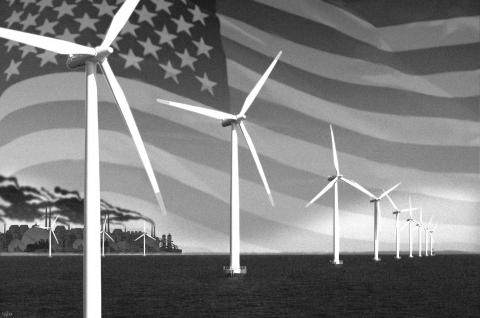
They are also the only three Chinese-made wind turbines operating in the US.
That could soon change, though, as Goldwind and other Chinese-owned companies plan a big push into the US wind power market in coming months.
While proponents say the Chinese manufacturers should be welcomed as an engine for creating more green jobs and speeding the adoption of renewable energy in the US, others see a threat to workers and profits in the still-embryonic US wind industry.
“We cannot sit idly by while China races to the forefront of clean energy production at the expense of US manufacturing,” US Senator Sherrod Brown, a Democrat, said during a debate this year over US federal subsidies for wind energy.
Such sentiments help explain why Goldwind is putting a distinctly US face on its efforts — and is diligently highlighting plans to do more than simply import low-cost equipment from China.
“Goldwind was approaching this as, ‘We’re going to build an organic, North American organization,’” said Rowland, a Texas native and former engineer at the Boston-based wind farm developer First Wind. “So the opportunity to work with them — and with folks I’ve known for a long time — was really attractive.”
By entering the US, the Chinese industry is coming to a world leader in wind energy capacity: about 41 gigawatts, or enough to power the equivalent of 10 million US homes. Only China itself, which recently passed US output, generates more wind power — 43 megawatts — although that is spread over a population more than four times the size of the population of the US.
However, US wind output still meets only a small portion of the US’ overall demand for electricity — about 2 percent — compared with countries like Spain, which gets about 14 percent of its electrical power from the wind.
And the tepid US economy, rock-bottom natural gas prices and lingering questions about US federal wind energy policy have stalled the US wind industry, which currently represents only about 85,000 jobs. Even the US market leader, General Electric, reported a sharp drop in third-quarter turbine sales, compared with the same period last year.
All of which might indicate that dim market prospects await the wave of wind-turbine makers from China. However, the Chinese companies can play a patient game because they have big backing from China’s government in the form of low-interest loans and other blandishments — too much help, in the critics’ view.
Even now, the US wind energy industry is by no means an all-US business. After GE, the current market leaders in the US are Vestas of Denmark, Siemens of Germany, Mitsubishi of Japan and Suzlon of India. None of the governments of those countries, though, are suspected of unfairly favoring their home industries and discriminating against foreign competitors on anything approaching China’s scale.
In the case of China, US President Barack Obama’s administration is investigating whether the Chinese may have violated WTO rules in subsidizing its clean-energy industry.
Rowland’s company, Goldwind, is the fledgling US arm of a state-owned Chinese company that has emerged as the world’s fifth-largest turbine maker: the Xinjiang Goldwind Science and Technology Co.
To help finance its overseas efforts, Xinjiang Goldwind raised nearly US$1 billion in an initial public stock offering in Hong Kong in October — on top of a US$6 billion low-interest loan agreement in May from the government-owned China Development Bank.
Goldwind, which set up a sales office in Chicago, has hired about a dozen executives, engineers and other employees so far. Most, like Rowland, are Americans already experienced in the wind energy field.
That includes Tim Rosenzweig, the company’s newly installed chief executive and the former chief financial officer of First Wind, who sees parallels with the resistance Japanese carmakers met when they set up operations in the US auto market in the 1980s.
“In terms of a business school case study, you definitely think of that, and I think that decisions around eventually putting manufacturing here solved part of that equation,” Rosenzweig said. “So our goals of localizing and creating jobs here and investing in the US — all that is part of the equation.”
Goldwind executives and their Chinese bosses no doubt learned from the uproar generated late last year when a Chinese energy conglomerate, A-Power Energy Generation Systems, joined a US investment firm and a Texas developer, Cielo Wind Power, to announce plans for a US$1.5 billion wind farm, using 240 to 300 turbines, in West Texas.
Critics said the project — which was eligible for about US$450 million in US federal stimulus funding set aside by the Obama administration for renewable energy projects — would support thousands of manufacturing jobs in China, while creating only a few hundred less valuable construction and maintenance jobs in the US.
Hoping to mute the jobs controversy, A-Power and its parent company, Shenyang Power Group, brokered a deal in August with the United Steelworkers union. The deal is meant to ensure that major components for the planned Texas wind farm — including the towers, some enclosures for the turbine and the giant turbine blades — would be supplied from the US.
The Chinese companies also said they expected to buy as much as 45,360 tonnes of steel from US mills to build the Texas project and A-Power and its partners announced plans to eventually open a manufacturing plant in Nevada.
Still, some skeptics say the Chinese manufacturers are too new to wind energy to warrant investing in their equipment for wind farms intended to operate for decades.
Wind turbines made by Chinese manufacturers sell for an -average of US$600,000 a megawatt, compared with US$800,000 or more for Western models made from Chinese parts and even higher prices for European and US machines. Yet, Western banks have been leery of lending wind farms money to buy the Chinese equipment because of concern about its reliability, according to Robert Todd, the Hong Kong-based director of the renewable energy, resources and energy group at HSBC.
However, with the US wind industry in the doldrums, there are few other big investments pending. The American Wind Energy Association estimates that this year only 5,500 megawatts of new capacity has been added in the US. That is only about half of last year’s total — and far less than the 17,600 megawatts, or more, being installed this year in China, which has provided more subsidies and set more renewable energy targets for its utilities.
Proponents of the Chinese push say the availability of inexpensive turbines from China — and ample customer financing from its state-owned banks — could help put wind energy back on a growth track by making it more affordable for US utilities and developers.
“Wind power in the United States is in a disordered phase because of a lack of funds,” said Andrew Hang Chen, the president of USFOR Energy, a consulting firm in Pittsburgh that advises the Chinese government and its state-controlled wind energy companies. “It’s a very good opportunity for Chinese businesses to access the US market.”
However, Steve Trenholm, the chief executive for North American operations at a big wind farm developer, E.ON Climate and Renewables, said his company still leaned toward staying with Western multinationals, most of which have set up at least limited manufacturing facilities in the US.
Especially when US federal grant money is involved, he said, “there is a strong preference to tie it to US manufacturing.”
Already, though, much of the manufacturing for US wind energy is done offshore, with the big European developers importing some of the most sophisticated and valuable turbine components from factories overseas. Even GE now buys gearboxes from China to install in turbines that it assembles in the US. The American Wind Energy Association has estimated that about 50 percent of a typical wind turbine being erected today in the US is imported.
However, the Chinese companies probably know they will be judged by a different standard. When Rosenzweig visited the company’s three pilot turbines here in Minnesota last month, accompanied by Rowland and the company’s spokesman, Colin Mahoney, they detailed the US-made bona fides of their machines.
The towers, they said, were built by SMI & Hydraulics, a metal fabricator in nearby Porter, Minnesota. US contractors in Big Lake, Minnesota, and Gary, South Dakota, were used to transport the equipment, lay the foundation and install the turbines.
The fiberglass blades came from a plant in South Dakota — albeit one owned by the Danish firm LM Wind Power. The company is also in discussion for future projects with other US tower makers, Mahoney said.
He estimated that US$6.2 million of the Minnesota pilot project’s cost of nearly US$10 million went to US manpower and components. However, the real guts of the Goldwind machines — the generators, hubs and nacelles, or turbine housings — were built in China.
Rosenzweig said his team was looking at ways to move more of that work to the US.
“There’s an economic proposition to actually have American workers here doing the assembling of the hubs and nacelles, and maybe generators down the road,” Rosenzweig said.
“We’ve been approached by a number of states and their economic development teams,” he said. “So we’re getting there.”
However, with the Chinese market starting to level off even though Chinese factory capacity keeps surging, Goldwind and other Chinese companies will still have a powerful financial incentive to avoid idling new assembly lines in China. And labor is much cheaper in China — US$300 a month for blue-collar workers and US$500 a month for engineers. Workers and engineers in the US could expect to make at least 10 times as much.
Nonetheless, Goldwind’s team sees plenty of room for US jobs.
Joining the Goldwind executives here for the tower tour was James Mikel, the head of Renew Energy Maintenance, a small firm based in Brandon, South Dakota, that has signed a long-term deal with Goldwind to handle upkeep of the turbines.
Mikel said he was initially wary of working with an unknown Chinese wind company. However, he said a visit last spring to Goldwind’s operations in Beijing — and the prospect of expanding employment at home — changed his mind. After all, the Chinese companies are the ones with the money to spend on the US wind industry right now.
“I was concerned at first, but I live here and these turbines mean more jobs,” Mikel said. “Five years from now, we’ll look back and wonder what all this concern was about.”
From the Iran war and nuclear weapons to tariffs and artificial intelligence, the agenda for this week’s Beijing summit between US President Donald Trump and Chinese President Xi Jinping (習近平) is packed. Xi would almost certainly bring up Taiwan, if only to demonstrate his inflexibility on the matter. However, no one needs to meet with Xi face-to-face to understand his stance. A visit to the National Museum of China in Beijing — in particular, the “Road to Rejuvenation” exhibition, which chronicles the rise and rule of the Chinese Communist Party — might be even more revealing. Xi took the members
Taiwan’s higher education system is facing an existential crisis. As the demographic drop-off continues to empty classrooms, universities across the island are locked in a desperate battle for survival, international student recruitment and crucial Ministry of Education funding. To win this battle, institutions have turned to what seems like an objective measure of quality: global university rankings. Unfortunately, this chase is a costly illusion, and taxpayers are footing the bill. In the past few years, the goalposts have shifted from pure research output to “sustainability” and “societal impact,” largely driven by commercial metrics such as the UK-based Times Higher Education (THE) Impact
The inter-Korean relationship, long defined by national division, offers the clearest mirror within East Asia for cross-strait relations. Yet even there, reunification language is breaking down. The South Korean government disclosed on Wednesday last week that North Korea’s constitutional revision in March had deleted references to reunification and added a territorial clause defining its border with South Korea. South Korea is also seriously debating whether national reunification with North Korea is still necessary. On April 27, South Korean President Lee Jae-myung marked the eighth anniversary of the Panmunjom Declaration, the 2018 inter-Korean agreement in which the two Koreas pledged to
I wrote this before US President Donald Trump embarked on his uneventful state visit to China on Thursday. So, I shall confine my observations to the joint US-Philippine military exercise of April 20 through May 8, known collectively as “Balikatan 2026.” This year’s Balikatan was notable for its “firsts.” First, it was conducted primarily with Taiwan in mind, not the Philippines or even the South China Sea. It also showed that in the Pacific, America’s alliance network is still robust. Allies are enthusiastic about America’s renewed leadership in the region. Nine decades ago, in 1936, America had neither military strength


 RSS
RSS