


The inter-Korean relationship, long defined by national division, offers the clearest mirror within East Asia for cross-strait relations.
Yet even there, reunification language is breaking down.
The South Korean government disclosed on Wednesday last week that North Korea’s constitutional revision in March had deleted references to reunification and added a territorial clause defining its border with South Korea.
South Korea is also seriously debating whether national reunification with North Korea is still necessary.
On April 27, South Korean President Lee Jae-myung marked the eighth anniversary of the Panmunjom Declaration, the 2018 inter-Korean agreement in which the two Koreas pledged to improve relations, reduce military tensions and build a permanent peace regime on the Korean Peninsula.
Lee acknowledged the reality of “two hostile states,” in which Pyongyang has abandoned the old language of one Korean nation and now treats the South as a separate belligerent country.
However, his answer was not to return to emotional slogans about national reunification.
If Pyongyang has insisted on “two hostile states” since North Korean leader Kim Jong-un introduced the buzzword in December 2023, South Korea cannot pretend that “one Korea” still exists in practice.
The opposite of “two hostile states” does not have to be one state. It can be “two peaceful states.”
Lee added that his government would continue pursuing a policy of “peaceful coexistence on the Korean Peninsula,” which Seoul officially released on Feb. 3.
The policy outlines three guiding principles: Seoul respects North Korea’s system, rejects unification by absorption and would not engage in hostile acts.
South Korea currently responds with a framework of peaceful coexistence with North Korea.
Last year, the Korea Institute for National Unification found that more South Koreans said reunification was unnecessary than necessary, and 63.2 percent said reunification would not be required if the two Koreas could coexist peacefully.
A Gallup Korea survey conducted in December last year found that 64.6 percent of South Koreans viewed North Korea as an independent state, while 79.4 percent said peaceful coexistence mattered more than reunification.
Seoul increasingly reflects this “two Koreas” reality in official language.
Just as Kim has referred to South Korea by its official name, the Republic of Korea, Lee’s unification minister Chung Dong-young has referred to North Korea as the Democratic People’s Republic of Korea.
On April 29, Chung said that talking about reunification is, in one sense, “violent.” Under today’s conditions, making reunification the immediate language of policy can sound less like reconciliation and more like a hostile merger.
South Korea has already seen how easily reunification language can become a language of confrontation and elimination.
Former South Korean president Yoon Suk-yeol, Lee’s immediate predecessor, framed reunification as the expansion of the value of freedom to the North, as outlined in his Aug. 15, 2024, unification doctrine.
Critics saw this as a freedom-led vision of northward expansion, one that risked turning reunification into pressure, provocation and even a military contingency with Pyongyang, which could have justified Yoon’s imposition of martial law.
Based on evidence and testimony presented in Yoon’s ongoing trials, the South Korean military under the Yoon administration provoked North Korea by sending drones over Pyongyang in October 2024.
This prompted severe reactions from Pyongyang two months before Yoon declared martial law.
Similarly, China has never renounced the use of force in pursuit of reunification. It continues to conduct military drills around Taiwan.
China’s Anti-Secession Law authorizes non-peaceful means if Taiwan is deemed to have seceded or if the possibilities for peaceful reunification are completely exhausted.
Hardline reunification politics could therefore slide into dangerous provocation and even military crisis.
During the Korean War, control of the Korean Peninsula shifted repeatedly and violently.
The capital cities of Seoul and Pyongyang changed hands a total of six times, resulting in millions of casualties.
By August 1950, North Korea had nearly overrun the entire peninsula.
Two months later, South Korea, backed by UN forces, came close to reunifying the peninsula under Seoul’s control until communist China entered the war.
Today, however, leaders of both Koreas increasingly speak in terms of a “two-state” reality.
This reality gives Taiwan, with its clear territorial status, more room to reject Beijing’s claim that political separation must end in unification.
Taiwan’s government says Beijing has no right to represent it because the People’s Republic of China (PRC) has never ruled Taiwan.
No territory currently administered by the Republic of China has ever been governed by the PRC.
Within East Asia, if North and South Koreans are questioning reunification language, even though reunification nearly happened several times in 1950, Taiwanese have reason to ask why unification with a state that has never ruled them should be treated as destiny.
If the two Koreas can move toward peaceful coexistence, do the people on both sides of the Taiwan Strait not deserve the same?
Alan Jeong is a writer on politics, policy and foreign affairs based in South Korea.
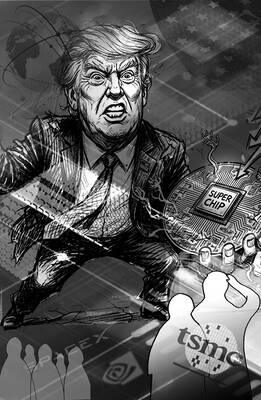
The White House’s decision to take a 9.9 percent stake in Intel Corp is looking like very shrewd business indeed. Since the government bought in at US$20.47 a share last August, the US chipmaker’s surging stock price has delivered the US a US$43 billion return. One of the reasons the investment has so far proved so sound is that the White House has made sure of it. According to The Wall Street Journal, Howard personally pushed deals on Intel’s behalf with some of the most lucrative clients imaginable. They include Nvidia Corp, the company at the heart of the AI
A single photograph can cut through a lot of noise, but it can also be used to misrepresent the truth. At the very least, it can concentrate the mind on something that requires further investigation. On Monday last week, Ma Ying-jeou Foundation CEO Tai Hsia-ling (戴遐齡) and former National Security Council secretary-general King Pu-tsung (金溥聰) held a news conference in which they showed a photograph of former foundation CEO Hsiao Hsu-tsen (蕭旭岑), now Chinese Nationalist Party (KMT) deputy chairman. In the image Hsiao is seated next to Xiamen Taiwan Businessmen Association chairman Han Ying-huan (韓螢煥). The two men were holding
I first met Professor Ray Jiing (井迎瑞) as a film and documentary student at Shih Hsin University’s (SHU) Department of Radio Television and Film in 1988. The following year, he went on to become the director of the Chinese Taipei Film Archive — forerunner of the Taiwan Film and Audiovisual Institute (TFAI). Over his eight-year tenure, Jiing rescued and restored over 200 classic Taiwanese films. In 1997, he established the Graduate Institute of Studies in Documentary and Film Archiving at Tainan National University of the Arts (TNNUA), and I joined the program in his third cohort of students. Beyond a
President William Lai Ching-te’s (賴清德) May 20 second-anniversary address was not just a routine policy review; it was damage control. US President Donald Trump’s remarks — that he did not want to see anyone move toward independence and that the delivery of a major Taiwan arms package could depend on the progress of US-China relations — unsettled Taiwan’s public and created an opening for opposition parties to question whether Taiwan was being treated as a bargaining chip in Washington’s dealings with Beijing. Lai’s speech was designed to close that opening. The address covered the expected ground: sovereignty, cross-strait relations, defense spending,


 RSS
RSS