


Will one of US president-elect Barack Obama’s New Year’s resolutions be to quit smoking once and for all?
His good-humored waffling in various interviews about smoking made it plain that Obama, like many who have vowed to quit at this time of year, had not truly done so.
He told Tom Brokaw of NBC several weeks ago, for example, that he “had stopped” but that “there are times where I’ve fallen off the wagon.”
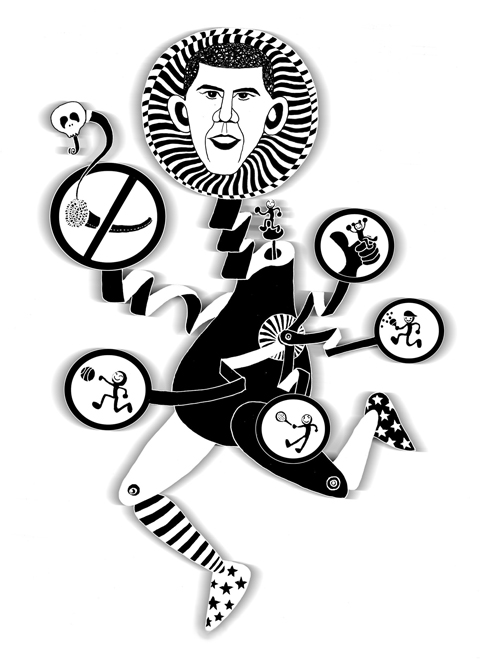
He promised to obey the no-smoking rules in the White House, but whether that meant he would be ducking out the back door for a smoke is not known. His transition team declined to answer any questions about his smoking, past or present, or his efforts to quit.
Anti-smoking activists would love to see him use his bully pulpit to inspire others to join him in trying to kick the habit, but he has not yet taken up their cause.
The last president to smoke more than occasionally was Gerald Ford, who was quite fond of his pipe. Jimmy Carter and both presidents George Bush were reportedly abstainers, but Bill Clinton liked cigars from time to time, though he may have chewed more than he smoked.
Obama’s heaviest smoking was seven or eight cigarettes a day, but three was more typical, according to an interview published in last month’s issue of Men’s Health magazine. In a letter given to reporters before the election, Obama’s doctor described his smoking history as “intermittent,” and said he had quit several times and was using Nicorette gum, a form of nicotine replacement, “with success.” Obama was often seen chewing gum during the campaign.
His pattern matches that of millions of other people who have resolved but stumbled in their efforts to give up cigarettes. Today, 21 percent of Americans smoke, down from 28 percent in 1988. Off-again, on-again smoking and serial quitting are common, as is the long-term use of nicotine gum and patches.
“It takes the average smoker 8 to 10 times before he is able to quit successfully,” said Steven Schroeder, director of the Smoking Cessation Leadership Center at the University of California, San Francisco.
Schroeder said that counseling was helpful, and that if Obama were his patient, he would urge him to try it, even if only by telephone (via 1-800-QUITNOW). With nicotine replacements and counseling, quit rates at one year are 15 percent to 30 percent, Schroeder said, about twice the rates of people who try to stop without help.
But Obama has apparently been chewing nicotine gum for quite a while. Is it safe? Neal Benowitz, another expert on nicotine addiction from the University of California, San Francisco, said that long-term use of the gum or patches, “if it keeps you off cigarettes, is OK.”
He said people had the best chances of quitting if they used more than one type of nicotine replacement at the same time — like wearing a patch every day, but also using the gum when cravings took hold.
Studies have found that 5 percent to 10 percent of people who tried nicotine replacements were still using them a year later, and nicotine itself appears not to be harmful, except possibly during pregnancy and for people at risk for diabetes, Benowitz said. The risks of cancer, other lung disease and heart problems come from other chemicals in cigarette smoke.
“If nicotine is harmful, it is a minuscule risk compared to cigarette smoking,” Benowitz said. “If people want to continue using gum or patches, and not cigarettes, their health will be enhanced.”
Nicotine can speed up the heart rate somewhat, he said, and it may raise blood pressure very slightly. More important, it can reduce the body’s sensitivity to insulin and may aggravate diabetes or pre-diabetic conditions. It also constricts blood vessels in the skin and may interfere with wound healing.
But still, Benowitz emphasized, “If the choice is between taking nicotine or smoking, nicotine is far, far better.”
Falling off the wagon is typical. Three months, six months and a year are major milestones, and most people who can quit for a year will be able to stay off cigarettes for good, Benowitz said. But about 10 percent relapse even after a year or more.
“It’s generally prompted by a stressful situation, when they’re fatigued and they need to concentrate and focus,” Benowitz said. “Obama talked about that. People are used to having a cigarette in that situation.”
Nicotine is strongly addictive for many people, and withdrawal can leave them irritable, restless, sleepless, depressed and struggling to concentrate. Some experts say it is harder to give up than cocaine or heroin.
“Then there is something called hedonic dysregulation,” Benowitz said. “It involves pleasure. Nicotine involves dopamine release, which is key in signaling pleasure. When people quit smoking they don’t experience things they used to like as pleasure. Things are not as much fun as they used to be. It’s something you get over in time.”
People become hooked on nicotine in part because, like alcohol and other addicting drugs, it alters the brain.
Some changes are long-lasting, and the younger people are when they take up smoking, the stronger their addiction.
“There is increasing evidence that you lay down new neural circuits related to smoking, sort of memory tracks,” Benowitz said. “Nicotine does it, and other aspects of smoke do too. Your brain is forever changed.”
Those memory tracks could be hindering Obama’s efforts to quit. Schroeder also noted that for someone who smoked fewer than 10 cigarettes a day, as Obama reportedly did, nicotine replacements may be less helpful because the addiction may be more to the habit than to nicotine.
One of the best things that president-elect Obama has going for him is that he is a jogger.
“There is increasing evidence that if you can exercise, it’s often helpful” in quitting, Benowitz said. “I hope Obama can still find time to play basketball on a regular basis.”
We are used to hearing that whenever something happens, it means Taiwan is about to fall to China. Chinese President Xi Jinping (習近平) cannot change the color of his socks without China experts claiming it means an invasion is imminent. So, it is no surprise that what happened in Venezuela over the weekend triggered the knee-jerk reaction of saying that Taiwan is next. That is not an opinion on whether US President Donald Trump was right to remove Venezuelan President Nicolas Maduro the way he did or if it is good for Venezuela and the world. There are other, more qualified
China’s recent aggressive military posture around Taiwan simply reflects the truth that China is a millennium behind, as Kobe City Councilor Norihiro Uehata has commented. While democratic countries work for peace, prosperity and progress, authoritarian countries such as Russia and China only care about territorial expansion, superpower status and world dominance, while their people suffer. Two millennia ago, the ancient Chinese philosopher Mencius (孟子) would have advised Chinese President Xi Jinping (習近平) that “people are the most important, state is lesser, and the ruler is the least important.” In fact, the reverse order is causing the great depression in China right now,
This should be the year in which the democracies, especially those in East Asia, lose their fear of the Chinese Communist Party’s (CCP) “one China principle” plus its nuclear “Cognitive Warfare” coercion strategies, all designed to achieve hegemony without fighting. For 2025, stoking regional and global fear was a major goal for the CCP and its People’s Liberation Army (PLA), following on Mao Zedong’s (毛澤東) Little Red Book admonition, “We must be ruthless to our enemies; we must overpower and annihilate them.” But on Dec. 17, 2025, the Trump Administration demonstrated direct defiance of CCP terror with its record US$11.1 billion arms
The immediate response in Taiwan to the extraction of Venezuelan President Nicolas Maduro by the US over the weekend was to say that it was an example of violence by a major power against a smaller nation and that, as such, it gave Chinese President Xi Jinping (習近平) carte blanche to invade Taiwan. That assessment is vastly oversimplistic and, on more sober reflection, likely incorrect. Generally speaking, there are three basic interpretations from commentators in Taiwan. The first is that the US is no longer interested in what is happening beyond its own backyard, and no longer preoccupied with regions in other


 RSS
RSS