


China’s recent aggressive military posture around Taiwan simply reflects the truth that China is a millennium behind, as Kobe City Councilor Norihiro Uehata has commented.
While democratic countries work for peace, prosperity and progress, authoritarian countries such as Russia and China only care about territorial expansion, superpower status and world dominance, while their people suffer.
Two millennia ago, the ancient Chinese philosopher Mencius (孟子) would have advised Chinese President Xi Jinping (習近平) that “people are the most important, state is lesser, and the ruler is the least important.” In fact, the reverse order is causing the great depression in China right now, expected to be much worse than the 1929 Great Depression in the US. Both of these two economic depressions are caused by considerable wealth disparity. Studies show that in the 1920s, US workers could not afford to buy the cars they built at the rate of one car per eight minutes, when unprecedented wealth was being created.
However, the US was a democratic country, and political forces were able to reverse the course. China’s prosperity is almost entirely driven and enjoyed by the political elites. Once the vast majority are too poor to even afford the life necessities, the economic engine simply shuts down.
The military force from the world’s second-largest economy would be unable to sustain a long fight, just like Russia in the Ukraine war. However, the damage and suffering can be severe and lasting, as nobody wins in a war, if the dictatorship government is so crazy as to commit the fatal mistake of launching an attack. For this reason alone, Taiwan and Japan should join NATO as members to stop an injustice aggression by the justice defense.
The ancient Chinese philosopher Confucius (孔子) once said: “Virtue is never solitary; it always has neighbors.”
Europe is a good neighbor to Taiwan and Japan, only separated by a few bad apples. The good neighbors of peace-loving countries should unite to look at the enemies of the people in their eyes.
Since Canada has joined the EU’s Security Action for Europe, Taiwan’s and Japan’s membership in NATO would virtually create a Northern Pacific Alliance together with the US.
There can never be peace internally or externally until there is fairness and justice, which are absent from Chinese society. That is bad for China’s neighbors, and it is the cause for Chinese people to rise up for change. However, until China is democratized, Taiwan and Japan would have to be better prepared. By joining NATO, European countries also have the strength to surround the evil empires from all corners.
Japan has already collaborated with NATO and the EU on various projects, including cybersecurity, disaster relief and joint capability development, and has been involved in NATO’s support for Ukraine on cyberdefense and countering disinformation.
Taiwan has also provided significant humanitarian assistance and financial donations to Ukraine. Channeled mainly through non-governmental organizations, Taiwan is one of the leading donors from the Indo-Pacific region.
Moreover, dozens of Taiwanese have volunteered to fight in Ukraine’s International Legion. A 25 year-old soldier, Tseng Sheng-kuang (曾聖光), was killed in action in 2022 and was posthumously given a state award by Ukrainian President Volodymyr Zelenskiy.
Taiwan and Japan would be able to provide comprehensive support to NATO countries, spanning political, military and cooperative efforts, not to mention artificial intelligence and world’s most advanced chips.
Taiwan and Japan joining NATO is the right step forward at a time when Russia is devastating Ukraine, and China is threatening Asian stability. Taiwan and Japan would help secure peace and stability for every member, and vice versa. The commitment from NATO members through collective defense, namely that an attack on one is an attack on all, itself effectively deters potential adversaries. Unity makes strength.
According to last year’s World Happiness Report, based on income, life expectancy, social support, freedom, generosity and trust, Taiwan is the happiest country in Asia, ranking 27th globally, while Japanese are among the most welcoming in the world.
If Taiwan and Japan could join the rank and file of Europe along with the Nordic countries, this could be the happiest country club in the world.
James J. Y. Hsu is a retired professor of theoretical physics.
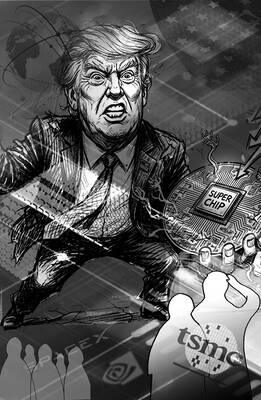
The White House’s decision to take a 9.9 percent stake in Intel Corp is looking like very shrewd business indeed. Since the government bought in at US$20.47 a share last August, the US chipmaker’s surging stock price has delivered the US a US$43 billion return. One of the reasons the investment has so far proved so sound is that the White House has made sure of it. According to The Wall Street Journal, Howard personally pushed deals on Intel’s behalf with some of the most lucrative clients imaginable. They include Nvidia Corp, the company at the heart of the AI
The Ministry of the Interior, working with the navy and coast guard, is organizing Taiwan’s first joint exercise simulating escort tankers carrying liquefied natural gas (LNG) and oil through a Chinese blockade. The drills simulate fuel transport along three maritime corridors leading toward Japan, the Philippines and the US. Deputy Minister of the Interior Sawyer Mars (馬士元) said that a blockade of the Taiwan Strait would amount to “almost a 100 percent blockade of the regional energy supply.” Minister of National Defense Wellington Koo said planning to counter a blockade is standard practice in Taipei. While the exercise is limited in
A single photograph can cut through a lot of noise, but it can also be used to misrepresent the truth. At the very least, it can concentrate the mind on something that requires further investigation. On Monday last week, Ma Ying-jeou Foundation CEO Tai Hsia-ling (戴遐齡) and former National Security Council secretary-general King Pu-tsung (金溥聰) held a news conference in which they showed a photograph of former foundation CEO Hsiao Hsu-tsen (蕭旭岑), now Chinese Nationalist Party (KMT) deputy chairman. In the image Hsiao is seated next to Xiamen Taiwan Businessmen Association chairman Han Ying-huan (韓螢煥). The two men were holding
In a Taiwanese university classroom, a lecturer asks in English: “Can anyone give me an example from Taiwan?” Students look down. No one answers. After class, one student writes on the course platform in Mandarin: “I understood the concept, but I didn’t know how to answer in English.” That moment highlights a key issue in Taiwan’s English-medium instruction (EMI) reform: It is not just about more English-taught courses, but whether students can learn, participate and belong. EMI expansion is part of the Bilingual 2030 policy and the Ministry of Education’s BEST Program, aiming to improve English ability, support EMI teaching


 RSS
RSS