


Tomorrow marks 10 years to the day that Taiwan was devastated by the 921 Earthquake, a magnitude 7.3 tremor that reduced tens of thousands buildings to rubble and claimed more than 2,400 lives.
But that catastrophic day also spawned a new beginning for the residents of Taomi Village (桃米村), located near the earthquake’s epicenter in Nantou County’s Puli Township.
“I couldn’t make money at home [before the quake], so I left this place,” says Guan Yu-fu (官裕富), a 43-year-old from Taomi who spent much of his 20s doing factory work and odd jobs throughout Taiwan.
Guan has since found work as an eco-tour guide and runs an idyllic guesthouse in the hills outside the village.
“Now, living here today, I feel a big sense of achievement.”
The quake destroyed more than half of Taomi’s buildings, but left one of its assets unscathed — its natural resources. The area’s unique ecosystem of wetlands, creeks and forests hosts a diversity of wildlife, including more than half of Taiwan’s 32 frog species and more than a third of its dragonfly and bird species.
The town is also the new home of the Paper Dome, a temporary church built in Kobe, Japan, after that city’s deadly earthquake in 1995. The structure opened to the public on Sept. 21 last year and is now a major tourist attraction.
Before 921, Taomi was a poor farming village, a mere dot on the map for tourists on their way to Sun Moon Lake (日月潭). Many of the village’s 1,200 residents farmed bamboo shoots for a living, but that business was already going downhill as post-processing factories moved to China.
Now, Taomi has reinvented itself as a popular eco-tourism destination, with nearly a dozen conservation areas and a cadre of 30 certified tour guides specializing in wildlife and botany.
The village is an example of a community whose residents managed to recover from one of the country’s worst natural disasters and are thriving thanks to an environmentally minded vision for the future.
LEARNING TO LOVE FROGS
It took a while for Guan to buy into that vision. He used to see nature as just “trees in the mountains.”
Back home and unemployed after the quake, he joined a government-funded work relief program where “volunteers” earned NT$600 a day helping to clean up the village.
There was a catch: To join the program, participants had to agree to spend weekends attending classes on Taomi’s ecology and wildlife.
“We got kidnapped,” laughed Guan. “But we had to do it — it was all for that NT$600.”
The carrot-and-stick approach to getting Taomi residents to attend classes came from the New Homeland Foundation (新故鄉文教基金會), which ran the work relief program under a government contract and was searching for a way to create sustainable jobs in Taomi after the quake. The Puli-based NGO initially saw conventional tourism as a possible option for redevelopment.
Then a survey of the area by the Council of Agriculture’s Taiwan Endemic Species Research Institute (TESRI) found an abundance of frog species, suggesting a rich and diverse ecosystem. This prompted the two organizations to broach the idea of eco-tourism with residents and led to the creation of a curriculum and licensing system for tour guides in 2000.
One year and an exam later, Guan was among a group of nine who received certification to lead
eco-tours at Taomi’s frog-watching sites.
In the beginning it was just a job. Guan was more impressed with the money — he earned NT$1,200 per tour — than the work itself. Despite hundreds of class hours on Taomi’s frogs, he still thought they were “ugly.”
It took a few observant tourists to help Guan put things in perspective. He changed his mind about frogs after witnessing one five-year-old’s effervescent reaction: “Ooooh! This frog is so pretty. How beautiful! How handsome!”
Guan shook his head. “I had lived to be 34 years old ... and it was only then that I came to see that frogs could be pretty, could be beautiful, could be cute.”
Another tourist’s comment really hit home. “You [tour guides] are pretty good at talking. But have you ever actually put your hands to work for your own community or home?”
For Guan, it was as if the tourist had seen right through him. The remark got him thinking about “bringing ecological conservation into” his own life.
As his affection for frogs grew, so did his appreciation for the land. He created frog-friendly ponds outside his home and guesthouse, a traditional sanheyuan (三合院) in Taomi’s forested hills. Soon, he and his family were surrounded day and night by a chorus of honking and chirping frogs.
A COMMUNITY COMES TOGETHER
Guan wasn’t the only person cultivating a new attitude toward nature. The ecology classes created by New Homeland and TESRI inspired other Taomi residents to clean up and maintain ponds and other natural sites around the village, something they continue to do today in a community-wide effort.
One project included the restoration of a section of Maopukeng Creek (茅埔坑溪) that was damaged by Typhoon Toraji in 2001. Concrete retaining walls on both sides of the creek were torn down and replaced with layers of rock. This slowed the river’s current and created a more hospitable habitat for wildlife.
The site is now maintained by Taomi residents as an “eco-park” for frog and butterfly watching and is safe for wading. It hasn’t been damaged by subsequent typhoons.
“Environmental engineering” projects such as these, along with the ecology classes, have encouraged Taomi residents to remain proactive about learning, says Liao Yung-kun (廖永坤), an eco-tour guide and owner of the Sanmaowu (三茅屋) guesthouse.
“Before [the quake], it was rare for us to gather in a class and discuss the community’s environment, culture or events. Now, everyone wants to work to build an ecological village, so we haven’t stopped taking classes or studying on our own,” he says.
Residents now organize their own classes through the Taomi Community Development Association (桃米社區發展協會).
Courses focus on vocational training and have covered everything from hospitality and catering for guesthouse owners to classes on how to deal with government regulations and policies. There are also workshops on crafts such as hat-weaving with paper pulp, something a few Taomi residents are trying to develop into a business.
New VALUES
Taomi’s tourist numbers paint a picture of success. In 2001, the village saw 7,000 visitors, which increased to 16,000 in 2002, says Liao, who started keeping track of the figures during his tenure as head of the Taomi Community Development Association.
He estimates that as many as 200,000 people will visit this year with the opening of the Paper Dome.
Taomi is a model of sustainable development, or “industrial development” without an environmental cost, says Chiang Ta-shu (江大樹), a professor of public policy and administration at National Chi Nan University in Puli.
“This community’s residents had to change their values. They had to learn about how to care for and cherish their natural environment and learn about ecological preservation. They were able to take this compassion for the natural environment and turn it into an employment opportunity.”
As southern Taiwan begins its recovery from Typhoon Morakot, Taomi offers a lesson for the central government in reconstruction, says Chiang. “They [government officials] should first encourage residents to learn about how they can develop in the future.”
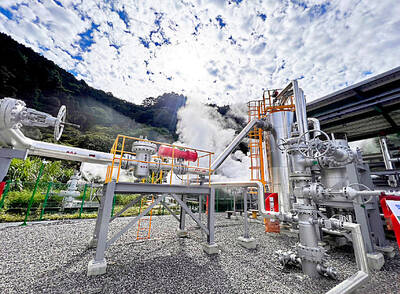
Taiwan’s semiconductor industry consumes electricity at rates that would strain most national grids. Taiwan Semiconductor Manufacturing Co (TSMC) alone accounted for more than 9 percent, or 2,590 megawatts (MW), of the nation’s power demand last year. The factories that produce chips for the world’s phones and servers run around the clock. They cannot tolerate blackouts. Yet Taiwan imports 97 percent of its energy, with liquefied natural gas reserves measured in days. Underground, Taiwan has options. Studies from National Taiwan University estimate recoverable geothermal resources at more than 33,000 MW. Current installed capacity stands below 10 MW. OBSTACLES Despite Taiwan’s significant geothermal potential, the

In our discussions of tourism in Taiwan we often criticize the government’s addiction to promoting food and shopping, while ignoring Taiwan’s underdeveloped trekking and adventure travel opportunities. This discussion, however, is decidedly land-focused. When was the last time a port entered into it? Last week I encountered journalist and travel writer Cameron Dueck, who had sailed to Taiwan in 2023-24, and was full of tales. Like everyone who visits, he and his partner Fiona Ching loved our island nation and had nothing but wonderful experiences on land. But he had little positive to say about the way Taiwan has organized its

The entire Li Zhenxiu (李貞秀) saga has been an ugly, complicated mess. Born in China’s Hunan Province, she moved to work in Shenzhen, where she met her future Taiwanese husband. Most accounts have her arriving in Taiwan and marrying somewhere between 1993 and 1999. She built a successful career in Taiwan in the tech industry before founding her own company. She also served in high-ranking positions on various environmentally-focused tech associations. She says she was inspired by the founding of the Taiwan People’s Party (TPP) in 2019 by Ko Wen-je (柯文哲), and began volunteering for the party soon after. Ko
Chinese Nationalist Party (KMT) Chair Cheng Li-wun (鄭麗文) returned from her trip to meet People’s Republic of China (PRC) dictator Xi Jinping (習近平) bearing “a gift” for the people of Taiwan: 10 measures the PRC proposed to “facilitate the peaceful development of cross-strait relations.” “China on Sunday unveiled 10 new incentive measures for Taiwan,” wrote Reuters, wrongly. The PRC’s longstanding habit with Taiwan relations is to repackage already extant or once-existing policies and declare that they are “new.” The list forwarded by Cheng reflects that practice. NEW MEASURES? Note the first item: establishing regular communication mechanisms between the Chinese Communist Party


 RSS
RSS