


“We call it boys’ toys for warfare,” bellows Chris Burgess, as the hip-hop act Stromkern roars Come Armageddon Come from the plasma screen behind him.
On the video a radio-controlled buggy is zipping along a dusty street, its onboard camera swiveling left and right, on the lookout for snipers and roadside bombs that might lie ahead.
Burgess belongs to one of 11 teams unveiled as finalists in the UK Ministry of Defence’s most ambitious –– and unusual –– attempt to bring high-tech science to the frontline. Called the Grand Challenge, the £4 million (US$7.9 million) project calls on engineers to design a robot that can scour an urban area for enemy combatants and explosives and report back, preferably without human intervention.
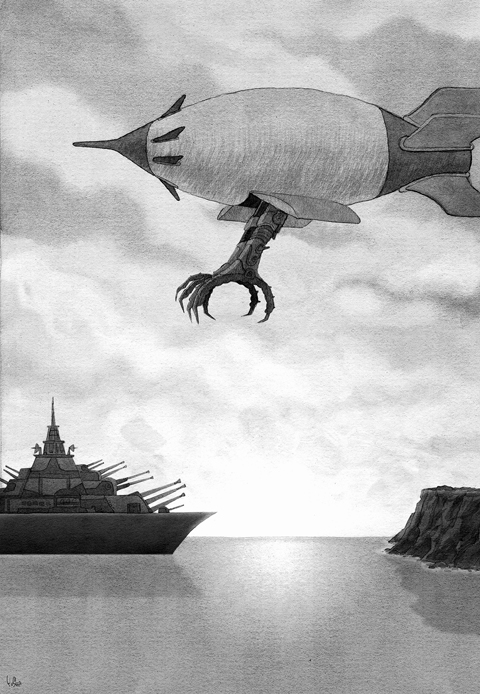
Among the finalists are a swarm of tiny helicopters that can peer into windows, a flying saucer, and what looks like a scaled-down version of a mechanical diggger. By August the teams, a hodge-podge of defense companies, universities and sixth form colleges, will go head-to-head over three weeks to decide on a winner. The battle will be played out on the streets of Copehill Down, a mock- up of an East German village built in the English countryside during the Cold War.
The competition will test each robot’s ability to go into the village and spot different threats, including snipers, groups of gunmen, armed vehicles and improvised explosive devices. Teams will be docked points for missing threats, being slow and targeting harmless civilians lurking among the buildings.
“It’s a very tough challenge,” said Andy Wallace at the ministry. “They have to deploy, move around by themselves and avoid obstacles, while locating and identifying things that pose a threat before reporting back.”
The challenge is a tacit admission that the large defense companies which provide the British military’s frontline technology rarely come up with the most imaginative ideas.
By throwing open the challenge to all comers the British government aims to tap the brainpower of smaller companies and individual researchers. The idea was pioneered by the Pentagon, whose own Grand Challenge was set up to encourage new technology for driverless vehicles.
The winner will receive the RJ Mitchell trophy, named after the father of the Spitfire World War II fighter plane and molded from metal recycled from one of the fighters. Those who perform best will get backing from the ministry to turn their robots into gadgets that will support soldiers in the future.
Team Mira, one of the finalists backed by BAE Systems and involving students from the Royal Grammar school in Guildford, south of London, has built a ground-based buggy that uses a laser scanner, thermal imaging and cameras to scan the streets for signs of danger. To check rooftops and other inaccessible areas the buggy automatically launches a flying saucer-like vehicle that can hover over buildings and send images back to base.
“It’s a bit like Wacky Races,” team member Richard Adams said.
Another of the finalists, Swarm Systems, is putting its faith in eight “quadrotors” –– small, flat helicopters the size of dinner plates that will fly into the village in formation and beam back video and sound. Microphones built into the aerial vehicles filter out everything except voices. The helicopters are designed to take off autonomously and can fly a few meters above the ground.
“We’re working on a version that you’ll just pull out of your bag and throw into the air,” said Owen Holland, an engineer on the team from Essex University. “Hopefully it’s not going to give anyone a haircut.”
At Bruton school for girls in Somerset, three students joined the Silicon Valley team to develop surveillance vehicles for the challenge. The team plumped for a powered glider, a hot air balloon and a kite. The balloon and kite will be tethered and carry cameras high above the village, while the plane feeds back live video to glasses worn by its operator.
Burgess, of the Mindsheet team, says they hope to enter several robotic cars in the final that automatically drive to vantage points before beaming video of the village back to base. In his view many of the finalists’ robots are too elaborate for war zones.
“A lot of these teams have got flying machines or big vehicles, but they’ll be on eBay within minutes of arriving in Afghanistan,” he said. “And with ours, you could put some P4 explosive on the back, drive it into a compound and detonate it. It’s fun and gets the job done.”
Wallace, who says the ministry anticipates an “enjoyable and fun event,” said: “Each of the teams has something unique and interesting.”
“If we see something we like we’ll either make them an offer or find another way to help them develop the technology,” he said.
From the Iran war and nuclear weapons to tariffs and artificial intelligence, the agenda for this week’s Beijing summit between US President Donald Trump and Chinese President Xi Jinping (習近平) is packed. Xi would almost certainly bring up Taiwan, if only to demonstrate his inflexibility on the matter. However, no one needs to meet with Xi face-to-face to understand his stance. A visit to the National Museum of China in Beijing — in particular, the “Road to Rejuvenation” exhibition, which chronicles the rise and rule of the Chinese Communist Party — might be even more revealing. Xi took the members
The Chinese Nationalist Party (KMT) and the Taiwan People’s Party (TPP) on Friday used their legislative majority to push their version of a special defense budget bill to fund the purchase of US military equipment, with the combined spending capped at NT$780 billion (US$24.78 billion). The bill, which fell short of the Executive Yuan’s NT$1.25 trillion request, was passed by a 59-0 margin with 48 abstentions in the 113-seat legislature. KMT Chairwoman Cheng Li-wun (鄭麗文), who reportedly met with TPP Chairman Huang Kuo-chang (黃國昌) for a private meeting before holding a joint post-vote news conference, was said to have mobilized her
The inter-Korean relationship, long defined by national division, offers the clearest mirror within East Asia for cross-strait relations. Yet even there, reunification language is breaking down. The South Korean government disclosed on Wednesday last week that North Korea’s constitutional revision in March had deleted references to reunification and added a territorial clause defining its border with South Korea. South Korea is also seriously debating whether national reunification with North Korea is still necessary. On April 27, South Korean President Lee Jae-myung marked the eighth anniversary of the Panmunjom Declaration, the 2018 inter-Korean agreement in which the two Koreas pledged to

I wrote this before US President Donald Trump embarked on his uneventful state visit to China on Thursday. So, I shall confine my observations to the joint US-Philippine military exercise of April 20 through May 8, known collectively as “Balikatan 2026.” This year’s Balikatan was notable for its “firsts.” First, it was conducted primarily with Taiwan in mind, not the Philippines or even the South China Sea. It also showed that in the Pacific, America’s alliance network is still robust. Allies are enthusiastic about America’s renewed leadership in the region. Nine decades ago, in 1936, America had neither military strength


 RSS
RSS