


The streets are quiet in Myanmar. The "destructive elements" are in jail. The international outcry has faded. The junta's grip on power seems firm.
Two months after they cracked down on huge anti-government demonstrations led by Buddhist monks, the generals who rule Myanmar have reason to feel relief.
It seems they have ridden out their most difficult challenge in two decades and are set to maintain control through force and fear, offering only small concessions to the demands of their critics abroad.
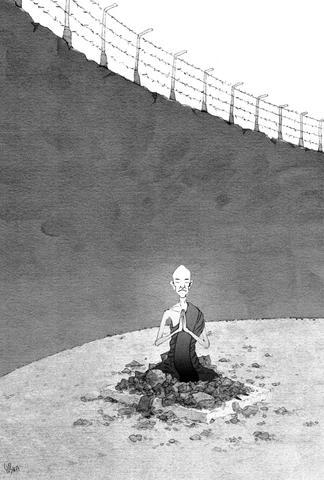
If change is coming in Myanmar, experts say, it is likely to be a long process and to emerge from within the power structure.
Diplomats and human rights groups say that an unknown number of protesters and monks remain in prison today, that many monasteries in the main city, Yangon, have emptied out and that new arrests are reported almost every day.
"This is the soft continuation of the crackdown of August and September," said David Mathieson, an expert on Myanmar for Human Rights Watch, which released a report on the uprising on Friday.
During the crackdown, the report said, security forces fired into crowds, beat marchers and monks and arbitrarily detained thousands of people.
The report documented 20 deaths in Yangon, but said it believed the toll was much higher.
"Without full and independent access to the country it is impossible to determine exact casualty figures," it said.
The government admits to only 15 deaths.
Meeting with reporters here last week, the top US diplomat in Myanmar, Shari Villarosa, said the continuing repression "raises questions about the sincerity of the military in pursuing what we will consider to be a genuine dialogue leading to national reconciliation."
In what seems to be a sign of Washington's waning clout in the region, China, India and Myanmar's Southeast Asian neighbors have brushed aside Washington's calls for an economic embargo and the diplomatic isolation of the junta.
As the attention of the world shifts elsewhere, the generals have made it clear that they intend to follow their own course, as they have through a half-century of self-imposed isolation.
On Monday, they signaled their defiance by announcing that a constitutional drafting committee had begun its work and was not going to listen to outside voices. The constitution is one step on what the junta calls a "road map to democracy." Many analysts call it a dodge to evade genuine reform.
"The road map will, of course, lead to a military-dominated civilianized government, which will perpetuate themselves in power," said David Steinberg, a leading expert on Myanmar at Georgetown University in Washington.
As it has in the past when it has faced international pressure, the junta has offered small gestures of compliance. But analysts say that whatever happens, the generals are not about to give real ground to the demands of the UN.
In one of these concessions, UN envoy Ibrahim Gambari will visit Myanmar this month for the third time in an attempt to nudge the government toward a dialogue with its opposition.
He follows in the footsteps of a half a dozen other UN envoys over the past 17 years who have failed to moderate the behavior of the junta.
In another concession, a government official has held three meetings with Aung San Suu Kyi, the pro-democracy leader who has spent 12 of the last 18 years under house arrest. The official, Minister of Labor Aung Kyi, said on Monday that more meetings were planned, though he was vague about the time frame.
"We need to consider what to discuss and why," he said. "We are choosing what and why. So we will take where, how and when into consideration in the future."
It was possible to read, in this dismissive comment, a note of confidence that the generals hold the upper hand in their dealings with the outside world.
"This is not what the Security Council has called for -- a genuine process to heal the country," a Western diplomat said by telephone from Yangon.
"The name of the game is for them to barrel on regardless, see off every challenge and pretend there's no problem," said the diplomat, who spoke on condition of anonymity.
At a briefing for diplomats and reporters on Monday, Information Minister Kyaw Hsan belittled the protests as the work of a few agitators and dissident monks who were acting with the support of foreign powers.
"Actually, the August/September protests were trivial for the whole country and in comparison to other events in other countries," the information minister said.
They dissolved "because the general public did not take part and our security forces were able to make pre-emptive strikes."
The monks who took part "were not in touch with worldly affairs" and fell victim to the fabrications and instigation of anti-government groups, he said.
The crackdown, witnessed abroad in smuggled photographs and on videotape, drew condemnation and warnings from around the world.
Notable among all of the critics was ASEAN, whose sharp words suggested a real hardening of world opinion against Myanmar, which is one of its members.
In a statement by Singaporean Prime Minister Lee Hsien Loong, ASEAN said the videos and photographs "have evoked the revulsion of people throughout Southeast Asia and all over the world."
But this mood seems to have passed.
A meeting of all 10 members in Singapore last month offered an occasion to join hands with the US to bring pressure on the junta. Instead, the association seemed at pains to accommodate the generals.
At Myanmar's request, ASEAN canceled an invitation to Gambari, the UN envoy, to address the meeting. It also changed the language of a much-trumpeted new charter to weaken its section on human rights.
As if nothing had happened in Myanmar in recent months, ASEAN Secretary-General Ong Keng Yong said: "We don't want to come across as being too confrontational in a situation like this."
On June 11, Beijing designated the Taiwan Strait and several areas around Taiwan to be “coastal waters.” For those not familiar with the UN Convention on the Law of the Sea (UNCLOS), China’s designation constitutes a declaration of authority to control and regulate all maritime activities within those waters. Articles 8 to 11 of the UNCLOS gives coastal nations far more authority over their “internal waters,” that is the waters to the landward side of the geographic baseline that marks the start of the 12 nautical mile (22.2km) limit of their territorial waters. Internal waters include ports, rivers, inland waterways and
The post-Cold War belief that sovereignty, international law and economic interdependence would shield smaller states from great-power coercion is steadily eroding. Across the world, major powers are once again thinking in terms of strategic neighborhoods, buffer zones and spheres of influence. Geography is reasserting itself as a central determinant of security. For Taiwan, this shift is not merely an academic debate. It is an existential challenge. Situated just 180km off the coast of communist China, democratic Taiwan occupies a position that Beijing increasingly regards as lying within its natural sphere of influence. As China’s military power expands and its ambitions grow more
It is the biggest conundrum in the world economy right now: How has China managed to go on an oil detox? As my colleague Javier Blas has written, its sharply declining appetite for petroleum is probably the single-biggest factor that has kept the crude market balanced since the Strait of Hormuz closed. The perception that China is an opaque and secretive market adds to the mystery. Perhaps the Chinese government has been releasing barrels from hidden underground stockpiles, or sparking up secret chemical plants? A close look at the reams of official data available suggests a more humdrum explanation. Public
Earlier this month, Taipei Mayor Chiang Wan-an (蔣萬安) called for the abolition of the Control Yuan, suggesting that the Chinese Nationalist Party (KMT) and Taiwan People’s Party caucuses in the Legislative Yuan should reject all nominees to effectively freeze the institution before pursuing a constitutional amendment to abolish it. However, KMT legislators are yet to raise a constitutional amendment proposal and KMT Chairwoman Cheng Li-wun (鄭麗文) has made it clear that abolishing the Control Yuan is not among the party’s current priorities. Chiang, who studied law in the US, has shown his own lack of understanding of constitutional law, and


 RSS
RSS