


Think of it as the Sinatra test. Tomorrow, assorted liberal, democratic and opposition groups will take on the might of Russian President Vladimir Putin in elections for the Moscow city parliament. This should be fertile terrain: The capital city is packed with well-educated, enlightened folk and was once seen as the citadel of Russia's pro-democracy movement. Put another way, and to paraphrase Ol' Blue Eyes, if the opposition can't make it here, they can't make it anywhere.
But they won't make it. You don't need to be a pollster to know that Putin and his United Russia party are on course for a thumping majority tomorrow. Merely travelling around the city, as I have this week, spells it out. It's his party which has grabbed the giant hoardings -- along with the national colors and the age-old symbol of the Russian bear -- leaving the opposition to stand on freezing street corners, handing out photocopied flyers.
How come Putin, now five years into his presidency, is so dominant? If this was normal politics, you'd say Putin is popular because he has restored national pride, a welcome antidote after the Yeltsin years, when the antics of their wobbly, drunken president embarrassed most Russians; he has made voters believe that Russia can be a great power once more; and, above all, he has presided over a phenomenal economic boom.
The naked visibility of wealth comes as a shock to someone who last came here in 1988 -- when every shop looked like an empty stockroom, when the entire country was painted in the bleakest shade of grey, and when retail activity was confined to buying a slab of frozen margarine claiming to be ice cream. Now the streets heave with Mercs and BMWs; Louis Vuitton and Christian Dior sit directly opposite Lenin's tomb in Red Square; and the casinos of Novi Arbat are lit up in enough throbbing neon to make it the Las Vegas of the east. Sip tea in Cafe Pushkin and you can well believe that Moscow has more dollar billionaires than any other city in the world (36 at last count) or that Russia numbers its millionaires at 88,000.
But it's not just the oligarchs with their Lamborghinis who have got richer. The national GDP has more than tripled to US$700 billion, while average monthly wages have gone from US$80 in 2000 to US$200 today: not massive, but enough of a surge to explain why most Russians are happy to keep Putin at the helm.
Not normal
That would be the explanation if Sunday's election were a normal one in a normal democracy. But Russia can hardly make that claim.
Yes, there are freedoms that would have been unimaginable when I was last here: You can meet Sasha Petrov of Human Rights Watch in his office -- rather than at a secret rendezvous -- and he will tell you of his fear that Russia is moving toward a "one-party state" out loud, rather than in whispers. There are independent Web sites, as well as newspapers that criticize the government. Basic freedoms -- to move around, to own private property -- are now taken for granted. But democracy is a different story.
Television gives airtime to Putin and to a couple of licensed critics, chief among them the clownish xenophobe Vladimir Zhironovsky, whose anti-semitic rants are tolerated, if not sponsored, by the Kremlin as a useful outlet. Otherwise, no one gets a look in. Hardly a surprise, since every national TV network is now either state-run or owned by a state-run company.
Denied access to television, where Russian politics is fought, opposition groups are also starved of cash. The Kremlin saw to that when it prosecuted and jailed Russia's richest man, Mikhail Khodorkovsky. Whatever the official charges against him, his real crime was clear: He had political ambitions. The message went out to Russia's business elite: Enter politics and we'll take you down. The result is that few now dare fund any opposition activity. With the rules tightening on foreign involvement in NGOs -- which could see a raft of think tanks and human rights groups closing down -- the political space is shrinking.
These days, if you want to hear the opposition message you have to go out and find it. I went to the HQ of Yabloko, a pro-western liberal party that will be lucky to make a blip in the election. Its leader, Grigori Yavlinsky, polled 22 percent against Putin in the 2000 presidential election; now he can barely get a hearing.
`To the morgue'
To describe the state of Russian democracy, he tells the joke of the patient on a trolley who asks the hospital orderlies where they are taking him.
"To the morgue," they say. "But I'm alive!" he insists. "We're not there yet," they reply.
In other words, Russian democracy may still have the outward signs of life but not for much longer. Petrov says the political system is a "waxwork": it resembles a real system, with presidents and parliaments and elections, but don't be misled; it is a fake. All power, every decision that matters, is in the hands of one man. Putin hand-picks the mayors and regional governors who were once elected; he appoints the heads of the vast oil and gas companies, in which the state is the single biggest shareholder, and these men sit in the Kremlin as his ministers. The boundary between business and government is erased and atop it all sits Putin, the 21st-century tsar.
It's as if the president is offering two grand bargains. The first is with his people. You give up democracy, he says, and in return I shall give you prosperity. You may not be able to vote in meaningful elections, but you will be able to bank on the value of the rouble. And, while the price of oil remains high, I will make all of us better off.
Putin's second offer is to the world. Let me guarantee you a steady supply of the oil and, especially, the gas on which you rely. While I'm at it, let me help you with troublemakers such as Iran, Afghanistan or North Korea, bringing them to heel. But, says Putin, in return you must treat me with respect.
I got a sense of what that respect might entail in a meeting at the Kremlin on Tuesday. Led through the long Soviet-style corridors into the office of the chain-smoking spokesman Dmitry Peskov, I was told: "We're an economic power ... we're strong enough to prevent anyone interfering with our interests." Translation: we are players once more; we insist on a free hand in Chechnya and beyond.
Should we accept this bargain? The former chess champion Garry Kasparov, now active in Russian politics, wishes we wouldn't. After an opposition rally in a Moscow theater on Monday, he explained how the West could force Putin to democratize: by hurting Putin's oligarch friends abroad.
"You hit an opponent where he is weak, and his weakness is the bank accounts of his friends," he said.
Investigate those, said the grandmaster, and Putin will soon get the message.
Somehow I don't think that's going to happen. Realpolitik says we want cheap gas; we like having Russia, sandwiched between India and China, on our side; and we find it useful having a "strong man" to deal with. That's good news for Putin and whoever he chooses to succeed him in 2008. It's bad news for the democrats fighting the chill in Moscow -- who have learned to expect nothing else.
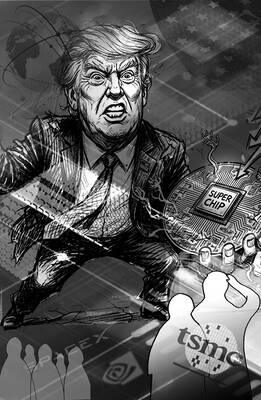
The White House’s decision to take a 9.9 percent stake in Intel Corp is looking like very shrewd business indeed. Since the government bought in at US$20.47 a share last August, the US chipmaker’s surging stock price has delivered the US a US$43 billion return. One of the reasons the investment has so far proved so sound is that the White House has made sure of it. According to The Wall Street Journal, Howard personally pushed deals on Intel’s behalf with some of the most lucrative clients imaginable. They include Nvidia Corp, the company at the heart of the AI
A single photograph can cut through a lot of noise, but it can also be used to misrepresent the truth. At the very least, it can concentrate the mind on something that requires further investigation. On Monday last week, Ma Ying-jeou Foundation CEO Tai Hsia-ling (戴遐齡) and former National Security Council secretary-general King Pu-tsung (金溥聰) held a news conference in which they showed a photograph of former foundation CEO Hsiao Hsu-tsen (蕭旭岑), now Chinese Nationalist Party (KMT) deputy chairman. In the image Hsiao is seated next to Xiamen Taiwan Businessmen Association chairman Han Ying-huan (韓螢煥). The two men were holding
I first met Professor Ray Jiing (井迎瑞) as a film and documentary student at Shih Hsin University’s (SHU) Department of Radio Television and Film in 1988. The following year, he went on to become the director of the Chinese Taipei Film Archive — forerunner of the Taiwan Film and Audiovisual Institute (TFAI). Over his eight-year tenure, Jiing rescued and restored over 200 classic Taiwanese films. In 1997, he established the Graduate Institute of Studies in Documentary and Film Archiving at Tainan National University of the Arts (TNNUA), and I joined the program in his third cohort of students. Beyond a
President William Lai Ching-te’s (賴清德) May 20 second-anniversary address was not just a routine policy review; it was damage control. US President Donald Trump’s remarks — that he did not want to see anyone move toward independence and that the delivery of a major Taiwan arms package could depend on the progress of US-China relations — unsettled Taiwan’s public and created an opening for opposition parties to question whether Taiwan was being treated as a bargaining chip in Washington’s dealings with Beijing. Lai’s speech was designed to close that opening. The address covered the expected ground: sovereignty, cross-strait relations, defense spending,


 RSS
RSS