

Preoccupied of late with war words, I have not kept up with the jonesing.
Jonesing for Joni was listed in Entertainment Weekly, describing a PBS documentary on the folk singer Joni Mitchell.
"For those of you who have been jonesing for an interactive theater fix" was the lead of a recent film review by Michael Gallucci in The Cleveland Scene.
"Love Is the Drug, and I'm Jonesing for a Hit" was the headline in The New York Observer over an article last month by Susan Shapiro kvetching about her husband's lack of sexual aggressiveness.
This is obviously a participle in play, presumably the latest, hot, with-it usage. On digging into the New York Times archives, however, I found this Oct. 19, 1970, citation in a profile of Alva John, a Harlem broadcaster: "That food may not be the most delicious in the world, but it's not nearly so dangerous as these jones you've been having."
The reporter, now Charlayne Hunter-Gault of PBS, explained in parenthesis: "A jones is a craving brought on by drug usage."
The root is a proper noun: For a reason I cannot fathom, Jones -- a family name held in my estimation by nearly 18 million Americans -- was applied in the early 1960s to heroin addiction. J.E. Lighter's Historical Dictionary of American Slang speculates about another possible origin: the male sex organ.
In the 1970s, the noun -- no longer capitalized -- most often referred to withdrawal symptoms, and made the transition to verb: jonesing out. In 1984, I noted that "jonesin' " was extended to mean "doin' nothin'," as addicts often do, but it was not until this millennium that the participle made the leap into popular speech as a generalized "craving."
"When I was little," says my colleague Maureen Dowd (meaning when she was growing up in Washington), "we used to say `jone-ing,' which meant `picking on.' When you were jone-ing on someone, you were mocking them." This local usage was overwhelmed by the national underground popularity of "jonesing," in its postnarcotics sense of "lusting for."
On Gawker Stalker, a Web site that observes, and leers and snickers at, personalities in the news, a notably slim fashion editor was spotted "zeta-jonesing on a McVeggie at the gaudy, fou-fou McDonald's on 42nd btw 8th & b'way."
Thus does the language come full circle. The allusion is to the actress Catherine Zeta-Jones, cattily scolded for adding a few pounds since her Oscar-winning performance in Chicago. Cruelly but creatively, the blogger applies her hyphenated last name to the lusting after a tasty burger by the hungry editor. To take the meaning of this nonce variation from the context, "zeta-jonesing" is "indulging in a craving for (meatless) food." This specialized usage returns "jonesing" to its original state of a proper noun in participle form.
In current slang use, "jonesing" has evolved from its narcotics-addiction base to a general lusting, craving or yearning. It seems to have shouldered aside "to have the hots for."
HARM'S WAY
As GW2 effectively ended, President Bush said, "We continue to pray for all who serve in our military and those who remain in harm's way." Next day, Secretary of State Colin Powell protested Russia's aid to Iraq, which "put our young men and women in harm's way."
"In danger" and "at risk" are seldom heard; we will now delve into the etymology of the operative phrase for potential trouble.
It did not start as the title of a 1965 movie starring John Wayne and Kirk Douglas. Rather, both "in harm's way" and "out of harm's way" popped up in the mid-17th century.
Thomas Manton, chaplain to Oliver Cromwell, delivered a sermon arguing that man's "duty is to run in harm's way" because "there are none so much harmed, maligned and opposed in the world, as those that follow that which is good, as those that will have no fellowship with the unfruitful works of darkness."
The phrase was immortalized in the Revolutionary War by Commodore John Paul Jones. The Scottish-born sailor is best known for his stirring "I have not yet begun to fight," uttered in 1779 aboard his sinking Bonhomme Richard (a salute to Benjamin Franklin's Poor Richard), after which Jones gained the surrender of the more powerful HMS Serapis.
As Evan Thomas points out in his coming biography, John Paul Jones: Sailor, Hero, Father of the American Navy, the year before, in 1778, the feisty captain specified in a letter what kind of ship he wanted to command: "I wish to have no connection with any ship that does not sail fast," he wrote, "for I intend to go in harm's way." Jones underlined both "fast" and the phrase now on everyone's lips: "in harm's way."
SECDEF
The Pentagon loves initialese; few Pentagonians realize that the word "initialese" was coined by the fourth secretary of defense, Robert Lovett, at a dinner in the Waldorf-Astoria hotel in New York in 1952.
As a cub reporter, I interviewed Lovett about that time for a profile in The New York Herald-Tribune.
He was amused by what he called the rampant shortenings: initialese like JCS for "Joint Chiefs of Staff" and half-acronyms like "Cincpac" for "Commander in Chief, Pacific," and "Cincaflant" for "Commander in Chief, Air Forces, Atlantic." (That last strikes me as too close to "sycophant." The acronym for "Commander in Chief, United States," was never adopted, because naval people in the White House thought it sounded suicidal.)
I asked Lovett about the initialese for his job as secretary of defense. The chief of Naval Operations was the CNO; the Department of Defense was DOD -- would he be known as the SOD?
"No," he replied, deadpan. "I have an ulcer. Rarely drink." I didn't get it then, but my British-born wife has since explained that one English slang meaning of "sod" (probably short for sodden, "soaked") is "drunk."
Which is why all secretaries of defense ever since, including today's Donald Rumsfeld, are known in Washington not by the acronym drawn from the abbreviation of their office, SOD, but as the "SecDef."

For the last 15 years, China has relied on gray zone operations to advance its territorial ambitions across Asia. And for 15 years, the US has struggled to respond. But the open door on which China has been pushing may finally be closing. Gray zone operations involve the assertive use of a variety of tools in ways that create conditions that can be described as neither peace nor war. Military forces might act provocatively — even dangerously — while carefully avoiding violence, whereas law enforcement employs nonlethal violence as a first resort. Such an approach creates difficult calculations for its targets.
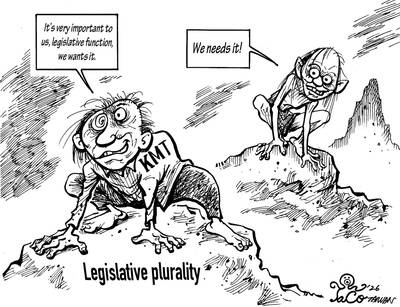
EDITORIAL CARTOON
Grab Holdings Ltd plans to acquire Taiwan’s No. 1 food delivery business, Foodpanda, for US$600 million. The Fair Trade Commission (FTC) is reviewing the proposal. Grab offers ride-hailing, dining, fresh food and grocery delivery, parcel delivery, payments, loans, insurance and digital banking services in 900 cities across eight Southeast Asian countries. Leveraging mapping data and artificial intelligence (AI) models developed in cooperation with China, it has built a comprehensive retail and consumer ecosystem. If Grab were to enter the Taiwanese market, it would have a major impact on the food service industry, convenience stores, supermarkets and e-commerce services. The ecosystem
On Wednesday last week an Indonesian frigate conducted exercises with the Chinese navy east of Taiwan, in waters Beijing has repeatedly used to demonstrate its capacity to encircle and blockade the nation. What was Indonesia doing there? The answer comes readily from Jakarta. Indonesia was practising bebas aktif, or “free and active” foreign policy, working with competing powers while reserving the right to belong to none of them. Indonesian personnel joined the US-led RIMPAC exercises in Hawaii this year, military contacts with Russia have continued, and the KRI I Gusti Ngurah Rai met the Chinese frigate Honghe while sailing home from


 RSS
RSS