


Dean Kamen, creator of the much-ballyhooed "Ginger" scooter, has been named the winner of the US$500,000 Lemelson-MIT prize for inventors.
The award, given annually, was bestowed in recognition of Kamen's development of the self-balancing scooter and of an infusion pump that has allowed diabetics to lead more normal lives. Kamen, owner of DEKA Research & Development Corp in Manchester, New Hampshire, holds more than 150 patents.

PHOTO: AP
"He is a true genius. His commitment to bettering the lives of people is intense and his inventions keep getting more remarkable," said former Baxter International chairman Vernon Loucks Jr., who nominated Kamen.
Kamen, who will receive his prize Wednesday in San Francisco, said he started inventing early.
"At 5 years old, I figured out a way to make my bed without having to run from one side of the bed to another," the 51-year-old Kamen said, describing a system of pulleys, blankets and strings. "It always seemed like such a big frustration."
Also honored Wednesday will be 86-year-old Ruth Rogan Benerito, winner of the Lemelson-MIT Lifetime Achievement Award. The retired Tulane Medical School professor and US Department of Agriculture researcher helped introduce easy-care cotton after World War II, when wrinkle-proof synthetics were gaining prominence.
Benerito said she was shocked to receive the award.
"At my age, you think your career is over with," said Benerito, who was informed of the honor while playing pinochle.
The Lemelson-MIT Program was established in 1994 by inventor Jerome Lemelson and his wife, Dorothy. It is based at the Massachusetts Institute of Technology.

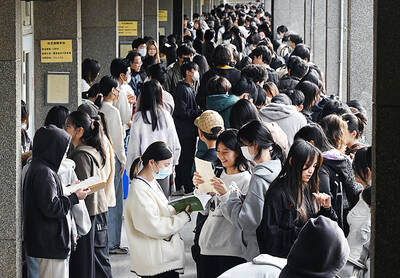
A global survey showed that 60 percent of Taiwanese had attained higher education, second only to Canada, the Ministry of the Interior said. Taiwan easily surpassed the global average of 43 percent and ranked ahead of major economies, including Japan, South Korea and the US, data from the Organisation for Economic Co-operation and Development (OECD) for 2024 showed. Taiwan has a high literacy rate, data released by the ministry showed. As of the end of last year, Taiwan had 20.617 million people aged 15 or older, accounting for 88.5 percent of the total population, with a literacy rate of 99.4 percent, the data

CCP ‘PAWN’? Beijing could use the KMT chairwoman’s visit to signal to the world that many people in Taiwan support the ‘one China’ principle, an academic said Chinese Nationalist Party (KMT) Chairwoman Cheng Li-wun (鄭麗文) yesterday arrived in China for a “peace” mission and potential meeting with Chinese President Xi Jinping (習近平), while a Taiwanese minister detailed the number of Chinese warships currently deployed around the nation. Cheng is visiting at a time of increased Chinese military pressure on Taiwan, as the opposition-dominated Legislative Yuan stalls a government plan for US$40 billion in extra defense spending. Speaking to reporters before going to the airport, Cheng said she was going on a “historic journey for peace,” but added that some people felt uneasy about her trip. “If you truly love Taiwan,

NEW LOW: The council in 2024 based predictions on a pessimistic estimate for the nation’s total fertility rate of 0.84, but last year that rate was 0.69, 17 percent lower An expected National Development Council (NDC) report expects the nation’s population to drop below 12 million by 2065, with the old-age dependency ratio to top 100 percent sooner than 2070, sources said yesterday. The council is slated to release its latest population projections in August, using an ultra-low fertility model, the sources said. The previous report projected that Taiwan’s population would fall to 14.37 million by 2070, but based on a new estimate of the total fertility rate (TFR) — the average number of children born to a woman over her lifetime — the population is expected to reach 12 million by
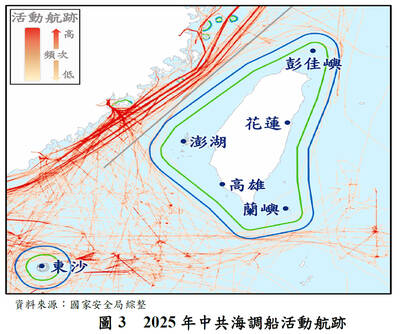
INTENSIFYING THREATS: Beijing’s tactics include massive attacks on the government service network, aircraft and naval vessel incursions and damaging undersea cables China is prepared to interfere in November’s nine-in-one local elections by launching massive attacks on the Taiwanese government’s service network (GSN), a report published by the National Security Bureau showed. The report was submitted to the Legislative Yuan ahead of the bureau’s scheduled briefing at the Foreign Affairs and National Defense Committee tomorrow. The national security team has identified about 13,000 suspicious Internet accounts and 860,000 disputed messages, the bureau said of China’s cognitive warfare against Taiwan. The disputed messages focus on major foreign affairs, national defense and economic issues, which were produced using generative artificial intelligence (AI) and distributed through Chinese


 RSS
RSS