


Chinese Nationalist Party (KMT) Chairwoman Cheng Li-wun (鄭麗文) yesterday arrived in China for a “peace” mission and potential meeting with Chinese President Xi Jinping (習近平), while a Taiwanese minister detailed the number of Chinese warships currently deployed around the nation.
Cheng is visiting at a time of increased Chinese military pressure on Taiwan, as the opposition-dominated Legislative Yuan stalls a government plan for US$40 billion in extra defense spending.
Speaking to reporters before going to the airport, Cheng said she was going on a “historic journey for peace,” but added that some people felt uneasy about her trip.
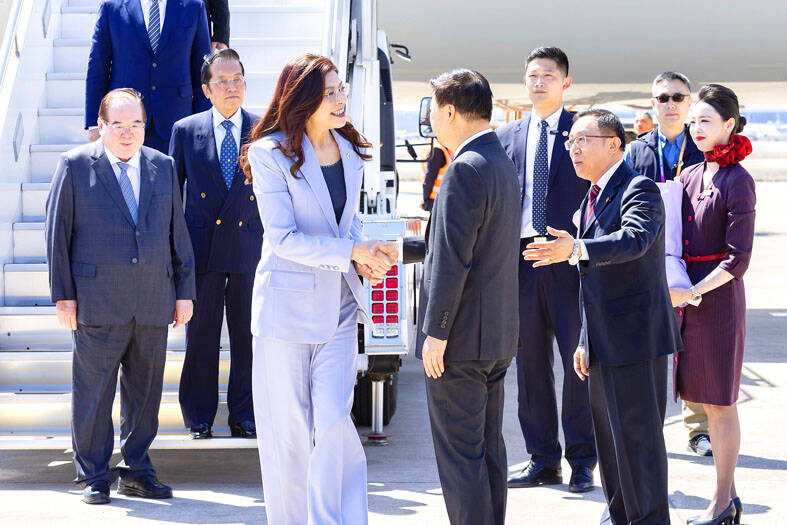
Photo courtesy of the KMT
“If you truly love Taiwan, you will seize even the slightest chance, every possible opportunity, to keep Taiwan from being ravaged by war,” she said.
“So I would rather believe that all Taiwanese hope this trip will succeed, because we can transform the most dangerous place in the world into the safest place in the world,” she said.
Cheng arrived at Hongqiao International Airport in Shanghai under tightened security and then took a train to Nanjing, home to the mausoleum of party founder Sun Yat-sen (孫逸仙), who overthrew the last imperial government and founded the Republic of China (ROC) in 1912.
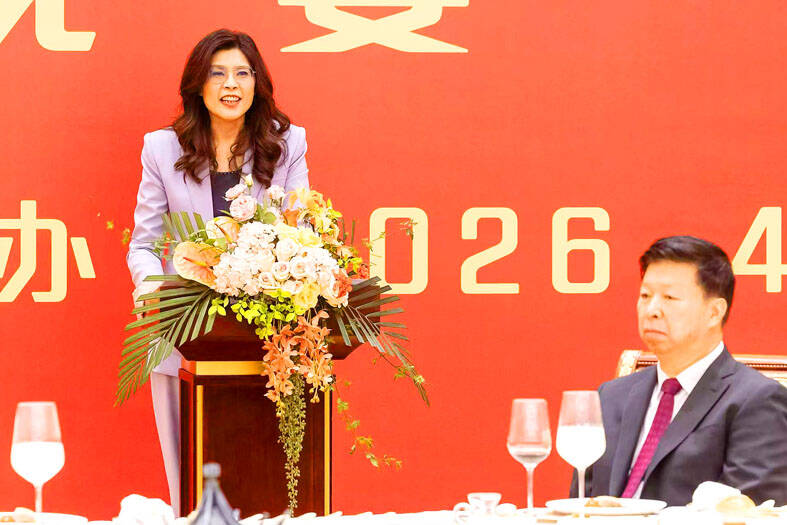
Photo courtesy of the KMT
Late on Monday, Ocean Affairs Council Minister Kuan Bi-ling (管碧玲) posted a picture on Facebook of Chinese warship deployments around Taiwan — two off the east coast, and one each to the north, northwest and southwest.
“When you depart, you are doing so from within what they see as the ‘Taiwan cage,’” Kuan told reporters yesterday, referring to how China’s military has termed Taiwan’s planned “T-Dome” air defense system and talking about Cheng’s trip.
Amid the ongoing trip to China by Cheng, Premier Cho Jung-tai (卓榮泰) yesterday called for stronger legal scrutiny of Taiwanese political leaders’ exchanges with Beijing.
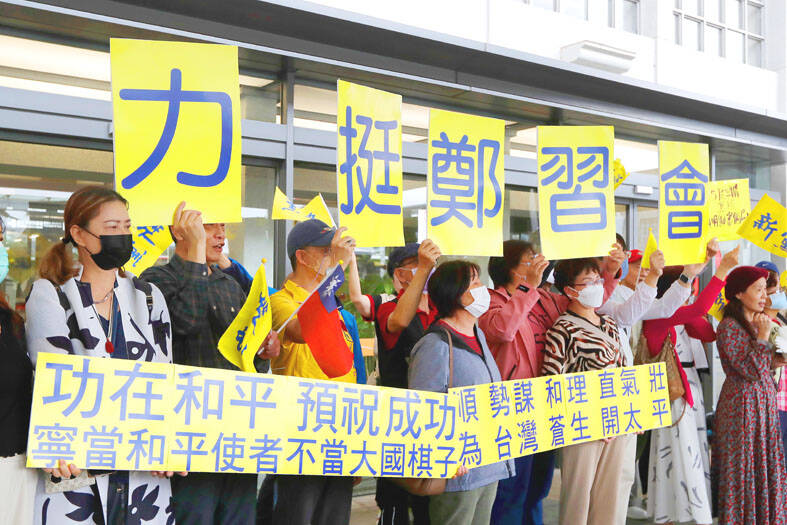
Photo: Chiang Ying-ying, AP
Taiwanese political leaders should not surrender to China through nonresistance or inaction, Cho said at a legislative plenary session, adding that laws governing exchanges between Taiwanese political leaders and China should be bolstered to safeguard national security.
The Executive Yuan has proposed amendments to the Act Governing Relations Between the People of the Taiwan Area and the Mainland Area (臺灣地區與大陸地區人民關係條例) that would require lawmakers to disclose information and contacts with Chinese political and military figures.
Mainland Affairs Council Minister Chiu Chui-cheng (邱垂正), addressing the same session, said the KMT chair should ask Beijing to stop sending military aircraft and warships around Taiwan, and instead squarely face the ROC’s existence, democratic values and way of life.
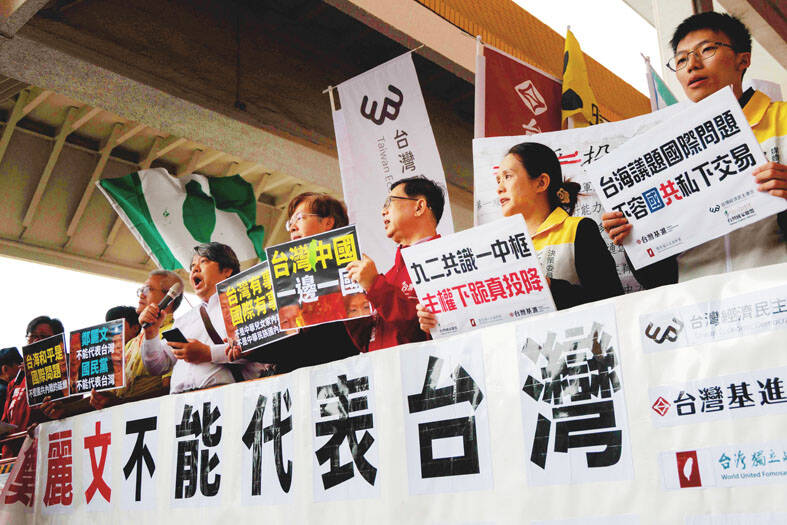
Photo: Cheng Yu-chen, AFP
Cheng should take seriously that China’s ambition to annex Taiwan remains unchanged, and not become a tool of the Chinese Communist Party’s (CCP) “united front” tactics to divide Taiwan by following the CCP’s political script, Chiu added.
Cheng’s supporters have framed her advocacy as a matter of survival.
“Cheng’s visit to China is buying time and space for Taiwan by persuading Beijing that there are still people in Taiwan who favor closer ties with China,” KMT Vice Chairman Chang Rong-kung (張榮恭) said in an interview with Bloomberg News.
That “reduces the need for Xi to resort to military means for now,” he said.
“Beijing will likely use the meeting to signal to the world that many people in Taiwan support the ‘one China’ principle,” Tunghai University political science professor Chang Chun-hao (張峻豪) said.
“She could become a useful tool or pawn for Beijing in conveying messages to the international community,” he added.
Washington has watched the optics with caution since the trip was announced on Monday last week.
US Senator Jeanne Shaheen, who visited Taipei last week, said that while “talking is good,” Beijing should be engaging with Taiwan’s elected leaders, not just the opposition.
Additional reporting by CNA and Bloomberg

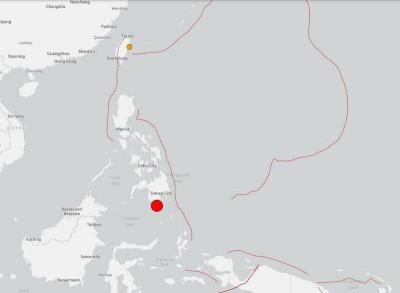
A magnitude 7.8 earthquake struck off the southern coast of Mindanao in the Philippines at 7:38am today, prompting the US Tsunami Warning System to issue an alert for neighboring countries, including Taiwan. The system issued a purple alert indicating a "tsunami threat." The potential threat zone includes Taiwan, the Philippines, Papua New Guinea, Yap and Palau. There were no immediate reports of major damage in the Philippines or Indonesia. The quake struck at a depth of 10km, said the German Research Centre for Geosciences, which had earlier pegged the earthquake at magnitude 8.2. Phivolcs, the Philippine agency, said the quake was magnitude 7 and
RESILIENCE: Taiwan plays a key role in semiconductors, energy, information infrastructure and advanced manufacturing, AIT Director Raymond Greene said Taiwan’s continued investment in deterrence and resilience remains vital, especially in uncrewed systems and other emerging technologies, American Institute in Taiwan (AIT) Director Raymond Greene said yesterday. Greene made the remarks at the annual National Strategic Summit on Supply Chain Resilience held by the Research Institute for Democracy, Society and Emerging Technology (DSET), a government-backed think tank. As Taiwan last year became the US’ fourth-largest trading partner and supply chain security is becoming more important, cooperation in emerging technologies continues to deepen between the two countries, he said. The US is committed to accelerating innovation, building key infrastructure, strengthening cooperation

The National Chungshan Institute of Science and Technology yesterday showcased its locally developed variants of the Vision 60 robotic patrol dog, which it plans to deploy on the nation’s outlying territories in the South China Sea. The variants were produced under the Joint Lab project — created by the institute and domestic companies — and assembled with domestically produced motors, lenses and artificial intelligence (AI) systems alongside licensed tech from the US, Missile and Rocket Systems Research Division deputy director Jen Kuo-kang (任國光) told the media event at a military base in Taipei’s Dazhi (大直) area. Taiwan has built up its strengths

RIGHT DIRECTION: Taiwan’s efforts to prevent forced labor include a proposal to ‘fully prohibit’ employers from withholding workers’ documents, an official said Taiwan is to establish a mechanism to restrict imports of goods linked to forced labor, the Executive Yuan said yesterday, after the US proposed imposing additional tariffs on Taiwanese goods over labor concerns. “The Ministry of Labor and the Ministry of Economic Affairs are to establish an interministerial review procedure,” Executive Yuan spokesperson Michelle Lee (李慧芝) said at a news briefing in Taipei. “The government is to use the Foreign Trade Act [貿易法] as the legal basis to restrict imports of goods produced with forced labor” and bring its supply chain governance more in line with international standards on human rights, resilience


 RSS
RSS